.jpg/800px-Pittsburgh_Penguins%2C_Washington_Capitals%2C_Bryan_Rust_(33744033514).jpg)
Hockey
One of the most popular sports on Earth is hockey. It has been expressed globally from Canada to Africa for decades. It has been played by men, women, and children of all colors and backgrounds too. Determination, strength, and discipline accurately describes the sport's composition. For a long time, hockey champions have existed among many leagues like Wayne Gretzky, Gordie Howe, Mario Lemieux, and other people. Many people have fought in the hockey games for trying to gain overt victories. Yet, the camaraderie among the players is truly priceless indeed. For generations, hockey has brought families together, advanced more teamwork, and made history in multifaceted ways. For example, the first black player in the National Hockey League was Willie O'Ree, who debuted with the Boston Bruins on January 18, 1958. He was a trailblazer for diversity in hockey. The popularity of hockey has increased since the end of World War II. In our time, the hockey games are shown on ABC, TNT, and other networks. The Stanley Cup is a cultural staple of our world society.

Equipment and Rules
In the sport of hockey, there are many items of equipment. There are hockey sticks, a ball, and stadiums worldwide that deals with hockey. In hockey, people wear stakes, a helmet with a face mask or visor, gloves, elbow pads, shoulder pads, and shin guards. Many may wear a mouth guard and a protective cup depending on the level of play. Other people wear a neck guard, jerseys, hockey socks, and other items like a hockey bag. Hockey rules have differences and similarities between Ice hockey rules and field Hockey rules. In Ice Hockey, the main object is to score more goals than the opposing team by shooting a puck into their net using a hockey stick. In ice hockey, each team has six players. There is one goaltender and five skaters (forwards and defensive). There is a game structure when each game is played in three periods, typically lasting 20 minutes each. If the game is tied, it may go into overtime. The rink is divided into three zone. They are the offensive zone, defensive zone, and the neutral zone. Players must be aware of offside rules, which prevents them from entering the offensive zone before the puck. There are penalties too for infractions. After a penalty, a player is sent to the penalty box, leaving their team shorthanded.
There are field hockey rules. The objective in field hockey is to score by hitting a ball into the opponent's goals using a curved stick. Field hockey usually is played with 11 players on each other, including a goalkeeper. The game can also be played in smaller format like a 5-a-side. The game is played on a rectangular field, and players can only use their sticks to control the ball. Only goalkeepers can use their bodies to stop the ball. Goals can only be scored from within the shooting circle, which is a semi-circle in front of the goal. Fouls can result in free hits, penalty corners, or penalty strokes, depending on the severity and location of the infraction.
The History of Hockey
When did hockey begin historically? Nothing is new under the sun. There have been games played with curved sticks and a gall found in the histories of numerous cultures. In Egypt, 4000-year-old carvings feature teams with sticks and a projectile, hurling dates to before 1272 BC in Ireland, and there is a depiction from approximately 600 BC in Ancient Greece, where the game may have been called kerētízein (κερητίζειν) because it was played with a horn or horn-like stick (kéras, κέρας). In Inner Mongolia, the Daur people have been playing beikou, a game similar to modern field hockey, for about 1,000 years. Most evidence of hockey-like games during the Middle Ages is found in legislation concerning sports and games. The Galway Statute enacted in Ireland in 1527, banned certain types of ball games, including games using "hooked" (written "hockie", similar to "hooky") sticks. By the 19th century, the various forms and divisions of historic games began to differentiate and coalesce into the individual sports defined today. Organizations dedicated to the codification of rules and regulations began to form, and national and international bodies sprang up to manage domestic and international competition.
There are many different types of hockey. We know of field hockey being played by people globally. It can be played in single sex sides and mixed sex sides too. The governing body is the 126-member International Hockey Federation (FIH). Men's field hockey has been played at every Summer Olympic Games since 1908 except for 1912 and 1924, while women's field hockey has been played at the Summer Olympic Games since 1980. Modern field hockey sticks are constructed of a composite of wood, glass fibre or carbon fibre (sometimes both) and are J-shaped, with a curved hook at the playing end, a flat surface on the playing side and a curved surface on the rear side. All sticks are right-handed – left-handed sticks are not permitted. While field hockey in its current form appeared in mid-18th century England, primarily in schools, it was not until the first half of the 19th century that it became firmly established. The first club was created in 1849 at Blackheath in south-east London. Field hockey is the national sport of Pakistan. It was the national sport of India until the Ministry of Youth Affairs and Sports declared in August 2012 that India has no national sport. Bandy is a type of hockey played in a certainly facility too. There is ice hockey too. The contemporary sport developed in Canada from European and native influences. These included various stick and ball games similar to field hockey, bandy and other games where two teams push a ball or object back and forth with sticks. These were played outdoors on ice under the name "hockey" in England throughout the 19th century, and even earlier under various other names. In Canada, there are 24 reports of hockey-like games in the 19th century before 1875 (five of them using the name "hockey"). The first organized and recorded game of ice hockey was played indoors in Montreal, Quebec, Canada, on March 3, 1875, and featured several McGill University students. Ice hockey sticks are long L-shaped sticks made of wood, graphite, or composites with a blade at the bottom that can lie flat on the playing surface when the stick is held upright and can legally curve either way, for left- or right-handed players. There is para ice hockey, inline sledge hockey, air hockey, street hockey, ball hockey, and roller hockey including more styles of the sport of hockey.

Different Types of Hockey
There are many types of hockey in the world. Field hockey is played on natural grass, gravel, or sand based or water based artificial turf. It is played with a small hard ball that is about 2.9 inches in diameter. It is popular among men and women from the Americas, Europe, Asia New Zealand, South Africa, and Argentina. Games can be played between single sex sides or mixed sex sides. The governing body is the 126-member International Hockey Federation (FIH). Men's field hockey has been played at every Summer Olympic Games since 1908 except for 1912 and 1924, while women's field hockey has been played at the Summer Olympic Games since 1980. Modern field hockey sticks are constructed of a composite of wood, glass fiber or carbon fiber (sometimes both) and are J-shaped, with a curved hook at the playing end, a flat surface on the playing side and a curved surface on the rear side. All sticks are right-handed – left-handed sticks are not permitted. Indoor hockey is a type of indoor field hockey. Indoor hockey is played in a smaller area and between smaller teams than field hockey. The sidelines are replaced by solid barriers from which the ball rebounds and remains in play. Bandy is played with a ball on a football pitch-sized ice arena (bandy rink), typically outdoors, and with many rules similar to association football. It is played professionally in Russia and Sweden. The sport is recognized by the IOC, including the variety rink bandy. Its international governing body is the Federation of International Bandy. Bandy has its roots in England in the 19th century, was originally called "hockey on the ice." A similar Russian sport can also be seen as a predecessor and in Russia, bandy is sometimes called "Russian hockey." Bandy World Championships have been played since 1957 and Women's Bandy World Championships since 2004. There are national club championships in many countries and the top clubs in the world play in the Bandy World Cup every year. Sledge hockey, a variant of ice hockey designed for players with physical disabilities, was created in the 1960s and has since been renamed, "Para-ice hockey." There is roller hockey and inline hockey. There is street hockey, air hockey, beach hockey found in Southern California beaches, ball hockey, box hockey, broomball, deck hockey, floor hockey, unicycle hockey, and other hockey related sports.
Legends of Hockey (including those of black African descent)
There are many hockey legends. One prominent one was Wayne Douglas Gretzky. He is a former Canadian professional ice hockey player and former head coach. He played 20 season in the National Hockey League (NHL) form 1979 to 1999. He is known as the greatest ice hockey player ever by the NHL. He is the leading point scorer and assist producer in NHL history. Gretzky has more assists than any other player has total career points. He is the only NHL player to total over 200 points in one season, a feat he made in four times. Gretzky scored more than 100 points in 15 professional seasons. By the time of his retirement in 1999, he held 61 NHL records, 40 regular season records, 15 playoff records, and six All-Star records. He played centre. He was born and raised in Brantford, Ontario. As a child, he played hockey above and beyond his peers. He had stamina and an intelligence plus reading of the game that caused him much success throughout his sports career. He set up behind his opponent's net too. He can improvise on the fly. He worked on many hockey teams too. He loves his wife and his children. The first black NHL player was Willie O'Ree who played first with the Boston Bruins on January 18, 1958. He was honored with the NHL's Willie O'Ree Community Hero Award and he was inducted into the Hockey Hall of Fame in 2018. He was born in Fredericton, New Brunswick, Canada. His grandparents were escapees of slavery in the United States, moving to Canada via the Underground Railroad. He played organized hockey when he was five years old. He played in his family's backyard rink. His autobiography is The Willie O'Ree Story: Hockey's Black Pioneer. He experienced racist slurs from people in the stands, but he stood firm in performing his sport that he loved. There were 23 black players in the NHL by the mid 2010s. Other black players are Art Dorrington, Mike Marson, and other human beings. O'Ree has been the NHL's Diversity Ambassador to go in North Africa to schools and hockey programs to promote messages of inclusion, dedication, and confidence.
Canada and Hockey
Canada is the birthplace of ice hockey. Hockey is the national pastime of Canada. Canada is known as a place that is not just filled with snow. It is a multicultural country with millions of residents filled with musicians, athletes, politicians, theologians, scholars, writers, social activists, and other human beings from Calgary to Toronto. We know many well-known Canadian human beings like Tamia, Deborah Cox, Michael J. Fox, Dan Aykroyd, Jim Carrey, etc. Hockey is played year-round in Canada by men, women, and children at numerous competitive levels. Canada has major junior leagues, and media broadcasts like Hockey Night in Canada. The sounds of hockey from the stakes on ice, sticks on pucks, and play by play announcers are deeply embedded in the Canadian national culture. Canada is home to numerous NHL teams. Canada has dominant national teams for men, women, and para hockey doing well on the international stage.
Hockey and the Olympics
There is a long history of ice hockey at the Olympic Games. Ice hockey tournaments have been in the Olympic Games since 1920 being 95 years ago. The men's tournament was introduced at the 1920 Summer Olympics and was transferred permanently to the Winter Olympic Games program in 1924, in France. The women's tournament was first held at the 1998 Winter Olympics. Back then, the Olympic Games were for amateur athletes. This changed after the Eastern Bloc nations including the Soviet Union used full time trained athletes being paid to compete in the Olympics. In 1986, the International Olympic Committee (IOC) voted to allow professional athletes to compete in the Olympic Games starting in 1988. The National Hockey League (NHL) was initially reluctant to allow its players to compete because the Olympics are held in the middle of the NHL season, and the league would have to halt play if many of its players participated. Eventually, NHL players were admitted starting in 1998. The league skipped 2018 and 2022 editions but then agreed to return for 2026 and beyond.
From 1924 to 1988, the tournament started with a round-robin series of games and ended with the medal round. Medals were awarded based on points accumulated during that round. In 1992, the playoffs were introduced for the first time since 1920. In 1998, the format of the tournament was adjusted to accommodate the NHL schedule; a preliminary round was played without NHL players or the top six teams—Canada, the Czech Republic, Finland, Russia, Sweden and the United States—followed by a final round which included them. The tournament format was changed again in 2006; every team played five preliminary games with the full use of NHL players. The games of the tournament follow the rules of the International Ice Hockey Federation (IIHF), which differ slightly from the rules used in the NHL. In the men's tournament, Canada was the most successful team of the first three decades, winning six of seven gold medals from 1920 to 1952. Czechoslovakia, Sweden and the United States were also competitive during this period and won multiple medals. Between 1920 and 1968, the Olympic hockey tournament was also counted as the Ice Hockey World Championship for that year. The Soviet Union first participated in 1956 and overtook Canada as the dominant international team, winning seven of the nine tournaments in which they participated. The United States won gold medals in 1960 and in 1980, which included their "Miracle on Ice" upset of the Soviet Union. Canada went 50 years without a gold medal, before winning one in 2002, and following it with back-to-back wins in 2010 and 2014. Other nations to win gold include Great Britain in 1936, the Unified Team in 1992, Sweden in 1994 and 2006, the Czech Republic in 1998, Russia (as OAR) in 2018 and Finland in 2022. Other medal-winning nations include Switzerland, Germany and Slovakia.
In July 1992, the IOC voted to approve women's hockey as an Olympic event; it was first held at the 1998 Winter Olympics in Nagano. The Nagano Organizing Committee was hesitant to include the event because of the additional costs of staging the tournament, but an agreement was reached that limited the field to six teams, and ensured that no additional facilities would be built. The Canadian teams have dominated the event. The United States won the first tournament in 1998 and in 2018. Canada has won all of the other tournaments (2002–2014, 2022). The first Olympic ice hockey tournament took place at the 1920 Summer Olympics in Antwerp, Belgium. The first Winter Olympic Games were held in Chamonix, France. Although NHL players were originally planned to participate in the 2022 Beijing Winter Olympics, the league and the NHL Players' Association announced on December 21, 2021, that they would be pulling out of the tournament, citing the impact of the ongoing COVID-19 pandemic. Finland won their first ever men's ice hockey gold medal after going undefeated and beating the Russian Olympic Committee in the final. Slovakia claimed their first ever bronze medal after defeating Sweden 4–0. For the first time in history, the Czech Republic did not qualify for the quarter-finals and finished in ninth place, their lowest placement in history.
In 2018, the United States' women's ice hockey team defeated Canada for the gold medal in a shootout, winning 3–2. The Americans' winning the gold medal game marks the first time in 20 years that the United States took home a gold medal in women's hockey. They previously won in 1998 in Nagano, Japan, which was also against Canada. Canada's loss effectively ended their winning streak of four consecutive winter games, having won since 2002. The 2022 edition was played with ten teams for the first time. Canada won their fifth gold medal, defeating the United States in the final 3–2. Finland defeated Switzerland 4–0 for the bronze medal. The final standings were a repeat of the 2021 IIHF Women's World Championship.

Conclusion
Hockey is a worldwide sport that focuses on teamwork and strategy. It is a very physical game, and even fights have occurred among different teams. The penalty box is ever used in hockey games constantly. Yet, what is important involving hockey is about the love of the sport that hockey players earnestly invest in their hearts. There are 2 teams filled with six players each in hockey that battle for one goal of victory. Tons of people already know about the greatest hockey players in history like Wayne Gretzky (who holds many NHL records for goals, assists, and points), Mario Lemieux, and Alex Ovechkin. There are many unsung players like Gordie Howe, Sidney Crosby, Patrick Roy, and Martin Brodeur. Hockey can be played on the ice, in the grass, and in other locations. People wear skates, helmets, protective padding, and use hockey sticks in the game. Hockey is heavily popular in Canada, America, Russia, Sweden, Finland, and other countries of the world.

15 Years After the Haiti Earthquake
The 2010 Haitian Earthquake has been one of the most terrible disasters in human history. First, it is important to give acknowledgement of history. Haiti was originated inhabited by Native Americans. Later, evil French imperialists kidnapped and sent black Africans into Haiti to fund the Western imperialistic system. By 1804, courageous black Haitians defeated French forces making Haiti the first black Republic of the North Hemisphere. That was historic. Racists wanted vengeance. The racist Thomas Jefferson hated the success of the Haitian Revolution. So, European powers used embargoes against Haiti, and even some U.S. imperialistic forces occupied Haiti for a time during the 20th century. Haiti has been through up and downs like dictators ruling Haiti and Haitians making great contributions in music, athletics, scholarship, medicine, and other forms of civilization. The 2010 Haiti Earthquake reminded people that Haiti still suffers complications. Today, rival gangs dominate Haiti in a dangerous cycle. In other to find solutions, we have to evaluate the 2010 Haiti Earthquake and its complex aftermath.

Always Remember 1804
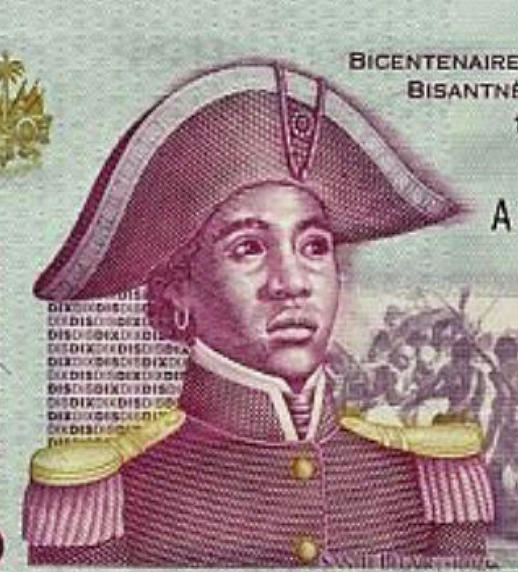
It is important to remember the Haitian Revolution. It lasted from 1791 to 1804. It was an era when the French imperialists harmed the black population in Haiti. Native Americans in Haiti were previously mostly exterminated by the imperialists, too. The Haitian Revolution involved thousands of black people who fought for freedom. Many alliances existed at that time. It was complex, as it was a slave revolt and a class struggle at the same time. French, British, and Spanish military forces were involved. There were white landowners, non-landowners, and free black landowners in that time period. There were many black leaders of the Haitian Revolution, like the former slave Toussaint Louverture. He was inspired by the American Revolution and wanted equality for black people. He wanted the Enlightenment principles to spread. Toussaint Louverture would pass away before an independent Haiti would be formed, but he set the stage for much of the Haitian Revolution. Haitian slaves were forced to work in large plantations where they generated cash crops of sugar, coffee, and cotton against their will. Haiti was called Saint Domingue by the French imperialists.
The French Revolution motivated black people to stand up for their rights. After the March 1793 French assembly gave full rights and French citizenship to free black people and biracial people, the white planter class in Haiti opposed this act. The French sent military forces and a new governor to enact these measures. Spain signed a peace treaty with France and left the conflict. British forces sent troops to the island of Haiti. Great Britain allied with the white planter class. Louverture captured Haiti and abolished slavery over the island by 1801. Napoleon sent his brother-in-law Charles Leclerc to fight to conquer Haiti with 35,000 soldiers. Louverture wanted a truce, but the French imperialists trick him, captured him, imprisoned him, and forced him to die in prison in France. France wants to re-implement slavery, and Haitians like General Jean-Jacques Dessalines fought back. Leclerc died of yellow fever. Napoleon sent troops to Haiti to force slavery. These forces fail. President Thomas Jefferson wanted to oppose the Haitian Revolution, but President John Adams supported the Haitian Revolution as a means to end slavery in Haiti. By 1804, Haitian leader Dessalines officially declared independence on January 1, 1804, making Haiti the first black Republic in the Americas in world history.

The Earthquake
The Haitian Earthquake started in many phases. It was one of the most destructive earthquakes in the Western Hemisphere in the modern age. There were previous ones in 1770, in 1946, etc. So, Haiti has experienced natural disasters for a long time. Previously, Haiti experienced Tropical Storm Fay and the Hurricanes Gustav, Hanna, and Ike, all in the summer of 2008, causing nearly 800 people to be killed. The earthquake in 2010 in Haiti had a magnitude of 7.0M inland on January 12, 2010. It happened about 16 miles WSW from Port-au-Prince. It happened on the blind thrust faults associated with the Enriquillo-Plantain Garden fault system and lasted for less than 30 seconds.
There is no evidence of surface rupture based on seismological, geological, and ground deformation data. It is also thought that the earthquake did not involve significant lateral slip on the main Enriquillo fault. Strong shaking associated with intensity IX on the Modified Mercalli scale (MM) was recorded in Port-au-Prince and its suburbs. It was also felt in several surrounding countries and regions, including Cuba (MM III in Guantánamo), Jamaica (MM II in Kingston), Venezuela (MM II in Caracas), Puerto Rico (MM II–III in San Juan), and the bordering Dominican Republic (MM III in Santo Domingo). According to estimates from the U.S. Geological Survey, approximately 3.5 million people lived in the area that experienced shaking intensity of MM VII to X, a range that can cause moderate to very heavy damage even to earthquake-resistant structures. Shaking damage was more severe than for other quakes of similar magnitude due to the quake's shallow depth.
The quake occurred in the vicinity of the northern boundary where the Caribbean tectonic plate shifts eastwards by about 20 mm (0.79 in) per year in relation to the North American plate. The strike-slip fault system in the region has two branches in Haiti, the Septentrional-Oriente fault in the north and the Enriquillo-Plantain Garden fault in the south; both its location and focal mechanism suggested that the January 2010 quake was caused by a rupture of the Enriquillo-Plantain Garden fault, which had been locked for 250 years, gathering stress. However, a study published in May 2010 suggested that the rupture process may have involved slip on multiple blind thrust faults with only minor, deep, lateral slip along or near the main Enriquillo–Plantain Garden fault zone, suggesting that the event only partially relieved centuries of accumulated left-lateral strain on a small part of the plate-boundary system. The rupture was roughly 65 km (40 mi) long with mean slip of 1.8 metres (5 ft 11 in). Preliminary analysis of the slip distribution found amplitudes of up to about 4 m (13 ft) using ground motion records from all over the world.
The U.S. Geological Survey recorded eight aftershocks in the two hours after the main earthquake, with magnitudes between 4.3 and 5.9. Within the first nine hours, 32 aftershocks of magnitude 4.2 or greater were recorded, 12 of which measured magnitude 5.0 or greater; in addition, on January 24, the US Geological Survey reported that there had been 52 aftershocks measuring 4.5 or greater since the main quake. On January 20, at 06:03 local time (11:03 UTC), the strongest aftershock since the earthquake, measuring magnitude 5.9 Mw, struck Haiti. USGS reported its epicenter was about 56 km (35 mi) WSW of Port-au-Prince, which would place it almost exactly under the coastal town of Petit-Goâve. A UN representative reported that the aftershock collapsed seven buildings in the town. According to staff of the International Committee of the Red Cross, which had reached Petit-Goâve for the first time the day before the aftershock, the town was estimated to have lost 15% of its buildings and was suffering the same shortages of supplies and medical care as the capital. Workers from the charity Save the Children reported hearing "already weakened structures collapsing" in Port-au-Prince, but most sources reported no further significant damage to infrastructure in the city. Further casualties are thought to have been minimal since people had been sleeping in the open. There are concerns that the main earthquake could be the beginning of a new long-term sequence. Although not precise, it is suggested that there has been a sequence of quakes progressing westwards along the fault, starting with an earthquake in the Dominican Republic in 1751.
The Pacific Tsunami Warning Center issued a tsunami warning immediately after the initial quake but quickly cancelled it. Nearly two weeks later, it was reported that the beach of the small fishing town of Petit Paradis was hit by a localized tsunami shortly after the earthquake, probably as a result of an underwater landslide, and this was later confirmed by researchers. At least three people were swept out to sea by the wave and were reported dead. Witnesses told reporters that the sea first retreated, and a "very big wave" followed rapidly, crashing ashore and sweeping boats and debris into the ocean. The tsunami reached heights up to 3 m (9.8 ft).
The Aftermath
On January 12, 2010, people dug through rubble to help rescue survivors and recover bodies from the 2010 Haitian Earthquake. During the night, many people were digging through the rubble, using flashlights or torches. The Argentine Air Force Mobile Field Hospital, already deployed at Port-au-Prince, was the only medical facility still open. Argentine helicopters from the United Nations forces were helping evacuate the gravely injured people to Santo Domingo. By January 2010, Haitian rescuers searched the collapsed buildings for victims. The wounded were taken to the hospital in ambulances, police pickup trucks, wheelbarrows, and improvised stretchers. Many hospitals collapsed: on January 13, 2010, the Argentine military field hospital remained open in Port-au-Prince, and it was struggling to attend to the huge numbers of injured. Médecins Sans Frontières (Doctors Without Borders) reported that at least two hospitals were still in good shape, and their doctors would begin treating about 500 people who needed emergency surgery. The bodies of the victims were piled on the streets. Heavy equipment was needed to dig through the ruins; many people were still trapped in collapsed buildings. A triage center was set up in a parking lot, but the wounded were forced to lie in medical tents to await treatment due to the many patients, and water was scarce. In Pétion-Ville, people used sledgehammers and their hands to dig through a collapsed commercial center.
The first international team to arrive in Port-au-Prince was ICE-SAR from Iceland, landing within 24 hours of the earthquake. Some rescue teams, such as the ones from Cuba, arrived in Haiti and started their mission. The Peruvian government sent rescue teams, dogs and 50 tons of food transported by two Peruvian Air Force airplanes. Peruvian companies were providing food donations and other basic aid. However, the scale of rescue and relief efforts was yet to meet the need. Because of difficulties reaching some affected areas, some rescue teams tried to enter Haiti through the Dominican Republic. The United States Coast Guard deployed helicopters and several aircraft and cutters to the region to aid in relief work and perform reconnaissance flights over Haiti, which aided in assessing the worst damaged areas. The Coast Guard Cutter Forward arrived in the waters off Port-au-Prince at about 8 a.m. on Wednesday, and together with a Maritime Intelligence Support Team was able to assess some of the damage caused to the port. The Coast Guard Cutter Mohawk also arrived in the coastal waters of Haiti on Wednesday afternoon. The International Committee of the Red Cross set up a special website to facilitate family contacts, which allowed people in Haiti and abroad to register the names of relatives whom they wanted to contact. It incorporated responses to those queries as they became available. Catholic Relief Services, which has worked in Haiti for 50 years, prepared food and other aid to help those affected, committing US $5 million to help survivors. There was a team of United States Air Combat Controllers landing at Toussaint Louverture International Airport and formed control of Air Traffic Control duties within 28 minutes to assist in humanitarian aid efforts. The Combat Controllers directed over 2,500 flights without incident from a card table using only hand radios. They were directing planes to take off and land every five minutes, bringing in over 4 million pounds of supplies. The team leader of the Combat Controllers, Chief Master Sergeant Tony Travis, was later recognized as one of Time magazine's 100 most influential people of 2010 because of their efforts.
By January 14, 2010, many relief supplies came from the neighboring Dominican Republic. Dominican president Leonel Fernandez visited Haiti to form an emergency plan for assistance with President Rene Preval to reestablish communications, rescuing the victims, burying the dead, clearing the rubble, reestablishing the supplies for electricity and water and coordinating the Dominican army with the United Nations Stabilization Mission for the relief operations. Jamaica and Colombia helped Haitian victims, too. Staff of the International Committee of the Red Cross already in the country distributed medical items to hospitals, and two ICRC-chartered aircraft carrying specialized staff and 40 tons of relief supplies – mainly medical items – left Geneva for the island. At the same time, the organization made its forensic expertise available to organizations attempting to recover and identify the dead. The destruction caused by the earthquake made it difficult to deal with infrastructure and communication. Dead bodies were in the streets, gangs acted violently when, and then the UN intervened, and it was hard to distribute food, water, temporary shelter, and medical supplies. Twitter and Facebook helped to spread messages about helping Haitians.
However, Haitians updating their Facebook statuses were blocked for repeatedly sending messages to tell people that they and their friends or family members were alive, which triggered spam guards on the website. The American Red Cross generated $7 million within 24 hours by offering an option to text message $10 donations by cell phone, setting a record for mobile donating. The OpenStreetMap community responded by greatly improving the level of mapping available for the area using post-earthquake satellite photography provided by GeoEye. By January 15, 2010, about 9,000 corpses were cleared off the street by Haitian government crews and buried in mass graves. Canadian Prime Minister Stephen Harper announced that Canada will consider fast-tracking immigration to help Haitian refugees. In the US, Haitians were granted Temporary Protected Status after Homeland Security Secretary Janet Napolitano called the earthquake "a disaster of historic proportions". Temporary protected status will allow about 100,000 Haitians in the United States illegally to stay for 18 months, will stop the current deportations of 30,000 more, but will not apply to Haitians outside the US. The USS Carl Venson used helicopter relief operations.
During the USS Carl Venson first day on-scene, the ship transferred about 35,000 gallons of fresh water to shore; the vessel has the overall capability to distill 400,000 gallons daily. Carl Vinson will also provide medical, air transport, and food preparation facilities; she offloaded combat aircraft in order to provide more space for relief supplies and an increased complement of 19 helicopters. The carrier is transporting 600,000 emergency food rations and 100,000 ten-liter water containers; 20,000 containers of water were distributed on January 25, 2010. The US Marines and the Israel Defense Forces' Home Front Command sent supplies to Haiti. The USNS Comfort arrived in Haiti by January 20, 2010. By late January 2010, the Haitian government declared an end to relief efforts. More aid is coming to Haiti, but relief efforts fall short of the need. This comes when UN Peacekeepers fire rubber bullets to try to control the crowds while distributing rice. The UN, EU, and other military forces patrol Haitian streets. The single We Are the World 25 for Haiti was released and debuted on February 12, 2010, during the opening ceremony of the 2010 Winter Olympics.
The US relief force has been reduced from roughly 20,000 troops to approximately 13,000 troops. The 190th Civil Engineering Squadron of the Kansas National Guard has returned home after relief efforts in Haiti on February 14, 2010. By May 2010, many foreign relief agencies had left Haiti. It is no secret that back then and today, Haiti faces the evil agenda of Western neocolonialism. The U.S. and the UN once supported the ruler Jovenel Moise. Moise came to power through an illegal proposed referendum. Moise was killed by assassination on July 7, 2021. On February 20, 2024, the Associated Press reported that Haiti's investigating judge had indicted several suspects in Moïse's murder, including his widow Martine, former acting prime minister Joseph, and former police chief Léon Charles. Now, rival gangs run most of the Haitian land.
Issues
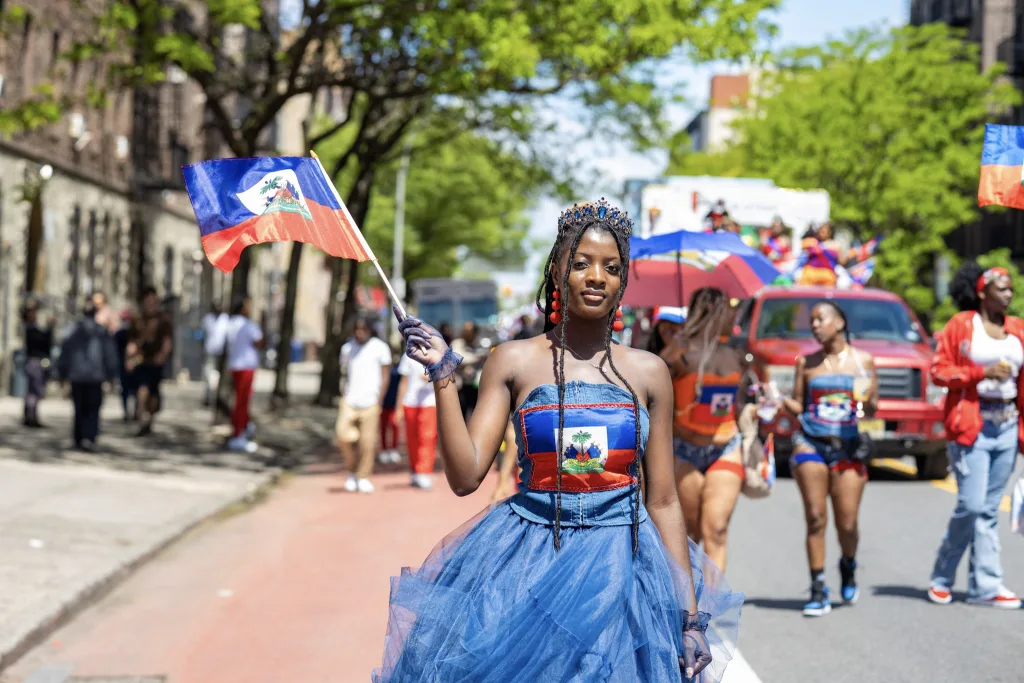
The issues in Haiti are very real. Haiti was once unjustly conquered by France. Haiti was France's richest colony and tons of black Haitians were enslaved. Black people in Haiti fought back for their independence, and Haiti was a Republic in 1804. After 1804, the West, including France wanted revenge against Haiti. A French spy named Medina was arrested by Henri Christophe in 1817. On Madina were instructions from France trying to re-enslave Haiti. Later, France wanted 150 million gold francs and reduce by 50 percent tariffs on all French imports.
This was 10 times worse the Haitian government. France wanted more like taking a loan from a French bank. Haitian President Boyer was there in that time. This tactic (of France using the lie that they are owe reparations to steal wealth from Haiti) from France harmed the Haitian economy. There were revolts in 1842. Boyer left office. Haiti was imposed unjust tax burdens by Western powers. There were many governments and resources went to debt service. The National Bank of Haiti was formed in 1880 being controlled by France. Wealth was stolen by France and sent to France from Haiti. America used the U.S. Marines to occupy Haiti in 1914. America left after 9 months in the first phase of occupation.
Wealth in Haiti was stolen by the National City Bank of New York. America occupied Haiti until 1934. Papa Doc was a dictator in Haiti. Many people left Haiti to America and other places to escape the rule of Papa Doc. Later, President Aristide rose up. He promoted the end of the Duvalier dictatorship in 1986 as Aristide was more democratic. Then, Aristide was a victim of an army led coup d'etat, and Aristide was forced into exile. Aristide came back to form a truth and reconciliation commission, demobilized the Haitian army, and caused a democratic transition of power in Haiti. Haiti improved from 1994 to 2000. Many in the international community blocked a 54-million-dollar loan in 1998 to help Haiti's water system. Haiti deserves its reparations. After Aristide called for reparations, a coup d'etat happened by February 2004. Aristide came back to Haiti. The 2010 Earthquake changed everything with people desiring food prices stabilization by 2009. After Michel Martelly and Moise were in power, there was the Ariel Henry Presidency. There was a strong 2021 Earthquake. Since 2022 (On July 7, 2022 massive clashes between two rival gangs began in Cité Soleil, an impoverished and densely populated neighborhood of Port-au-Prince), multiple gangs have a civil war in Haiti that continues to this day. Prime Minister Ariel Henry resigned by March 2024. By 2024, Alix Didier Fils-Aime was the Prime Minister of Haiti. Now, we have Fritz Alphone Jean (from the Transistional Presidential Council or CPT) being the current President of Haiti's CPT. Issues in Haiti relate to the economy, gang violence, poverty, United Nations occupation's legacy, and other issues.
Promoting Solutions
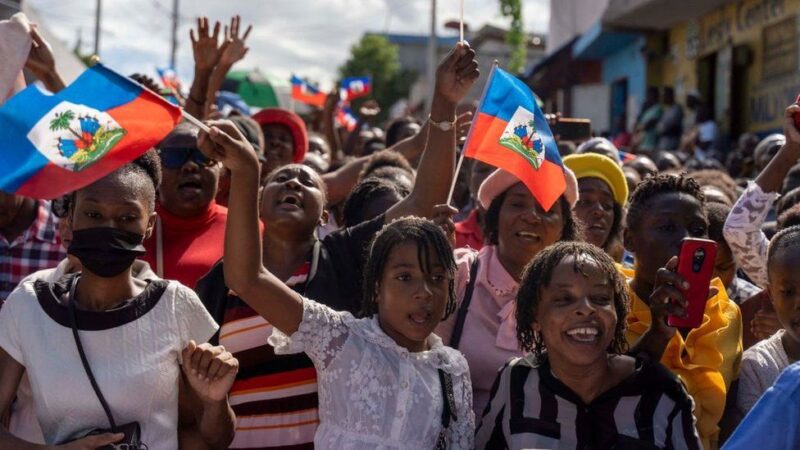
One advice in life is not just exposing the problems in life but to outline solutions to solve problems too. Fundamentally, Haiti deserves its own political independence. One major solution is the West (especially France) sending reparations to Haiti for its mistreatment, abuse, and colonization of Haiti for years and centuries. There is no excuse for France to be off scott free when it tried to conquer Haiti multiple times to promote the evils of slavery, imperialism, racism, and colonialism. France was never held accountable for its war against Haiti for years. Haiti is owed billions of dollars of reparations to build up its infrastructure from the bottom to the top. Also, Haiti should develop independent political leaders, not terrorist gang members or corporate funded leaders. Legitimate charities should be active to fund Haiti's education, healthcare, water, sanitation, and hygiene services. With the controversies surrounding UN occupying forces, UN occupying forces should leave Haiti. There should be free and fair elections to promote democratic power. Haitian institutions and grassroots Haitian leaders should be supported. Political leadership should promote human rights, accountability, and have legitimate safeguards to protect the human rights of all including women and children. America should stop illicit arms transfers from America to Haiti that contributes to the gang violence in Haiti. America should not interfere in future elections of Haitian leaders. Haitian people have the right to decide for themselves which leaders should govern their own nation. International groups, religious groups, and Haitian diaspora organizations have the right to work together to improve the country of Haiti too.

Reflections
It has been over 220 years since Haiti has been in existence. Haiti was born out of courage and the sacrifice of thousands of black people seeking freedom from overt tyranny and terrorism. Slavery is the pure representation of tyranny, terrorism, abuse, and inhumane behavior. French, English, and Spanish imperialism ruled Haiti in the realm of slavery. Prior to that time, the criminal Christopher Columbus visited the Caribbean and many members of his crew terrorized, raped, and exterminated the Native American population back in the late 1400s and early 1500s. Then, the black Haitians fought back to defend their human rights and end the oppressive system of slavery. After long years, the Haitians were victorious by 1804 making Haiti the first black Republic of North America. There were tons of heroes of the Haitian Revolution. We know who Toussiant Louverture and Jean-Jacques Dessalines were. Toussiant was a great military and political leader who commanded the revolutionary army in the 1800s. Dessalines was Louverture's lieutenant who was involved in the final phase of the Haitian Revolution. Also, there should be another point made involving Haitian history. There were numerous unsung people of the Haitian revolution like Dutty Boukman, Henri Christophe, Cecille Fatiman, Sanite Belair (she was brave), Marie-Jeanne Lamartiniere, and Francois Mackandal. The French wanted revenge, so the French unjustly paid a large bill for Haiti to pay. The hypocrite Thomas Jefferson opposed the Haitian Revolution, but he supported the French Revolution. Jefferson owned slaves and believed in the myth of black racial inferiority, so Jefferson is not the great role model that we should admire. Likewise, we should admire great Haitian people who made great contributions to the world involving culture, history, athletics, music, politics, the arts, agriculture, STEM fields, legal affairs, spirituality, and education. Haiti was a victim of Western occupation, wars, the 2010 Hurricane, and UN occupation. Yet, Haiti has shown great resiliency, and many Haitians worldwide will continue to fight for a better future of Haiti.
No comments:
Post a Comment