Islam
Over one billion people believe in Islam in the world, they worship Allah as God. Islam is the second largest religion in the world numerically. Its spread since the 600's A.D. has been wide ranging. It has a long history who starts with many people. Ultimately, Islam was created by a man from Saudi Arabia named Muhammad. To Muslims, Muhammad was a prophet who received a message from the angel Gabriel to establish a monotheistic spiritual movement. Obviously, I am not a Muslim for many reasons. Yet, it is important to know about Islam, because you can't realize your belief system without comprehending what other belief systems are. Being ignorant of other creeds only allows irrational behavior to reign in society. Being knowledgeable and agreeing to disagree with certain religions peacefully will make perfect sense. A lot of people already know that in the religion of Islam, you can't eat pork, you have to go to hajj to worship in Mecca (if a person is able to do it), you must follow zadat, and Muslims deny the existence of the Son of God. For me, I believe in the existence of the Son of the living God. Islam has been praised, maligned, and stereotyped. It's still here. Therefore, it is important to express our disagreements with Islam without bigotry or Islamophobia. Islamophobia is a very serious problem in the globe where many Muslims (along with Christians, Sikhs, Buddhists, Hindus, etc.) have been persecuted and murdered worldwide. We can show our dissent with concepts without malice and without hatred. Also, one important point is to be mentioned too. Many people are ashamed of the Gospel of the Lord Jesus Christ. We must never be ashamed of the Gospel which has saved souls for nearly 2 millennia. I wrote about Islam many years ago, so I decided to write a new work on Islam to completely outline views to a new generation of human beings. I have been on this Earth for almost a half of century, so my understanding of the world has increased. Still, we have the august responsibility to educate humanity on the truth concretely.

The History of Islam
Many people give different interpretations of the origin of Islam, but one thing is true. The prominent founder of Islam was Muhammad. By the early 600s A.D., the Visigoths, the Sassanids, and the Byzantine Empire dominated much of the Middle East. Back in the early 600s, before Islam, Saudi Arabia was filled with Christians, Jewish people, and polytheists. Jewish people and Christians lived in northern Arabia, too. Religion in pre-Islamic Arabia may be summarized as follows; Judaism became the dominant religion of the Himyarite Kingdom in Yemen after about 380 A.D., while Christianity took root in the Persian Gulf. The second half of the 6th century A.D. saw political disorder in pre-Islamic Arabia, and communication routes were no longer secure. Religious divisions played an important role in the crisis. There was also a yearning for a more "spiritual form of religion", and "the choice of religion increasingly became an individual rather than a collective issue." Many Arabic people in Saudi Arabia were Christians or Judaism converts. There were other Arabic monotheists that didn't want to be in Abrahamic religions or traditional Arabic polytheism. They wanted a new view and focused on worshiping Allah as God. This movement became Islam which places a special emphasis on Mecca and Kaaba temple as a pilgrimage site, and other concepts. Muhammad was born in Mecca which was a caravan trading center in ca. 570 A.D. His family belonged to the Arab clan of Quraysh, which was the chief tribe of Mecca and a dominant force in Hejaz region. Muhammad followed Taḥannuth, spending time in seclusion at the Cave Hira in the mountain Jabal al-Nour and "turning away from paganism."
Muslims believe that when Muhammad was 40 years old, he started to receive at the mount Hira revelations delivered to him via the angel Gabriel on the the Laylat al-Qadr, which would later form the basis of the Quran. It is said that Muhammad might be a descendant of Ishamel, son of Abaraham. Muhammad believed that his monotheistic strict faith would be the final expression of Biblical prophetism earlier codified in the sacred texts of Judaism and Christianity; to warn his compatriots of the impending Judgement Day; and to castigate the social injustices of his city. Obviously this isn't the case, as the Bible predicted that during the latter days, God will pour out his Spirit to cause men and women to see visions and make predictions of the future. Muhammad's message won over a handful of followers (the ṣaḥāba) and was met with increasing persecution from Meccan notables. In 622 A.D., a few years after losing protection with the death of his influential uncle ʾAbū Ṭālib ibn ʿAbd al-Muṭṭalib, Muhammad migrated to the city of Yathrib (subsequently called Medina) where he was joined by his followers. Later generations would count this event, known as the hijra, as the start of the Islamic era. The surahs of this period emphasized his place among the long line of Biblical prophets but also differentiated the message of the Quran from the sacred texts of Christianity and Judaism. The Hadiths of Islam is akin to the writing of the early church leaders for Christians. There were soon armed conflict between the Arabic Meccans and the Jewish tribes in the Yathrib area. After many military battles and political actions, Muhammad was able to secure control of Mecca and allegiance of the Quraysh in 629 A.D. Muhammad passed away in 632 A.D. Tribal chiefs across the Arabian peninsula entered into various agreements with him, some under terms of alliance, others acknowledging his claims of prophethood and agreeing to follow Islamic practices, including paying the alms levy to his government, which consisted of a number of deputies, an army of believers, and a public treasury. Muhammad established a constitutional state in Medina - on the basis of the Quran verses in line with the new concept, and of a treaty in which the rights and duties of the different communities in Medina were determined - and made radical reforms to create an Islamic society. There are debates among Muslims and non-Muslims alike about whether early Islam was spread violently or not. By 630 A.D., Muhammad and his followers returned to Mecca and took control of the city, cleansing the Kaaba of its idols and dedicating it solely to the worship of Allah.
After the death of Muhammad, there was the caliph or successor. These early Islamic empires were known as caliphates, spread by the sword or by violence. There were a series of four caliphs who governed the early Islamic empire: Abū Bakr (632–634), ʿUmar ibn al-Khaṭṭāb (Umar І, 634–644), ʿUthmān ibn ʿAffān (644–656), and ʿAlī ibn Abī Ṭālib (656–661). These leaders are known as the rāshidūn ("rightly-guided") caliphs in Sunnī Islam. They oversaw the initial phase of the early Muslim conquests, advancing through Persia, the Levant, Egypt, and North Africa.

In late 620s, Muhammad had already managed to conquer and unify much of Arabia under Muslim rule, and it was under his leadership that the first Muslim-Byzantine skirmishes took place in response to Byzantine incursions. Just a few months after Heraclius and the Persian general Shahrbaraz agreed on terms for the withdrawal of Persian troops from occupied Byzantine eastern provinces in 629, Arabic and Byzantine troops confronted each other at the Battle of Mu'tah as a result of Byzantine vassals murdering a Muslim emissary. Muhammad died in 632 and was succeeded by Abu Bakr, the first caliph with undisputed control of the entire Arabian Peninsula after the successful Ridda Wars, which resulted in the consolidation of a powerful Muslim state throughout the peninsula.
The province of Syria was the first to be wrested from Byzantine control. Arabic-Muslim raids that followed the Ridda Wars prompted the Byzantines to send a major expedition into southern Palestine, which was defeated by the Arabic forces under command of Khalid ibn al-Walid at the Battle of Ajnadayn in 634. Ibn al-Walid had converted to Islam around 627, becoming one of Muhammad's most successful generals. Ibn al-Walid had been fighting in Iraq against the Sasanians when he led his force on a trek across the deserts to Syria to attack the Byzantines from the rear. In the Battle of the Mud fought at or near Pella (Fahl) and nearby Scythopolis (Beisan), both in the Jordan Valley, in December 634 or January 635, the Arabic people scored another victory. After a siege of six months, the Arabic forces took Damascus, but Emperor Heraclius later retook it. At the Battle of Yarmuk (636), the Arabic forces were victorious, defeating Heraclius. The Muslim Arabic forces traveled fast to conquer Jerusalem in 638 A.D., Caesarea in 640, and other places.
After a two-year siege, the garrison of Jerusalem surrendered rather than starve to death; under the terms of the surrender, Caliph Umar promised to tolerate the Christians of Jerusalem and not to turn churches into mosques. True to his word, Umar allowed the Church of the Holy Sepulchre to remain, with the caliph praying on a prayer rug outside of the church. The loss to the Muslims of Jerusalem, the holiest city to Christians, proved to be the source of much resentment in Christendom. The city of Caesarea Maritima continued to withstand the Muslim siege—as it could be supplied by sea—until it was taken by assault in 640. The Muslim forces conquered Egypt from 639 to 642 A.D. The conquest was so rapid that it spread into Iran, all of North Africa, and parts of India. The Sassanian and Byzantine empires lost battles by many factors because of plagues, persecution of Christians who opposed the Chalcedonian creed, the zealous military attacks being organized, military support shown to the Muslim armies, etc. By 711, Muslims attacked Spain. After the Visigothic king of Spain Wittiza died in 710, the kingdom experienced a period of political division. The Visigothic nobility was divided between the followers of Wittiza and his successor Roderic. Akhila, Wittiza's son, had fled to Morocco after losing the succession struggle, and Muslim tradition states that he asked the Muslims to invade Spain. Starting in the summer of 710, the Muslim forces in Morocco had launched several successful raids into Spain, which demonstrated the weakness of the Visigothic state.

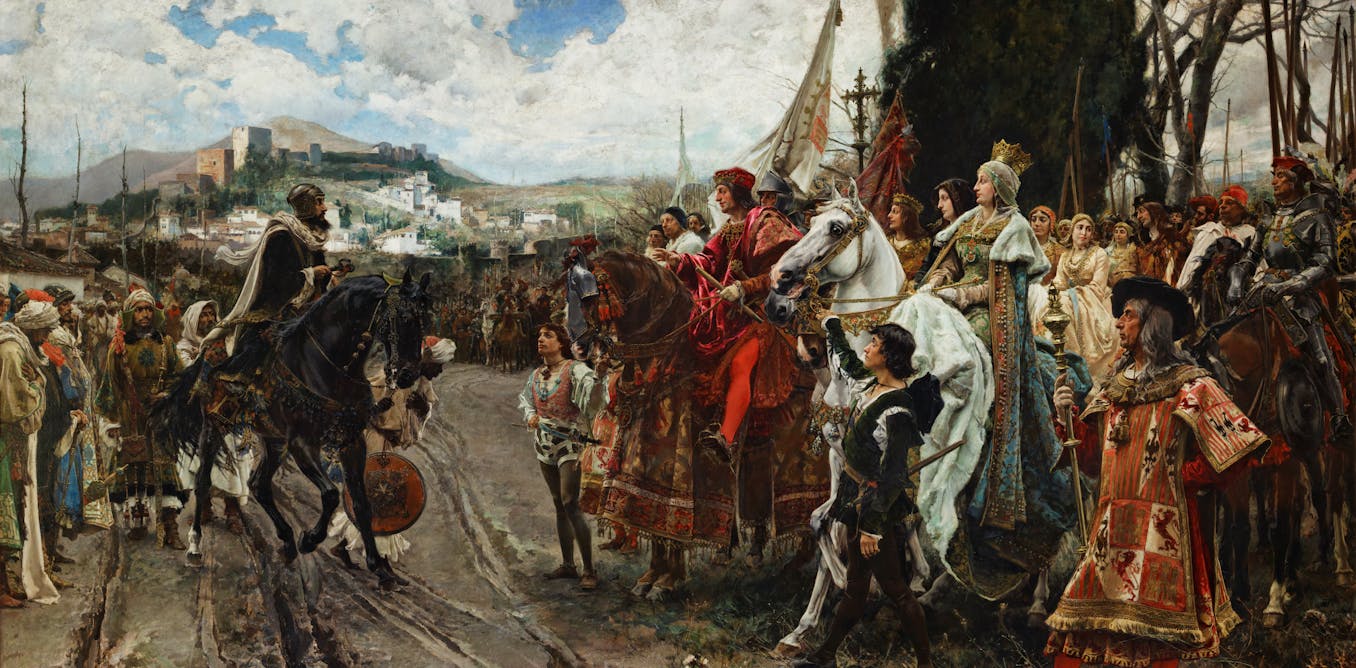
Taking advantage of the situation, the Muslim Berber commander, Tariq ibn Ziyad, who was stationed in Tangiers at the time, crossed the Strait of Gibraltar with an army of Arabic people and Berbers in 711. Most of the invasion force of 15,000 were Berbers, with the Arabic people serving as an "elite" force. Ziyad landed on the Rock of Gibraltar on April 29, 711. After defeating Roderic at the river Guadalete on July 19, 711, Muslim forces advanced, capturing cities one after another. The capital of Toledo surrendered peacefully. Some of the cities surrendered with agreements to pay tribute and local aristocracy retained a measure of former influence. The Spanish Jewish community welcomed the Muslims as liberators from the oppression of the Catholic Visigothic kings. In 712, another larger force of 18,000 from Morocco, led by Musa Ibn Nusayr, crossed the Strait of Gibraltar to link up with Ziyad's force at Talavera. The invasion seemed to have been on the initiative of Ziyad: the caliph, al-Walid, in Damascus reacted as if he was surprised to see him. By 713 Iberia was almost entirely under Muslim control. In 714, al-Walid summoned Ziyad to Damascus to explain his campaign in Spain, but Ziyad took his time travelling through North Africa and Palestine and was finally imprisoned when he arrived in Damascus. The events of the subsequent ten years, the details of which are obscure, included the capture of Barcelona and Narbonne, and a raid against Toulouse, followed by an expedition into Burgundy in 725.
The Muslim invasion reached as far north as France, but the Muslims were defeated at the Battle of Tours by the Franks in 732 A.D. The victory of the Franks, led by Charles Martel, over 'Abd al-Rahman Ibn 'Abd Allah al-Ghafiqi has often been misrepresented as the decisive battle that stopped the Muslim conquest of France, but the Umayyad force had been raiding Aquitaine with a particular interest in sacking churches and monasteries, not seeking its conquest. These actions are of course wrong and evil. Many Muslims in diverse lands promoted religious pluralism. Before Muslims were ready to build mosques in Syria, they accepted Christian churches as holy places and shared them with local Christians. In Iraq and Egypt, Muslim authorities cooperated with Christian religious leaders. Numerous churches were repaired and new ones built during the Umayyad era. Yet, Muslims forced Jewish people and Christians to pay a tax or jizya to Muslims in places like the Levant and Egypt. Muslims grew their influence in many places. Some Muslim controlled places had religious pluralism, and other places were more authoritarian and oppressive. As Jerusalem grew in importance to Muslims and pilgrimages increased, tolerance for other religions declined. Many Christians were persecuted and some churches were destroyed. The Sixth Fatimid caliph, al-Hakim bi-Amr Allah, 996–1021, who was believed to be "God made manifest" by his most zealous Shiʻi followers, now known as the Druze, destroyed the Holy Sepulcher in 1009. This powerful provocation helped ignite the flame of fury that led to the First Crusade. The dynasty was later overtaken by Saladin of the Ayyubid dynasty. In Africa, many Arabic Muslims had black slaves in East Africa. Muhammad had multiple slaves.
The Major Doctrines of Islam
The doctrines of Islam have similarities and massive differences from Judaism and Christianity. Islam believes in the existence of one Creator who created the Universe called Allah. Allah's etymological origin has been debated by scholars for years. Some believe that the term Allah is a contraction from al- ilah (or the god) and is linguistically related to God's names in other Semitic languages like Aramaic (Alaha) and HEbrew (Eloah). The word "Allah" now conveys the superiority or sole existence of one God, but among the pre-Islamic Arabic people, Allah was a supreme deity and was worshipped alongside lesser deities in a pantheon. Many Jews, Christians, and early Muslims used "Allah" and "al-ilah" synonymously in Classical Arabic. The word is also frequently, albeit not exclusively, used by Bábists, Baháʼís, Mandaeans, Indonesian Christians, Maltese Christians, and Sephardic Jewish people, as well as by the Gagauz people. The majority of scholars consider Allah to be derived from a contraction of the Arabic definite article al- and ilāh "deity, god" to al-lāh meaning "the deity, the God." In some sources, the contracted and un-contracted forms are used interchangeably. The contraction of the terms is mirrored by the parallel contraction of al-ʾilāt to Allāt. Originally, ʾilāh was used as an epithet for the West Semitic creator god ʾIlu (the Ugaritic version of El), before being adopted as the proper name itself for this god. A minority hypothesis posits that Allah is a loanword from the Syriac Alāhā. However, this form is likely a phonetic adaptation of the Arabic.
In an inscription of Christian martyrion dated to 512, references to al-ilah (الاله) appear in both Arabic and Aramaic. The inscription opens with the phrase "By the Help of al-ilah." Pre-Islamic Meccans worshiped Allah alongside a host of lesser gods and those whom they called the "daughters of Allah." One major aspect of Islam is the Islamic belief that God is one, God is eternal, and God has no begotten Son. One major cornerstone of Islam is that God has no Son as found in chapter 112 of the Qur'an (Al-'Ikhlās, The Sincerity). Conversely, the New Testament is clear that God has a Son, "......the Father sent the Son to be the Saviour of the world." (1 John 4:14).
1 Timothy 3:16 mentioned that, "And without controversy great is the mystery of godliness: GOD was manifest in the FLESH, justified in the Spirit, seen of angels, preached unto the Gentiles, BELIEVED ON in the world, RECEIVED UP into glory."
Isaiah 9:6 of the Old Testament is clear that, "For unto us A CHILD IS BORN, unto us a son is given: and the government shall be upon his shoulder: and his name shall be called Wonderful, Counsellor, THE MIGHTY GOD, THE EVERLASTING FATHER, The Prince of Peace."
Islam teaches that Noah, Abraham, and Jesus Christ are prophets. Alongside the Quran, Muslims also believe in previous revelations, such as the Tawrat (the Torah), the Zabur (Psalms), and the Injil (Gospel). They believe that Muhammad is the main and final of God's prophets, through whom the religion was completed. The teachings and normative examples of Muhammad, called the Sunnah, documented in accounts called the hadith, provide a constitutional model for Muslims. Islam is based on the belief in the oneness and uniqueness of God (tawhid), and belief in an afterlife (akhirah) with the Last Judgment—wherein the righteous will be rewarded in paradise (jannah) and the unrighteous will be punished in hell (jahannam). The Five Pillars, considered obligatory acts of worship, are the Islamic oath and creed (shahada), daily prayers (salah), almsgiving (zakat), fasting (sawm) in the month of Ramadan, and a pilgrimage (hajj) to Mecca. Islamic law, sharia, touches on virtually every aspect of life, from banking and finance, and welfare to men's and women's roles and the environment. The two main religious festivals are Eid al-Fitr and Eid al-Adha. The three holiest sites in Islam are Masjid al-Haram in Mecca, Prophet's Mosque in Medina, and al-Aqsa Mosque in Jerusalem. The Islamic creed (aqidah) requires belief in six articles: God (they believe in the oneness of God called tawhid), angels, revelation, prophets, the Day of Resurrection, and the divine predestination. Muslims use a shahadah to confess their faith. Those, who convert to Islam, are required to recite the shahada in front of witnesses.
Prayer in Islam, called as-salah or aṣ-ṣalāt (Arabic: الصلاة), is seen as a personal communication with God and consists of repeating units called rakat that include bowing and prostrating to God. There are five timed prayers each day that are considered duties. The prayers are recited in the Arabic language and performed in the direction of the Kaaba. The act also requires a state of ritual purity achieved by means of either a routine wudu ritual wash or, in certain circumstances, a ghusl full-body ritual wash. Muslims worship in mosques or masjids. Many mosques have a shelter for the poor and minarets or to allow the adhan or vocal call time for prayer. Muslims do the hajj or pilgrimage to Mecca at least once in their lifetime to Mecca during the Islamic month of Dhu Al-Hijjah.
The Islam and Roman Catholicism connection
There are many similarities and differences between Islam and Catholicism. There are some people who view Islam as coming from Catholicism as stated by the late Alberto Rivera has said and written about. I agree with Rivera on disagreeing with many doctrines of Roman Catholicism, but my research shows me that Catholicism didn't create Islam. Yet, there are similarities among both creeds. One similarity is that both Roman Catholicism and Islam use prayer beads. The prayer beads in Catholicism are called Rosary beads. The prayer beads in Islam are called Tashih or Misbaha. They are used for repetitive prayer. Both religious groups believe in a Day of Judgement, the resurrection of the dead, and an afterlife. Both religions follow a time of fasting during Lent for Catholics and during the month of Ramadan for Muslims. The Second Vatican Council had its declaration of Nosta Aetate for ending past conflicts among both groups. Both Muslims and Catholics venerate Mary to the point of carrying statues of Mary worldwide. Mary should be respected and honored for her contributions to the world, but she is not infallible. Catholics and Muslims view pilgrimages as a means of obtaining favor from God. Millions of Catholics yearly go to shrines globally; millions of Muslims yearly go on the Hajj to Mecca. Pope John Paul II in 1985 said that Roman Catholicism recognizes Allah as the God of the Bible.
The Evil of Islamophobia
You can't talk about Islam without talking about Islamophobia. Islamophobia is certainly wrong and evil. Islamophobia is the irrational fear, hatred, and discrimination against Muslims or the religion of Islam There are many things that Islamophobia is not. Islamophobia is not when people express peaceful dissent with the religion of Islam. People have the right to agree or disagree with Islam. Islamophobia is not opposing terrorism and opposing authoritarian theocracy. Islamophobia is hatred of Muslims because they are Muslim, it is blaming Islam for all evils on Earth, it is promoting Muslim travel bans, it is about promoting false information about Islam for the reason of hatred, it is about discrimination against Muslims because they are Muslim, and it is about dehumanizing Muslim people. Also, Islamophobia is about lying about Koranic verses or taking verses out of context to promote hatred of Muslim people. Islamophobia is vandalizing mosques that have happened during the aftermath of 9/11. You know me. I cite Koranic verses to show my dissent with many doctrines of Islam without hating Muslims. One famous Islamophobe is the infamous Robert Morey. He made the prediction that Islam would cause WWIII, which isn't the case.
According to an article in the Orange County Weekly, in November 2001, Morey told a San Diego church audience that he had advised the State Department to blow up Mecca and Medina (Muslim holy cities) to win the war on terror quickly. This is demonic behavior, as we can disagree with Islam without advocating the destruction of religious locations. Morey believed that Allah is the moon god Hubal, a deity worshiped in Kaaba in pre-Islamic Saudi Arabia, but that isn't the case. The truth is that in pre-Islamic Arabia, Allah was worshipped within a polytheistic system that included subordinate deities such as Hubal, Al-Lat, and Al-Uzza, who were seen as intercessors to Allah. One sign of Morey of being a total agent is how Morey defends Freemasonry. Robert Morey believes in the old heresy that Freemasonry was just a Christian gentleman group until the 19th century, which is false and a deceptive lie. Freemasonry, as we know it, existed in the late Middle Ages, with ties to occultism since its inception. Freemasonry swears an oath involving death, which Jesus never condoned, Freemasonry deceives Blue Lodge members, which Jesus Christ opposes, and Freemasonry merges mystery school secrecy with Theism in their lodges. Now, Robert Morey is a Reformed and pro-Reconstructionist, which is interesting as many Masons are part of those religious movements. Morey's book, Islamic Invasion, bashes not only Muslims but Arabic people. The problem with his book is that it is filled with inaccuracies. If you are going to disagree with Islam, you have to know what you're talking about with sources. Morey said, in his magazine The Truth Seekers, Sept-Dec, 1995 that, "...if the Muslims have their way, they will kill every Jew and every Christian on the planet."
We know that to be a lie, because I have worked with Muslims, communicated with Muslims, and seen Muslims in real life who don't desire my death as a Christian. The prophet Isaiah mentions that Jewish people, Gentiles (including people of Arabic descent), and all people will come to praise the light of the Lord as found in Isaiah 60:1-7. Whether one is Jewish or Arabic, black or white, Asian or Latino, Native American or Aboriginal, man or woman, immigrant or migrant, if he or she does the right thing, treats people right, and follows the Lord's way, then he or she will be blessed by the Most High God of the Universe. There is no partiality with God. Also, Robert Morey lacks an emphasis of the Gospel. The Gospel is clear that if anyone believes on Jesus Christ, he or she shall be saved. I John 1:7 says, But if we walk in the light, as he (Jesus) is in the light, we have fellowship one with another, and the blood of Jesus Christ his Son cleanseth us from all sin. I John 1:9 mentions that, "If we confess our sins, he is faithful and just to forgive us our sins, and to cleanse us from all unrighteousness." You can't bash people in order to cause people to believe in what you believe in. You have to come correct. So, Islamophobia is not dissent peacefully with Islam. It's about the scapegoating and dehumanizing of Muslim people because they are Muslim. It is about hatred of Islam in a bigoted tone. For example, recently in Dearborn, Michigan (with a high percentage of Muslim people), far right extremists have harassed people near mosques and spewed hatred of Muslims in 2025. We have others like Nour Zeidan calling Kamala Harris the b word which is sexism and evil too. One bigot named Jake Lang slapped bacon over the Koran in front of Muslims in Dearborn. Some of these far-right extremists want to burn the Koran. This is insanity as burning the Koran is disgusting and evil. Islamophobia is the hatred of Muslims that some unfortunately use, which is a perversion of what the true Gospel message is. The Gospel is about believing that the Lord and Savior Jesus Christ died on the cross for our sins and rose from the dead to ascend at the right hand of God the Father. The Gospel is about saving souls, acknowledging the greatness of cultural differences, love your neighbor as yourself, doing the right thing, and making sure that human beings are free to do good.
The Gospel and Islam Compared and Contrasted
The Gospel of Jesus Christ and Islam have many differences. We can't sugarcoat that reality. Also, it is clear that Christians and Muslims have the right to believe in what they believe in peacefully without oppression and discrimination. It is clear that we should make those differences clear. In the Gospel and the rest of the New Testament as found in Galatians 5:22-23, it reads that the fruit of the Spirit is the following: "...But the fruit of the Spirit is love, joy, peace, longsuffering, gentleness, goodness, faith, Meekness, temperance: against such there is no law." Also, Paul wrote that, "...There is neither Jew nor Greek, there is neither bond nor free, there is neither male nor female: for ye are all one in Christ Jesus." (Galatians 3:28). In the Koran, in Surah An-Nisa (4:1), it mentions that: "O mankind, fear your Lord, who created you from one soul and created from it its mate." This verse highlights the equality of men and women in their creation and in the eyes of God. Surah Al-Baqarah (2:228) mentions that: "And they (women) have rights similar to those (of men) over them in kindness, and men are a degree above them." Many years ago, I found out a verse in the Koran that condones beating women in Surah 4:34:"...Men are the managers of the affairs of women...Those you fear may be rebellious--admonish; banish them to their couches and beat them..."
Also, the Koran says that the testimony of a woman is half of a man found in Quran (2:282 - (Court testimony) "And call to witness, from among your men, two witnesses. And if two men be not found then a man and two women." Also, the Koran mentions that in Surah 4:11 that, "The male shall have the equal of the portion of two females." Not even the Old Testament mentions that. Men and Women are not identical. We have biological, social, psychological, and emotional differences, but we are equal in worth and value created in the image of God. Also, the Bible is clear that when the Son sets a person free, he or she is free indeed. In Islam, their god of Allah has no Son, but the Bible is clear that God has a Son as mentioned in Pslam 2 and in the following verse: "...they shall call his name EMMANUEL, which being interpreted is, GOD WITH US." (MATTHEW 1:23). The Gospel is clear that in dealing with a heretic, you leave that person alone if they reject what you're saying peacefully. In Surah At-Tawbah, verse 5 states: "And when the sacred months have passed, then kill the polytheists wherever you find them and capture them and besiege them and sit in wait for them at every place of ambush. But if they should repent, establish prayer, and give zakah, let them [go] on their way." Jesus Christ never condoned killing polytheists. The Koran in Surah 11:44 said that the ark rested on Mount Judi, but the Bible says that it came to rest on Mount Ararat. The Koran said that Abraham's father was Azar in Surah 6:74, but the Bible says that it was Terah. The Bible is clear that God the Father is knowable, personal, trustworthy, and his only begotten Son used his sacrifice to save the souls of the human race.
The Son of the Living God
The Son of God is Jesus Christ, Yeshua. He has been the most talked about person in religious circles. He has been praised, maligned, and supported. His life was filled with pain, resiliency, death, and resurrection. He rose up to talk with the rabbis, refuted the Prosperity Gospel by confronting the moneychangers in the Temple, and made many potent prophecies (like the destruction of the 2nd Temple which happened in 70 A.D., the spread of knowledge, and the rise of the fig tree in the latter days). Many of his followers exist today, and it has been almost 2,000 years after his crucifixion. He lived in Israel. One core tenet of Islam is to deny Jesus as God. One core tenet of Christianity is to view Jesus Christ as God in the flesh. The Bible is clear in Matthew 2:2,11 that the wise men worshiped the Christ child, the Archangel Gabriel said that Jesus Christ is Emmanuel or God with us as found in Matthew 1:23, and Jesus Christ said that he can forgive a person's sins in Matthew 8:2. In the New Testament, when men and women worshiped Jesus Christ as God, Jesus Christ never rebuked them for doing so. John 1:1 is clear that in the beginning was the Word, the Word was with God, and the Word was God. Jesus Christ called him the title of God in I Am as found in John 8:58. In John 10:30, Jesus Christ said that I and my Father one. Therefore, it is clear that the New Testament mentions that Jesus Christ is God. In Revelation 1:8, Jesus Christ called himself Alpha and Omega, the first and the last, and the Almighty.
Conclusion
Islam has been around for almost 1400 years now. It has been a religion that has grown in many communities of the world with over 1 billion followers. Like other religions, it has diverse factions in it. Islam has Sunni, Shia, Sufis, and other different types of Islam. Islam appealed to many people, because many people want direction in life, discipline, and a sense of purpose in life. Islam believes in one God like Judaism and Christianity. Yet, all 3 monotheist religious movements have multiple differences too. Islam believes that God has no Son and there is no Trinity. Christianity teaches that God has a Son, and the Trinity is mentioned in many verses of the Bible, too. Judaism teaches about the Golden Rule and other important lessons of life. Islam teaches that Mount Ararat was in Saudi Arabia and Abraham's father was a different name than what is mentioned in the Bible. Islam denies the physical resurrection of the Lord Jesus Christ when the physical resurrection of the Lord Jesus Christ is one major cornerstone of the Christian faith. Islam is a works-based religion, which means that you have to do almsgiving to be accepted into Paradise (or Heaven). The reality is that no human is perfect. No amount of works alone can merit salvation. Only by the blood of the Lamb can the soul of human beings be saved. Works are important, but they don't merit salvation, as we are saved by the grace of God. We do good works after salvation, not to get saved. Also, it is important to condemn Islamophobia. We can disagree with Islam without dehumanizing Muslims. Likewise, it is clear that we ought to stand on our spiritual beliefs while maintaining religious freedom at the same time. In our generation, there is a large group of ex-Muslims who believe in the Gospel now voluntarily live holy lives. Many of these ex-Muslims say that they had visions from Jesus Christ. Numerous people who left Islam in many nations face persecution or death, but they are courageous to stand by their views by the power of the Holy Spirit. I am not a Muslim, because I won't deny the Son, I don't agree with many of its doctrines, and I have a commitment to Yeshua Ha Mashiach. Therefore, we are not babies anymore, and we have this august responsibility to send the Gospel in a holy, respectful way, so people can leave the religion of Islam (which is filled with many false doctrines) and follow the faith of the Lord Jesus Christ (Yeshua). In closing, here are inspirational views:
"Let this mind be in you, which was also in Christ Jesus: Who, being in the form of God, thought it not robbery to be equal with God: But made himself of no reputation, and took upon him the form of a servant, and was made in the likeness of men: And being found in fashion as a man, he humbled himself, and became obedient unto death, even the death of the cross. Wherefore God also hath highly exalted him, and given him a name which is above every name: That at the name of Jesus every knee should bow, of things in heaven, and things in earth, and things under the earth; And that every tongue should confess that Jesus Christ is Lord, to the glory of God the Father. Wherefore, my beloved, as ye have always obeyed, not as in my presence only, but now much more in my absence, work out your own salvation with fear and trembling. For it is God which worketh in you both to will and to do of his good pleasure. Do all things without murmurings and disputings: That ye may be blameless and harmless, the sons of God, without rebuke, in the midst of a crooked and perverse nation, among whom ye shine as lights in the world; Holding forth the word of life; that I may rejoice in the day of Christ, that I have not run in vain, neither laboured in vain. Yea, and if I be offered upon the sacrifice and service of your faith, I joy, and rejoice with you all.
-Philippians 2:5-17
1 John 5:20 KJV states: "And we know that the Son of God is come, and hath given us an understanding, that we may know him that is true, and we are in him that is true, even in his Son Jesus Christ. This is the true God, and eternal life."
“But if we walk in the Light as He Himself is in the Light, we have fellowship with one another, and the blood of Jesus His Son cleanses us from all sin” (1 John 1:7).
By Timothy
No comments:
Post a Comment