
Geographic Landforms
In life, it is always vital to be a jack of all trades intellectually. That is precisely why I enjoy writing about a multitude of diverse subjects to outline the multifaceted nature of my curiosity. Science is about discovery, analysis, and research. Geography is one major lifeblood of human existence. How we learn about the placements of directions, how we evaluate relative location, and how we comprehend about longitude and latitude come from geographic research. Landforms are some of the most diverse natural structures on Earth. We all either live at, know about, or seen a myriad of geographic landforms before. Such landforms can be an isthmus, an island, a plain, or a valley. I live in a coastal plain near the Atlantic Ocean and other bodies of water like the Chesapeake Bay. My geographic region has forests, various flora, diverse fauna including rabbits, weather changes, and different human beings of many ethnicities and backgrounds. We measure landforms in square miles, meters, feet, and other various mathematical equations (involving chchemistry, physics, calculus, geometry, algebra, etc.). For example the gradient formula to calculate the slope (or gradient) of a hill is vertical rise/horizontal distance. The contour line interval uses math too. People of all ages can understand fully the importance of how landforms can interact with our vital, fragile ecosystem (with organisms) in general.
Geography in General
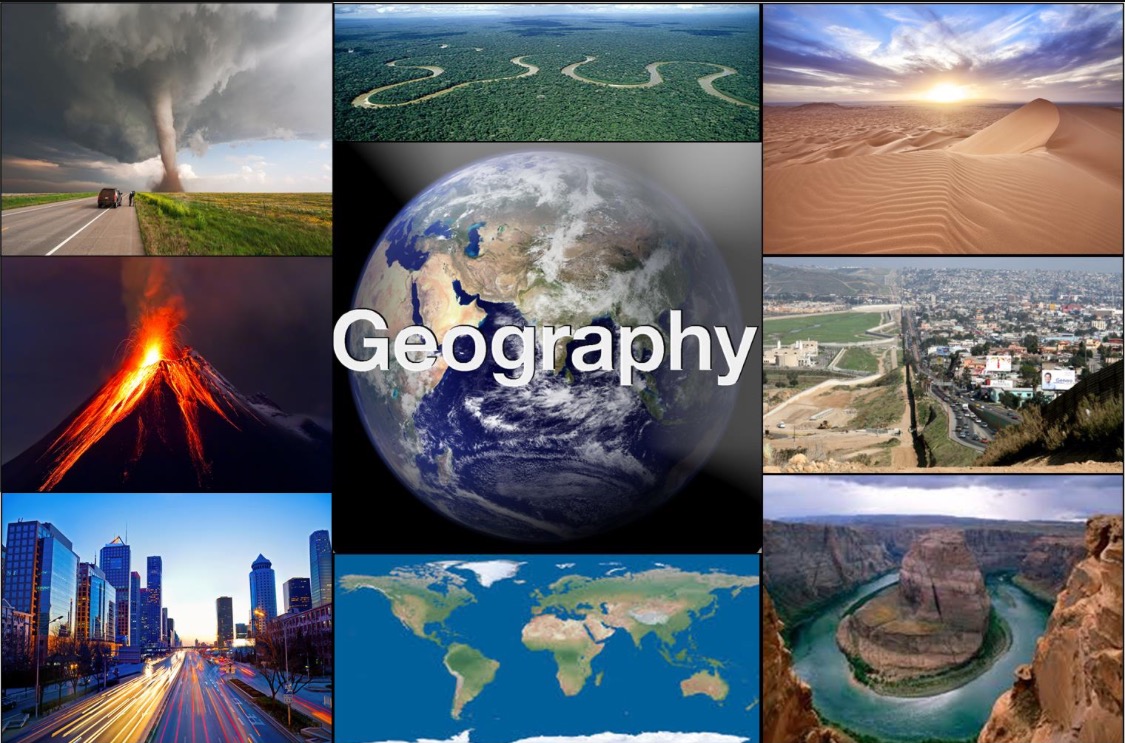
Geography is always an important subject to comprehend. Geography is the study of the Earth's physical features, atmosphere, and human-environmental interactions. It is the science of space and place. It analyzes where things are, why they are there, and how they change. There are many branches of geography. Many of the main branches are physical geography (natural systems), human geography (or sosocial/cultural systems), and other types of geography. Many of the themes of geography are location (being absolute and relatives), place, human environment interaction, movement (of people, goods, and ideas), and region. To know space, place, time, and scale is to understand much of geographic concepts in general. With physical geography, people study the natural environment, including climate, landforms, soils, and water (like geomorphology, hydrology, and climatology). Human geography deals with human activities and their impact including economic, political, cultural, and urban systems. Technical/geospatial geography deals with tools to map and analyze date like GIS (Geographic Information Systems), remote sensing, and cartography. Many careers in geography deals with a cartographer or GIS analyst, an urban or regional planner, environmental scientist and manager, intelligence analyst, an educator, etc. Many famous geographers are Eratosthenes who calculated the Earth's circumference, Alexander von Humboldt (the founder of modern geography who studied the interconnection of nature), and Carl Sauer (a key person involved in cultural geography). Geography is different than geology. Geography studies the surface of the Earth and interactions in it, and geology studies the Earth's internal content and composition.

Types of Geographic Landforms
There are tons of geographic landforms in the Earth. We have mountains being high, rocky areas that rise steeply above the surrounding land. They are often formed by tectonic activity as tectonic plates globally are a large part of the Earth's geological history. There are plateaus which are large, flat, or gently rolling areas of land that are significantly higher than the surrounding terrain. There are plains which are broad, flat stretches of land that are usually low in elevation compared to the surrounding area. Hills are elevated sections of land that are smaller and less steep than mountains. There are coastal landforms too. Valleys and canyons are low lying, often steep walled areas formed by erosion from rivers or glaciers. Valleys have depressions between mountains or hill, often containing a river. Peninsulas are lands surrounding by water on most of its sides. One example is how Hampton and Newport News is in a peninsula region of Hampton Roads, Virginia (757). There are deltas or fan shaped landforms created by the deposition of sediment at the mouth of a river. There are unique lands forms like an archipelago or a collection of islands, atoll being a ring shaped coral reef, and a bay being a recessed, coastal body of water connected to an ocean or lake. A coral reef is an outcrop of rock in the sea formed by the growth and deposit of stony coral skeletons. Landforms are formed by two main forces. One is endogenic processes or internal, tectonic forces that push up mountains and build terrain. Exogenic processes are external forces, such as wind, water, and ice erosion, that wear down the shape the landscape over time. There are more geographic landforms too. A desert is a landscape where little precipitation occurs and living conditions have unique biomes and ecosystems. They have a lack of vegetation. Glaciers are landforms made up of a body of natural ice, a form of rock. It moves over time and can be bigger or smaller. An aquifer is an underground layer of water bearing permeable rock, gravel, sand, or silt that stores and transmits ground water. It is the source for wells and springs. It can have vital freshwater reservoirs. An isthmus is a narrow strip of land connecting two larger land masses, bordered by water on two sides. It is found in Panama, the Suez region, and other places.
.jpg)
Urban, Suburban, and Rural Locations
In geography, we have urban, suburban, and rural areas. There are many differences between these geographic locations too. Urban areas are densely populated regions. They have a large percentage of people per square mile as compared to suburban and rural locations. Urban locations have tall and medium-sized buildings, busy streets, and diverse populations (with diverse ethnic and social demographics). Urban places have extensive public transportation, cultural attractions, shopping center, and entertainment options. Some urban places have congestion, noise, and air pollution. People live in homes, condos, apartments, and townhouses with limited private outdoor space at times. Economically, urban areas give people diverse job opportunities in finance, technology, health care, construction, retail, education, etc. The top five largest cities in the world in terms of population are Chongqing with 32.13 million people, Shanghai with 24.8 million people, Beijing with 21.84 million people, Dhaka with 21.28 million people, and Chengdu with 21.19 million people. America's top 10 cities in terms of population are New York City with 8.4 million people, Los Angeles with 3.8 million people, Chicago with 2.7 million people, Houston with 2.3 million people, Phoenix with 1.6 million people, Philadelphia with 1.573 million people, San Antonio with 1.526 million people, San Diego with 1.5 million people, Dallas with 1.3 million people, and Jacksonville, Florida with about one million people.
Suburban locations are usually on the outskirts for cities, but some cities have suburban elements in them. Suburbs serve as the residential communities for people who commute to urban centers for work. They have moderate population density, larger homes, and more green space than urban areas. Suburbs have parks, recreational facilities, and typically are mostly middle class areas. The housing usually have single family homes with yards and residents often use personal vehicles for transportation, because suburbs have limited public transportation. Suburbs have economic job opportunities in specific sectors like healthcare, education, tourism, etc.
Rural areas are low density regions which are found outside of urban and suburban areas. They have large farmland, forests, and natural landscapes from mountains to valleys. Life in rural places is slower paced and quieters with open spaces and scenic views. Housing is usually spread out with large plots of land (in acres at times) and multi-family dwellings. Rural residents usually rely on personal vehicles for transportation because of limited infrastructure and public transit. Economically, rural areas deal with agriculture, resource extraction, and small local businesses. They can have access to healthcare, education, and entertainment. The cost of living is generally lower than in urban areas. Urban, suburban, and rural areas are not inferior or superior to each other. A person's priorities and preferences determine whether they desire to live in urban, rural, or suburban places.
There are similarities among urban, suburban, and rural places. Each deal with transportation (like roads, bridges, transit, pedestrian or bike infrastructure), utilities (energy grids filled with electricity and gas. There are also telecommunications and waste management systems), housing plus zoning (that is the physical division of space for residential, commercial, and industrial buildings), and the usage of water and sanitation (that deals with water supply, stormwater management, and wastewater treatment). Each types of places have economic activities that deal with industry and commerce (like markets, corporate headquarters, manufacturing zones, and retail hubs), labor markets (which relates to the working age population of workers and how industries employ them), and supply chains (these systems are required to import food, raw materials, and goods into urban, suburban, and rural areas). These places has to deal with environmental and natural management (involving natural and artificial modified ecosystems within places). It can relate to biotic elements (filled with humans, street trees, parks, and wildlife), abiotic elements (air quality, water bodies, soil, and microclimate), and sustainability and resiliency (or climate adaptation plans, green building designs, and conservation efforts). All areas deal with governance and civic framework which is the political and organizational structures that manage a city, town, etc. All areas must focus on urban, suburban, and rural planning that deals with guide zoning, land use, and future city expansion, local government, public policy, taxation, budgeting, public participation (like voting, protests, ceremonies, rallies, etc.), and community networking.
.jpeg)
Solutions to Improve Geographic Landforms
In our generation, there are always tons of solutions to improve the compositions of geographic landforms. We must establish concrete investments to build more anti-flood zones, levees, and alternative forms of energy, so the environment can improve greatly (and human lives can be improved upon intrepidly). That is why infrastructure development (from building safe reservoirs to growing more parks) is a must in the 21st century with the existence of climate change and other global issues relating to Nature. There has been an increase of electric cars and a push to ban toxic chemicals from our water, soil, and air. That reality entails that we don't desire the precipitous growth of forever chemicals in our environment, we want natural foods to flourish, we seek cleaner air, and we will support programs to eliminate toxins from being consumed by humans and animals. Another solution is habitat rejuvenation projects to put extra sands in struggling beaches, increase the growth of trees in various locations, restore ecosystems, make more walkable neighborhoods that reduce greenhouse gas emissions, and to allow endangered animal species to flourish in their locations. Progressive environmental groups are paramount in focusing on developing our geographic atmosphere indeed.

Environmental Justice
Environmental Justice involving geographic issues is a paramount concept for us to know about and embrace. Environmental justice means that there must be fair treatment and meaningful involvement of all people (regardless of race, color, national origin, income, or background) to develop, implement, and enforce legitimate environmental laws and policies. It means that we want equal access to a healthy environment and protection from hazards, functioning as both a field of study and a social movement against systemic inequalities. We know that black people, persons of color, and the poor are readily the victims of environmental injustices like dangerous chemicals near water supplies, fusion centers without much environmental regulations, and homes being built near dangerous cancer filled locations. We want fair treatment that means that no group should bear a disproportionate share of negative environmental consequences. We want communities to have an equal opportunity to participate in decision making. We are opposed to some corporations and other oligarchical, corporate interests trying to expose marginalized communities to pollution and industrial hazards. Environmental justice is the correction of these disparities and to bridge environmentalism and civil rights together in a succinct manner.
One of the most important stories about this issue is the story of Cancer Alley. That is about an 85 mile stretch along the Mississippi River housing over 150 petrochemical plants. The predominantly black communities has been overburdened with elevated health risks and cultural erasure. They have secured key civil rights wins in state and federal courts. By February 2026, a federal judge rejected attempts to dismiss a major pollution lawsuit in St. James Parish, making a massive victory for local advocates. The lawsuit links current industrial land use systems to historical injustices orginating in slavery. The backlash and federal civil rights rollbacks have existed by the Trump administration. A federal court permanetnly barred the EPA and DOJ from imposing disparate impact civil rights requirements agianst the state. The EPA formed stricter regulations for toxic chemicals like chloroprene and ethylene oxide, targeting hazardous air pollutant commonly emitted by petrochemical facilities. Organizations that promote environmental justice are Deep South Center For Environmental Justice, Rise St. James, Louisiana Bucket Brigade, the Descendants Project, etc.

Epilogue
To truly know about geography is more than comprehending facts about longitude, latitude, and basic concepts of topography. It is a culture that focuses on the cultures of the human race as it relates to the study of the lands, features, inhabitants, and phenomena of the planet Earth. Social sciences and natural sciences combined encompass geography in fundamental terms. Long ago, many people falsely believed that the world was flat. Now, we know that the Earth is a spheroid being round. Mathematics has advanced in many ways to develop geographic sciences that focus on space, time, and scale to understand our natural environment. Researchers involved in geography deal with cartography, remote sensing, interviews, and surveying. In other words, how people build houses, how people protect animal species, how people measure chemicals in the water supply, and how human beings develop ways to monitor the weather all involve the subject matter of geography. From the three dimensional Cartesian coordinate system to show space to deal with absolute space, we understand how people move around the globe. The Earth has a lithosphere, atmosphere, hydrosphere, and biosphere with these entities being interrelated to each other. The Tobler's first law of geography is that everything is related to everything else, but near things are more related than distant. Its 2nd law is that the phenomenon external to a geographic area of interest affects what goes on inside. Many scholars love human geography, physical geography, technical geography, and integrated geography. Therefore, geography is always a beautiful subject of human discovery.
The Atmosphere
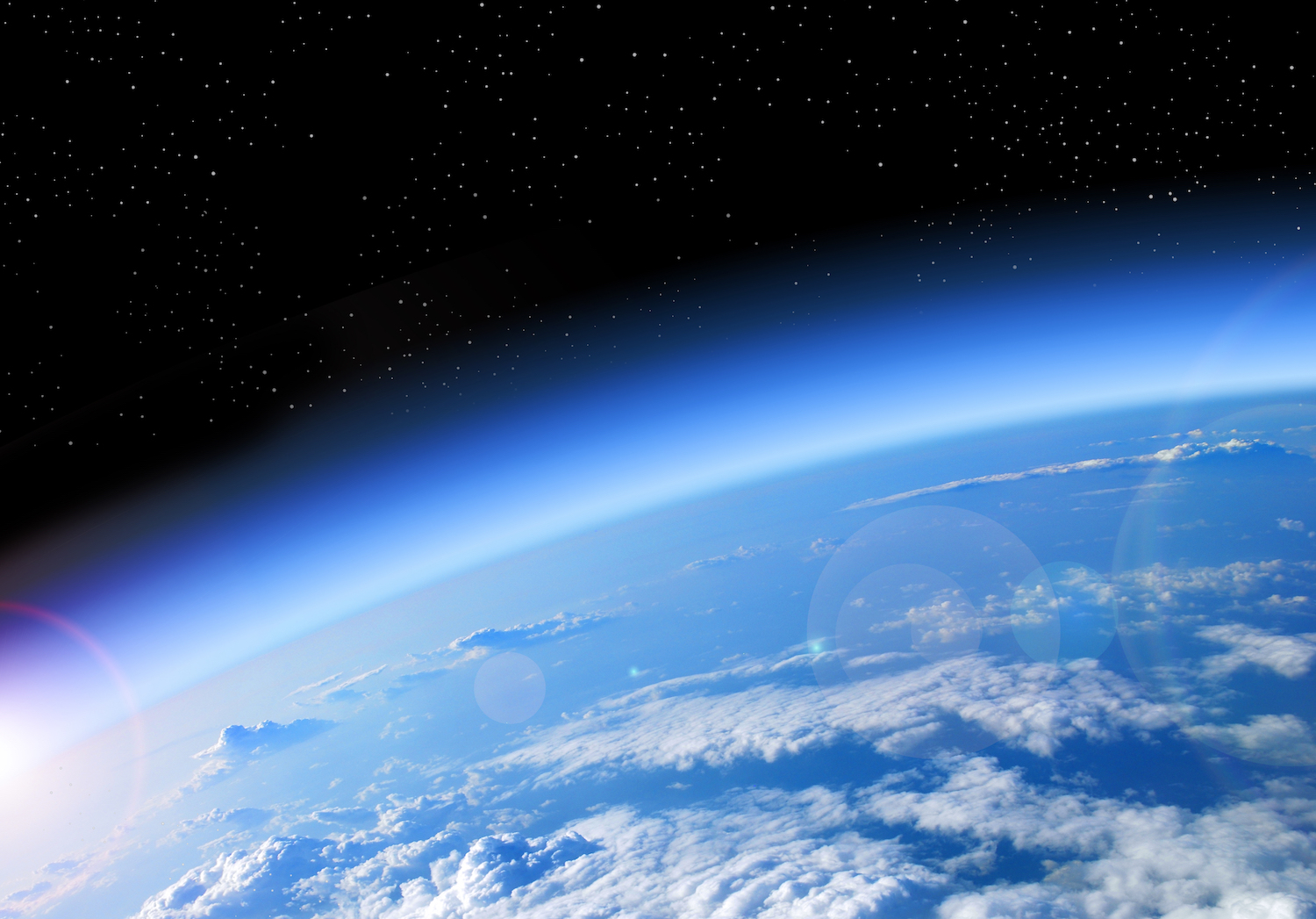
Science is not just the study of things that we can observe quantitively. When we were children and teenager, we learned about the scientific method that deals with the following concepts chronologically: Observation, Question, Research, Hypothesis, Experiment, Analysis, Conclusion, and Communication/Iteration. Also, science deals with the wonder and beauty of Nature too. Part of that exquisite wonder relates to the complexities of the compositions of the Earth's atmosphere. The parts of the atmosphere may differ in temperature, organisms, other forms of energy, etc. Yet, these parts of the atmosphere are related to the sun's rays going to the Earth. Each part of the vast atmosphere is key to developing and preserving our fragile ecosystem. From birds flying in the lowest atmosphere to satellites and the International Space Station at the highest atmosphere, all of us are interconnected with the functions of the vast Universe. The atmosphere has air filled with mixed gas, gravity retaining the atmosphere, and many particles (like aerosols, particulates, etc. that form clouds and hazes). Ultraviolet solar radiation, temperature variation, greenhouse gases, the ozone layer, and meteoroids exist in the atmosphere.
Troposphere
The troposphere is the lowest, densest layer of the Earth's atmosphere. It extends from the surface of the Earth to almost 5-10 miles. It contains about 80 percent of the atmosphere's mass and almost all water vapor. This region acts as the primary layer for weather, clouds, and air circulation. Temperature and pressure both decrease rapidly is the area where temperature stops stop decreasing with height, acting as a "lid" that separates it from the stratosphere. The troposphere is the location where almost all weather (including clouds, rain, snow, and storms) exists. It has vertical mixing and convection. The temperature declines as the height increases to as low as -60 degrees Fahrenheit (-51 degrees Celsius) at the tropopause. The air decreases nearly exponentially with height form roughly 1000 hPa at the surface to 120 hPa at the tropopause. This layer has humans and animals live and breathe with mostly nitrogen (78 percent) and oxygen (21 percent). There is surface heating. So, warmer air is less dense and raises, while cooler air sinks creating constant mixing and vertical convection currents. So, the troposphere is a natural filler. It holds ono water and traps dust and particles (making it essential for life on Earth).
Stratosphere
The stratosphere is just above the troposphere. It is about 31 miles above the Earth's surface. This layer has the ozone layer, which absorbs ultraviolet (UV) radiation from the Sun. It is very dry, stable, and warmer in its upper regions than its lower regions. That is why commercial jet aircraft often fly in the lower stratosphere to avoid turbulence. It has many stratified temperature zones, with the warmer layers of air located layers lower (closer to the plenary surface of the Earth). The reason why there is an increase of temperature with altitude is a result of the absorption of the Sun's ultraviolet (UV) radiation by the ozone layer. The ozone is exothermically photolyzed into oxygen in a cyclical fashion. The tropopause border is the border that demarcates the beginning of the temperature inversion.

Mesosphere and Thermosphere
The mesosphere is the third layer of the Earth's atmosphere. It extends 31-35 miles above the surface. It has extremely cold temperatures. It can be as cold as -91 degrees C. to -125 degrees C. It is the region above the stratosphere and below the thermosphere. The region protects the planet by burning up most meteors. It has the lowest temperatures in the atmosphere and forms noctilucent clouds, which are rare high altitude clouds. It plays a role in the global circulation of the atmosphere.

Ionosphere
The ionosphere is an electrified, shifting region of the Earth's upper atmosphere (being about 30-600 miles up) filled with charged particles created by solar radiation. It is important for long range radio communication by acting as a waveguide, while protecting the Earth by interacting with space weather. Solar activity massively changes the ionosphere's density and shape. Solar activity creates the D, E, and F layers that can disrupt GPS and satellites. The ionosphere is formed by extreme ultraviolet (EUV) and X-ray radiation from the Sun breaking apart atoms and molecules, a process called photoionization. The ionosphere is heavily dependent on the sun. During the day, it is much denser and more developed. At night, the density decreases. During solar flares and magnetic storms, the density can change rapidly, disrupting communication signals and radio propagation. The ionosphere enables long distance shortwave radio communication. Radio signals can bounce off the ionized layers, traveling over the horizon. The ionosphere exists in the upper mesosphere and lower thermosphere. The temperature varies, generally increasing with altitude, often reaching over 932 degrees Fahrenheit in the uppermost sections. The ionosphere serves as the edge of space, acting as a buffer that interacts with solar winds and protects the lower atmosphere. It is also home to the Aurora Borealis/Australis. It's a plasma region embedded within the upper atmosphere. The D Region is the lowest, the E Region is the middle layer, and the F Region is the highest. North of the ionosphere is the exosphere.
/diagram-of-energetic-neutral-atoms-from-a-region-outside-earth-s-magnetopause-181827893-58ab40555f9b58a3c9cce015.jpg)
Exosphere
In dealing with space, you have to know what the exosphere is. The exosphere is the outermost layer of the Earth's atmosphere. It goes from 375 to 500 km up to 10,000 km, acting as a transition zone to space. The exosphere is mostly made up of sparse hydrogen, helium, and oxygen. It is made up of by "collison-less" particles following ballistic trajectories. The exosphere protects the Earth by absorbing solar radiation being a home for satellite orbits (and its studied using satellite data and ultraviolet cameras). The exosphere is above the thermosphere which goes 6,200 miles into space. Atoms in the exosphere are far apart and rarely collide, allowing them to follow ballistic paths or escape into space. Exo meaning that it is the outermost shell of the atmosphere. Because the exosphere's air is so thin, conventional thermometers won't work. Yet, the particle kinetic temperatures are very high (being thousands of degrees) due to absorption of intense solar radiation. Yet, it feels extremely cold because of a lack of molecular collision. The exosphere is the final barrier between the Earth's atmosphere and the vacuum of space. Science study the region to see how the atmosphere interacts with solar winds. Scientists also study the geocorona (or a glowing part of the exosphere) by observing the scattered UV light with space telescopes and instruments mentioned by the UCAR Center for Science Education. Therefore, we live in the troposphere, then there is the stratosphere, the mesosphere, the thermosphere, the exosphere, and space.
.jpg/960px-Artemis_II_Launch_Crew_Walkout_(NHQ20260401_admin_0005).jpg)
The 2020s: In Retrospect So Far
The decade of the 2020s has exploded with creativity, social movements, hope, tragedies, and the end of the Presidency of an authoritarian fascist. This time saw the general public (not just dedicated scientists and researchers) reckon with the reality of artificial intelligence. A.I. has changed everything from movies, how people shop for items, and how music is presented (with a massive backlash from many artists and debates about control and originality). There is the new A.I. musician Xania Monet who has created songs, and the person who generated this A.I. creation is Telisha "Nikki" Jones. This time saw the growth of wars and other military conflicts in Venezuela, Iran, Afghanistan, Pakistan, and other places of the world. The early third of this decade was dominated by the COVID-19 pandemic. It first erupted in China by November 2019, but it was on a massive international scale by early 2020. By the middle of March 2020, tons of places in America were shut down completely. I remember that time just like yesterday. A recession existed because of the pandemic, over one million Americans died from the illness, and millions of Americans had to unemployment insurance to survive literally. Worldwide, millions of people also died from COVID-19. There were vaccinations that people received. Debates about closing stores continued, but we lived in an emergency setting back then. Also, there was the largest anti-racism, anti-police brutality protests globally in 2020. People wanted to seek justice for the unjust killings of George Floyd, Breonna Taylor, and all black victims of unjust police terrorism. The 2020s saw albums, victories from athletes (in the 2024 Paris Olympics and other events), and a resistance movement against Trumpism.

The early Era: COVID-19 and the Global Shutdown
By the early 21st century, massive changes happened in the world. By January 3, 2020, Qasem Soleimani was targeted and killed at Baghdad International Airport. From January 16 to February 5, Donald Trump was not voted out of office by the United States Senate in his first impeachment trial. Then, the United Kingdom formally withdrew from the European Union on January 31, 2020. By February 9, Bon Joon-ho's Parasite movie became the first South Korean film to receive the Academy Award recognitions at the 92nd Academy Awards. Then, by March 2020, the United States of America goes into massive lockdown due to the global pandemic of COVID-19. I remember that time just like yesterday. COVID-19 existed in China from November 2019, and it spread rapidly all over the world in December and January 2020. By February 2020, there was massive concern over the virus, but Trump tried to downplay it at first. It became real in America when the U.S. shutdown happened in mid-March of 2020. By March 25, 2020, the House and Senate approve a two trillion dollar emergency spending bill, the Cares Act, to prop up the economy as people lose jobs and are told to stay home due to the pandemic. President Trump signed the bill two days later as 3.2 million people during the week before had signed up for unemployment benefits, the highest amount in history. By April of 2020, the COVID pandemic passed over 1 million cases worldwide. On April 6th, 2020, the United States designates the Russian Imperial Movement as a terrorist organization and imposes sanctions on its leaders; it is the first white supremacist group the U.S. has designated as a terrorist organization. This time saw the Yemeni Civil War in existence along with the Syrian Civil War. On May 2, 2020, the United Nations publishes a report stating that Russia's indiscriminate bombing of civilians in Syria constitutes a war crime. George Floyd was killed by police officer on May 25, 2020.

Fights for Justice
After George Floyd and Breona Taylor were killed by police officers, the nation expressed outrage. Later, there were the largest anti-racism and anti-police brutality protests in human history from America to worldwide. Black Lives Matter and other movements promoted justice for black people. Millions of people protested. There were rebellions and innocent property damaged and destory which was wrong. Yet, the vast majority of anti-racism and anti-police brutality protests were peaceful. While this is going on, people are racing to created a COVID-19 vaccine, businesses close, and people wear masks all over the world. By September 2020, the worldwide death toll from COVID-19 exceeds more than one million human lives. By October 2020, there are over 35 million cases of COVID-19 worldwide. By November 2020, after a contentious and emotional 2020 election, Joe Biden was elected as the 46th President of the United States of America. Mail in ballots were counted, and Donald Trump lied and said that the 2020 election was stolen. By the end of 2020, COVID-19 vaccines from Modern and Pfizer plus BioNTech are finalized. By December, over 65 million people worlwide have COVID-19. On January 6, 2021, supporters of US President Donald Trump attack the US Capitol, disrupting certification of the 2020 presidential election, and forcing both houses of Congress to evacuate. Five people die during the ensuing riot. The event is classified as a domestic terrorist attack, and draws international condemnation. The January 6th terrorist insurrectionists were cowards, evil, and terrorists who tried to destroy American democracy. Yet, they failed in their efforts.

Cultural Changes and Backlash
Since 2025, the Trump administration has increased its backlash against progressive progress in American society. As early as January 2025, Trump issued executive orders to override the asylum laws, lay the groundwork for mass deportations, and challenge birthright citizenship. By June 2025, the Trump administration announced the restoration of Confederate names to all nine U.S. military bases. This is bizarre and racist as the Confederacy was acting in rebellion against America in order to maintain slavery permanently in America. Naming military bases after Confederate traitors is just plain wrong. By February 2026, there was a rule that reclassified thousands of civil servants to at will employment, which purged large portions of the federal workforce. By Spring of 2026, there has been aggressive rollbacks with the Department of Government Efficiency (DOGE) forcing deep cuts across the National Park Service and public lands agencies. The Trump administration has systematically rescinded federal guidance regarding race and disability based discrimination. Executive orders have been executed by Trump to eradicate DEI programs across federal agencies and government contractors, including limiting diversity initiatives in universities and workplaces. The Trump administration is the most anti-environmental administration in American history by ending legitimate environmental regulations, roll back EPA or Environmental Protection Agency pollution standards, and withdrawing from international climate pacts. MAGA members heavily embrace the sexist manosphere movement (it is a type of movement that promotes the lie that women and/or feminism is to be blamed for all of the problems that men go through), promote the racist "black fatigue" concept (in denying white racism), and some accept xenophobia too. These bigots show hatred of minorities by bashing DEI and bashing woke when the Golden Rule teaches all of us to treat each human being with dignity and respect irrespective of one's background or identity.
The Age of President Biden
The Age of President Joe Biden's Presidency was a paradox in that he won the 2020 election as a mdoerate candidate in the midst of progressive furvor (among many Democratic voters), but many of his economic and domestic policies were massively progressive not moderate. Joe was born up North in Scranton, Pennsylvania. He got his political start in Delaware where he was a Senator for decades. He ran for President multiple times and won it by 2020. Biden in 2020, defeated more progressive candiates during the Democratic primary (who are Kamala Harris, Bernie Sanders, and Elizabeth Warren). Joe Biden took his time and gathered more delegates as the political race proceeded by gaining support and giving speech plus his political organizing. Joe Biden went to South Carolina and won the primary, because Bernie Sanders is right on many economic issues, but he didn't come to gain more support among the African American leaders in South Carolina and Selma, Alabama. One of Bernie Sanders' great mistakes was not coming to Selma to commemeoriate the 55th Anniversary of Bloody Sunday. Joe Biden won the Democratic primary and debated Trump in highly charged debates. Those debates were filled with heated exchanges representing the massive political polarization in American society. Joe Biden won the 2020 election. After November 2020, Trump and his team tried their best in trying to sue to steal the election in Georgia, Arizona, Pennsylvania, Michigan, and in other places. Georgia voting for Biden was very historic. The Supreme Court prevented Trump from stealing the 2020 election via their court decision. Then, January 6th happened when MAGA terrorists invaded the U.S. Capitol illegally to assault police officers, yell racial slurs, damage property, steal Congressional items, threatened to hang then Vice President Mike Pence, wave Confederate and Neo-Nazi flags on Capitol grounds (for the first time in American history), and nearly assaulted Congressional leaders. The National Guard and other authorities stopped the terrorist mob by the afternoon. The National Guard remained for weeks in Washington, D.C. to protect Biden and the American people in D.C. President Joe Biden was inaugurated on January 20, 2021 when I was 37 years old. There were fireworks, celebrities celebrating Biden, celebrations, and a sense of release. President Joe Biden passed some of the most progressive legislation in U.S. history economically and socially. He signed economic bills that invested in our communities like: The American Rescue Plan, the expasnion of the Child Tax Credit in a historic level, summer nutrition benefits, investments in child care programs, and used the State Small Business Credit iniative to help invest in up to 100,000 small businesses over the next decade. Joe Biden had some foreign policy errors in Afghanistan and in other places. The country improved economically, and Biden grew to delay in his speeches. Ageism is a prejudice unfortunately that is common in America, so Biden was questioned of his intellectual capacity by 2024. By 2024, Biden decided to not run for re-election for the good of the country, and Kamala Harris won the Democratic nomination of 2024. Kamala Harris ran a valiant campaign and set many records, but she lost because of many complex reasons (like sexism, racism, economic angst, misinterpretation of Kamala's views, and other reasons). The Age of Biden showed America having great improvements and new challenges. It was a short four year time that saw massive blessings and the backlash of Trumpism causing Trump to win in 2024. After 2024, we are still fighting for our democracy that our ancestors courageously fought for.

Trump's Retribution Reactionary Agenda
Trump has a retribution agenda that has tried to ruin the lives of many of his public critics. Trump has pledged to seek revenge against people who disagree with him. For example, he failed to allow the DOJ to convict Letitia James. Now, the DOJ has indicted James Comey over the allegation that he threatened the life of Trump. Comey has explicitly denied this allegation. Trump wanted Jimmy Kimmel fired, but Jimmy Kimmel is still on the air as he has First Amendment rights. Trump wants prosecutors, federal agenda, and civil servants fired, suspended, or investigated for being perceived as disloyal or opposing his policies. This is fascism as people have the right to their own independent thinking plus dissent, regardless of who is in office. This retribution agenda has expanded since 2025 to extend to the government indicting the Southern Poverty Law Center (over the allegation of wire fraud, bank fraud, and conspiracy to commit money laundering), the Minnesota Church protest, the investigation of Minnesota Democrats, the investigation of Jerome Powell of the FED until it was dropped by Jeanine Pirro, the harassment of Mark Kelly, Ras Baraka being arrested plus the charges being dropped, and Trump harassing Adam Schiff.

Other Cultural and Societal Developments
2025 was one of the most important years of the 2020s being the first year when the authoritarian Trump was inaugurated as President. The start of the year saw the January 15th wildfires that devastated tons of acres of Southern California. South Korean President Yoon Suk Yeoi was impeached and arrested on January 15, 2025, too. The war in Ukraine continued. By January 6th, Indonesia became the 10th member of the BRICS organizaiton. Many people attacked the capital of Chad at N'Djamena's presidential palace. By January 15, 2025, Israel and Hamas approve of a ceasefire agreement that seeks to end the war. Israeli hostage and Palestinian prisoners are exchanged. By January 29, 2025, there was the Potomac River midair collision. The trade war continued among America and China. On March 2, 2025, Firefly Aerospace was the first commercial company to successfully land on the Moon with no technical issues, with its Blue Ghost Mission 1. More than 1,000 people, including civilians, are reported killed in a crackdown by Syrian transitional government security forces in the Alawite region, described as the country's worst violence for years on March 8, 2025. On March 8–17, 2025, the Special Olympics World Winter Games are held in Turin, Italy. The former President of the Philippines, Rodrigo Duterte, is arrested in the Philippines after being served an arrest warrant from the International Criminal Court for crimes against humanity (on March 11, 2025). On April 1, Fram2 launches aboard a SpaceX Falcon 9 rocket, becoming the first crewed spaceflight to enter a polar retrograde orbit. Pope Francis died on April 21, 2025 living to be 88 years old. Pope Leo XIV was elected as the new Pope. His name is Robert Francis Prevost. He is the first American citizen, Peruvian citizen, North American, and Augustinian pope in the history of the Catholic Church. On July 2025, at least 135 people were killed and over a hundred reported missing during a flood in Central Texas. Russians had a drone incursion into Poland by September 9, 2025. This is the first attack on NATO territory causing Poland to invoke Article 4. The Supreme Federal Court convicted former Brazilian president Jair Bolsonaro and sentences him to 27 years in prison for his involvement in the 2022 Brazilian coup plot. On October 1, 2025, Israel intercepts the Global Sumud Flotilla, a fleet carrying humanitarian aid to the Gaza Strip, in international waters, arresting 443 activists from 47 countries. On October 13, Hamas the last 20 living hostages in Gaza after they were kidnapped during the 2023 October 7 attacks. In exchange, Israel releases 250 Palestinian prisoners and more than 1,700 detainees.
.jpg/960px-Artemis_II_Launch_(SLS_MAF_20260401_ArtemisII-Launch-epb_003).jpg)
Early 2026
2026 was one of the important years in human history. It is the year of the 250th anniversary of the United States of America (with the signing of the Declaration of Independence which is a document thst desired a permanent break from the British Empire). January 1, 2026, was when Zohran Mamdani was sworn in as the 112th Mayor of New York City, being the first Muslim and Asian American to be mayor of New York City too. Books, films, and other works published in 1930 enter the public domain. Also, the Corporation for Public Broadcasting voted to dissolve itself. There was the killing of Renee Good in Minneapolis, Minnesota by an Immigration and Customs Enforcement officer. By January 2026, the U.S. launched a military raid in Venezuela that captured its president, Nicolas Maduro. The measles outbreak continues in America with more than 2,500 cases are reported nationally in America. In February 2026, the U.S. launched a major attack on Iran with Israel with the stated goal of regime change, killing its leader Ali Khamenei. Domestically, the US underwent two partial government shutdowns, with the first lasting four days, from January 31 to February 3, and the second lasting approximately 76 days, from February 14 to April 30, becoming the longest government shutdown in U.S. history and impacting the US Department of Homeland Security, with the core issue regarding the funding of Immigration and Customs Enforcement. In addition, 2026 saw the first major judicial actions against prediction markets, in particular Kalshi and the usage of its platform and other prediction markets to bypass state regulations on sports betting, with Nevada being the first to land a court-enforced ban of Kalshi and Arizona being the first to file criminal charges against Kalshi. In science and technology, the most prominent story so far has been the April 2026 NASA mission Artemis II, the first crewed deep-space mission since 1972. Artemis II sent four astronauts—including the first woman, black person, and Canadian—to circumnavigate the Moon. On April 28, 2026, Former FBI Director James Comey was indicted on federal charges of threatening the president due to a social media post that he made in May 2025 with seashells and numbers. In May 8, 2026, the Pentagon released declassified documents about UFOs and extraterrestrial life. Planned events include the 2026 FIFA World Cup, to be held across the U.S., Canada, and Mexico from June to July; and the 2026 midterms in November.
.jpg/960px-Pictures_of_the_Israeli_attack_on_Tehran_1_Mehr_(2).jpg)
Conclusion
The decade of the 2020s has been an explosive decade filled with progressive progress and a reactionary backlash even more potent than the Reaganism movement. It has been a decade of massive social change and pandemics. During the early part of the decade, COVID-19 was a dangerous pandemic that caused over 1 million Americans to die and more millions to die worldwide. It caused businesses to close, millions of people to take vaccines, and debates over personal distancing and individual rights. It was the worst health emergency in over a century. It was an international public health emergency until 2023. We know about the January 6 United States Capitol attack that caused damage to the United States Capitol and the near destruction of our democracy when MAGA terrorists assaulted police officers, destroyed property, and waved Confederate plus Neo-Nazi flags. We saw the rise of the AI boom into the next level with ChatGPT, Grok, and other inventions. We saw Russia illegally invade Ukaine in 2022. We witnessed the October 7 attacks in Israel by Hamas that resulted in Israel invading the Gaza Strip. War spread all over the Middle East. The destruction of Gaza against Palestinian people and the Hamas attacks on Israeli civilians both were evil and overt war crimes. We saw the fall of the regime of Assad by December 2024. Trump being in office for a 2nd time, and the July Revolution of Banglasdesh existed. In the 2020s, there was the historic Artemis II flyby of the Moon. That was the first crewed flight beyond low Earth orbit since 1972. It was launched in 2026 with the crew breaking the record for the furthest humans have been from Earth. In 2026, there have been far right governments stripping black political representation via gerrymandering schemes (which has been protested in Selma and Birmingham, Alabama). Culturally, the 2020s saw cryptocurrency, the growth of GLP-1 drugs, electric implants to cause people to walk, the increase of the sales of electric vehicles, and the rights of populist, anti-establishment movements (in the left and the right). Teleconferencing, online learning, e-commerce, and food delivery services are widespread now, especially after the pandemic. The 2020s saw new video games, the rise of Generation Z in pop culture, and the further usage of streaming services to promote television shows, sporting events, and films. Music has been promoted by Tik Tok and other streaming platforms from Amazon Music to Apple Music. Many artists like Beyonce, Billie Ellish, Taylor Swift, Olivia Rodrigo, Lady Gaga, Dua Lipa, Kendrick Lamar, Drake, Sabrina Carpenter, H.E.R, Coco Jones, and other people have presented their music to the globe. By the 2020s, country music has increased popularity among younger people. So, the 2020s have been at the center of the crossroads of world history, and we shall see what the 2030s will entail soon.
By Timothy

No comments:
Post a Comment