Monday, September 06, 2021

Fall 2021 Part 2


Presidents Part 1


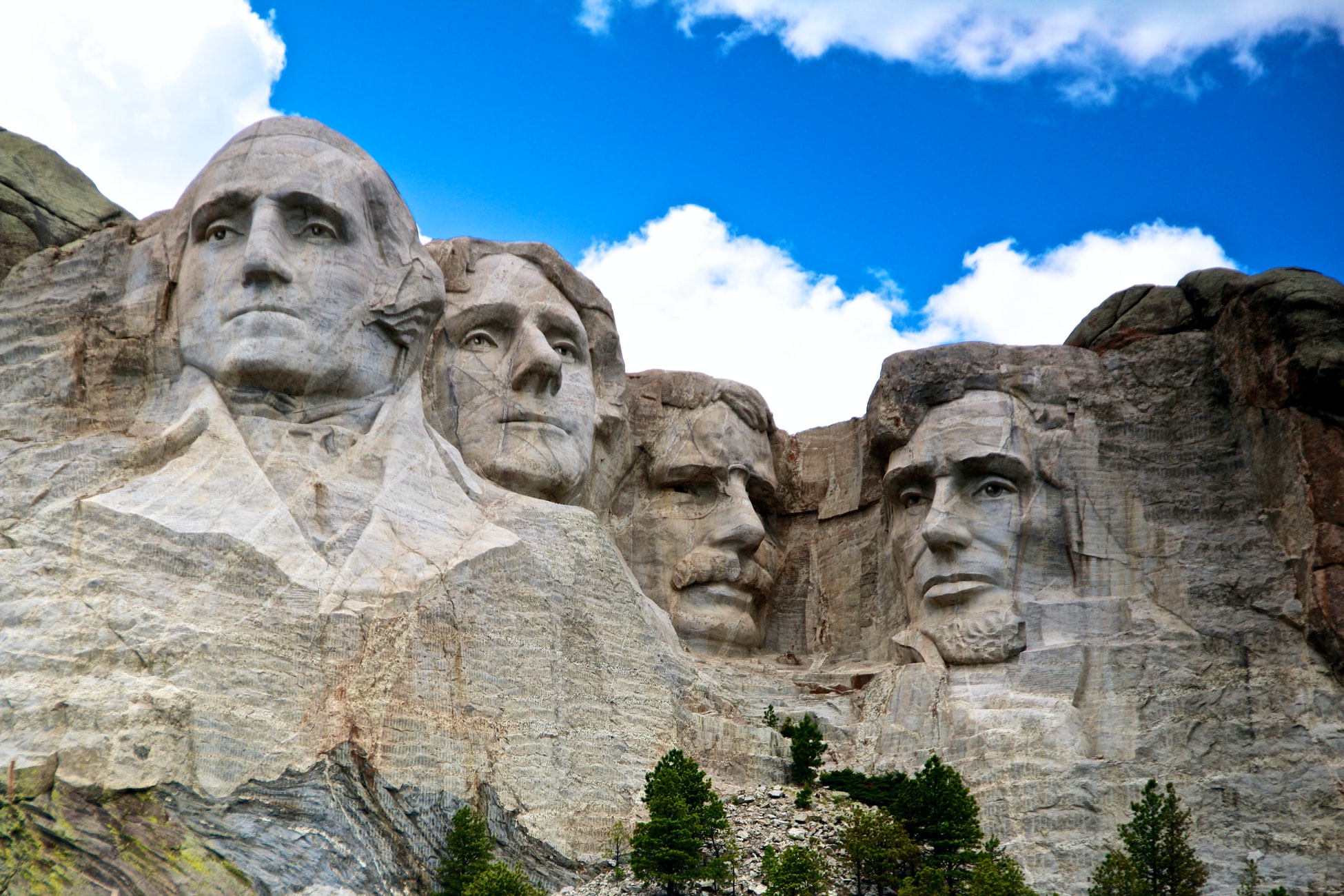
I decided to create a new series about the American Presidents, because Donald Trump lost the election in 2020 plainly speaking. 40 Years of the Reagan Revolution is now over. Frankly, if we want to move forward in America, we have to confront racism, police brutality, sexism, environmental pollution, and other evils still existing in the world (not just in America). This is a new era. Because of that, I knew that I wanted to analyze every President from George Washington to Joseph Biden. After more than two centuries, America is still here. We live in a more diverse national atmosphere culturally, socially, and politically than during the late 18th century. Yet, we exist now to advocate for the sacrosanct principle that justice is meant for all people without any exceptions. Presidents reflect the imperfections of America and the massive changes during the evolution of American society too. America has always existed in controversy. The first President George Washington was a notorious slave owner, Freemason, and signed a Fugitive Slave Act to allow vigilantes to kidnap black people who desire liberation. 


This fact ought to be known in history books, but some reactionaries in Texas including in other states enjoy historical revisionism (even some in the Texas Senate desire to omit calling KKK an evil group in textbooks. The KKK is a terrorist, racist group period) instead of truth. That is why I created this series, so people globally can witness the reality that good people and wicked people lived in America. In that sense, real progressive change can earnestly come about. People have every right to resist a capitalist system that promote poverty wages, billionaires having trillions of dollars of benefits (without some of them paying federal taxes), and police terrorism. The evolution of American Presidents dealt with the debates on the role of government, massive historical events, political revolutions, various wars, social movements, and various laws. So, we will win in the end after this journey for our rightful liberation. 
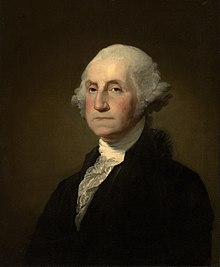


George Washington


To start with the history of the Presidency, you have to start in the beginning. Regardless of what far right conservatives or class reductionists say, America had a foundation made up of the evils of slavery and the genocide of the Native Americans. Many people back then fought for justice, and some didn't. That fact of history must always be emphasized. In order to make a better, you have to evaluate the past and the present. In the near future, I'm going to continue to describe more information that documents a summary of every President in American history. The first President of the United States was George Washington (1732-1799). He was born in my birth state of Virginia. He was not only a slave owner and President. He was a Freemason, a political leader, a statesman, and a military general. He fought in the French and Indian War, and he was the general of Patriot forces in the Americans Revolutionary War. During the beginning of the Revolutionary War, the Patriot forces suffered heavily until later on via better training and assistance from France including Spain. George Washington was also the person who presided at the Constitutional Convention of 1787. The Convention helped to form the Constitution of the United States. The growth of the federal government existed. Me personally, I believe in a strong federal government as a means to advance the general welfare of all people in society. He was President from April 30, 1789 to March 4, 1797. George Washington was a member of the Virginia House of Burgesses and the 14th Chancellor of the College of William and Mary (at Williamsburg, Virginia). From 1749 to 1750, he was an official Surveyor of Culpepper County, Virginia. Washington worked to adopt and ratify the Constitution, and he was elected twice as President by the Electoral College. He desired a strong, well financed national government. He also was impartial when there was a fierce rivalry between cabinet members Thomas Jefferson and Alexander Hamilton. The reason for this tension caused the Federalist vs. Anti-Federalist debate. Jefferson was more sympathetic with the Anti-Federalists who wanted a strong state government and a weaker national government. Alexander Hamilton supported Federalists who wanted a strong federal government to build roads, to set up banking, and the develop more infrastructure to grow American society. Washington sanctioned the Jay Treaty. George Washington gave his Farewell Address to condemn entangling alliances and political polarization. 


George Washington is probably the most famous Freemason in American history. He joined Masonry in the Lodge at Fredericksburg, Virginia. I'm from Virginia, so Fredericksburg is in Northern Virginia near the mountains. He was 20 years old when he received the first degree (or the Entered Apprentice) on November 4, 1752. To join, he paid the lodge 2 pounds and three shillings. He was in the 2nd degree of the Fellowcraft on March 3, 1753 when he was 21 years old. On June 24, 1779, Washington attended American Union Lodge's celebration of the Feast of St. John the Baptist. The lodge was made up of officers and enlisted men in the Connecticut regiments. He visited King Solomon's Lodge in Poughkeepsie, New York on December 27, 1783. He was the presiding Masonic member on the ceremonial laying of the Masonic cornerstone of the U.S. Capitol building on September 18, 1793 (in a corn, wine, and oil ceremony). 


One of the most terrible things that George Washington did was to own slaves and make policies to protect slavery. He only freed his slaves in a 1799 will. Also, he wanted to assimilate Native Americans into Anglo-American culture which is not right as Native Americans have the right to maintain their culturally diverse identities. George Washington was part of the Anglican Church as a large percentage of Presidents are. To this day, he has been praised in locations, stamps, monuments, and other themes. He was one of the most prominent Presidents in American history. His family were made up of Virginia planters. His great grandfather, John Washington, came into Virginia in 1656 from Sulgrave, Northamptonshire, England. Washington, during his youth, was a map maker as he studied mathematics like trigonometry including land surveying. Also, George Washington is related to the Frankish King Charlemagne I. On January 6, 1759, he married Martha Dandrige Custis. Washington opposed the British Parliament over the Stamp Act of 1765, over taxation without representation, and the Proclamation Act of 1763 (which forbid American settlements west of the Allegheny Mountains and protected the British flur trade). Washington opposed black people to join the Continental Army until the Dunmore Proclamation (that promised freedom to black slaves if they joined the British). It was only on January 16, 1776 when Congress allowed free black people to be in the American militia. By the end of the war, one-tenth of Washington's army were black human beings. 

As President, George Washington talked to people in his cabinet for advice. He rejected political divisiveness, but he believed in a strong central government. He had to deal with a military, budget, and other issues. Congress made many executive departments in 1789 like the State Department, the Treasury Department, and the Department of War. Washington did terrible things on the issue of slavery. He denied citizenship to black immigrants, slaves were barred from serving in state militias, and he admitted more slavery states. He signed the Fugitive Slave Act of 1793 to allow agents to kidnap slaves and bring them back into slavery. George Washington wanted Thomas Jefferson and Alexander Hamilton to have a true in their disagreements. He failed. Washington rejected Jefferson after his support of Freneau's National Gazette. By his 2nd term, he was neutral involving the French Revolution. Many of Washington's slaves escaped like Ona Judge to Portsmouth, Virginia and Hercules to Philadelphia. Washington knew slavery was evil, but he felt that radical change to eliminate slavery would end the Republic. That argument is of course wrong as freedom should be for all people regardless. Washington's will freed all of his slaves after the death of his wife Martha. Martha signed and order freeing slaves in 1801. George Washington wanted to leave office in 2 terms. He died by having a cold and it escalated massively. He lost much blood and passed away. He was 67 years old. Some believed that he died from epiglottis. He was buried at Mount Vernon, Virginia. 


John Adams


John Adams was the second American President. He lived from 1735 to 1826. As a statesman, attorney, diplomat, writer, and leader of the American Revolution, he was involved in very historic events. His wife was Abigail Adams, and his adviser was Thomas Jefferson. John Adams have had a long career in government. He was the 1st Vice President and the 1st United States Minister to the United Kingdom. He was the Chairman of the Maine Committee and the Delegate from Massachusetts to the Continental Congress. He was born in Braintree, Massachusetts. Harvard was where he was educated. He ironically defended British soldiers against the charge of murder from the Boston Massacre. He worked to draft the Declaration of Independence in 1776. Adams was the main author of the Massachusetts Constitution in 1780 that influenced the American Constitution. His essay of Thoughts on Government influenced political thought to this very day in 2021. As part of the Federalist Party, he was in opposition to the Jeffersonian republicans. John Adams was wrong to sign the Alien and Sedition Acts that violated human civil liberties. He helped to build up the Army and the Navy in the Quasi War with France. He was the first President to live in the White House. He was a friend to Thomas Jefferson. Of the first 12 U.S. Presidents, John Adams and his son were the only Presidents who never owned slaves. Adams's great great grandfather Henry Adams immigrated to Massachusetts from Baintree, Essex, England in ca. 1638. Adams was in a family of Puritans. His father was a deacon. He knew of the classics like Thucydides, Plato, Cicero, and Tacitus. John Adams was a lawyer before he was President. He supported the Boston Tea Party protest and he was a member of the Continental Congress. 


John Adams wanted American independence. He was part of the Second Continental Congress too. John Adams worked in diplomacy as a commissioner to France. Adams disagreed with Benjamin Franklin on how to deal with French relations. He didn't want a Franco-American alliance while Franklin did. He was a President later on. He suffered the XYZ Affair. John Adams wanted to be neutral involving France and England. Jefferson supported France, and Hamilton supported the UK. Thomas Jefferson was his vice President, and ironically Jefferson would defeat him in a Presidential race.  John Adams retired after 1801. John Adams believed in republicanism, bicameral Congress, and the separation of powers among executive, judicial, and legislative branches. John Adams became a follower of  Unitarianism. He publicly didn't like slavery, but he refused to support legal policies to abolish slavery. His wife publicly opposed slavery. John Adams was a Federalist, but he had his own thinking on many issues. 


Thomas Jefferson


As the third President of America, Thomas Jefferson's life and legacy has been debated. Thomas Jefferson was a very controversial man. He was a diplomat, a lawyer, a slaveholder, an architect, a musician, a philosopher, and he was vice President under President John Adams from 1797 to 1801. He believed in republicanism, individual rights (except for certain people, and you know what I mean. People who look like me), and promoted independence against Great Britain. He was a more conservative person on economic issues. He was a delegate from Virginia to the Continental Congress, the 2nd Governor of Virginia, and the delegate from Virginia to the Congress of the Confederation. He was the United States of Secretary of State and the 2nd United States Minister to France. Thomas Jefferson is an open book. He was a Virginia legislator who drafted a state law for religious freedom. Back then, many Baptists and other religious minorities were oppressed by the Church of England in Virginia. Numerous Baptists were thrown into prison in Virginia centuries because of opposition to baptizing infants. Therefore, the religious liberty law in Virginia rightfully states that a human being has the right to believe as he or she desires without oppression. Jefferson and James Madison formed the Democratic Republican Party to oppose the Federalist Party. Madison and Jefferson believed in the states' rights doctrine. He promoted the nullifying the federal Alien and Sedition Acts. 

He fought against the Barbary pirates, and he supported the Louisiana Purchase in 1803 that doubled the nation's size by theft without any consideration of the Native Americans tribes in the North American continent. Jefferson was a planter in his life. He surveyed many lands. Jefferson was part of the American Philosophical Society. He rejected organized religion denying the miracles of Jesus Christ by viewing him as only a great moral teacher. In the Christian faith, Jesus Christ was more than a moral teacher. He was the Son of the living God who saved the sins of the whole world. Thomas Jefferson believed in the views and teachings of the Enlightenment. He owned over 60 slaves, and he was a racist viewing black people as genetically and intellectually inferior (as found in his book about Virginia). Thomas Jefferson knew Sally Hemings, who was a multiracial slave. DNA evidence proved that Jefferson probably fathered at least six children with Hemings, including 4 that survived to adulthood. Evidence finds that Jefferson started his activities with Hemings when she was only 14 while he was 44 at Paris, France. Hemings was pregnant when she was 16 years old. Sally Hemings was born in Virginia.


By the time he was 16 years old, Thomas Jefferson studied at the College and Mary in Williamsburg, Virginia. He studied mathematics, metaphysics, and philosophy under Professor William Small. Small promoted empiricists like John Locke, Francis Bacon, and Sir Isaac Newton. Empiricists believe that what can be seen and researched directly relates to real evidence. Jefferson read literature on law, philosophy, history, religion, science, and agriculture. His library was made up of hundreds of books at first and he had over 1,200 titles by 1773 and grew to almost 6,500 volumes by 1814. On January 1, 1772, Thomas Jefferson married his 3rd cousin Martha Wayles Skelton. He had 6 children with Martha. He helped to finished Monticello. He was the primary author of the Declaration of Independence despite having the contradiction of being a slaveholder. Thomas Jefferson was President by March 4, 1801 when he was sworn in by Chief Justice John Marshall at the new Capitol in Washington, D.C. Jefferson ended the whiskey tax. He grew the military by investing in the U.S. Military Academy at West Point. He promoted the Lewis and Clark Expedition of the western side of North America. He wanted Native Americans to be assimilated into Western society. 

He had his 2nd term in 1804. John Randolph was once Jefferson's ally who accused Jefferson of moving too much into the Federalist direction. Jefferson wanted national roads and canals in 1808. Jefferson opposed the international slave trade in the 1800's. Jefferson accused Burr of treason for attempting to make a military response in America. Burr was found not guilty by Jefferson's political foe John Marshall. Thomas Jefferson, after he was President, sold his books to the Library of Congress. He founded the built the University of Virginia. He communicated with many country leaders. Thomas Jefferson wrote letters in Monticello visited by tourists constantly. He reconciled with John Adams before his death. Thomas Jefferson and John Adams exchanged letters to discuss issues, debate topics, and focus on other things. Thomas Jefferson met the Marquis de Lafayette before Jefferson's death at 1824. Jefferson and Madison gave Lafayette a tour of the University of Virginia. He died on July 4, 1826 on the 50th year anniversary of the Declaration of Independence. He freed Sally Heming's children in his instructions. Jefferson admitted that slavery was a moral evil that the nation will have to account to God for, but he issued contradictory responses to slavery (which was his error. He even opposed the Haitian Revolution). Jefferson was a farmer and inventor. Thomas Jefferson was a man who made numerous accomplishments, but he also was wrong in his promotion of racism and his refusal to be courageous on the issue of slavery. 


James Madison


James Madison, as the 4th President, was born at Belle Grove in Virginia. He was a diplomat, an  expansionist, a philosopher, a statesman, and one of the Founders. He was President from 1809 to 1817. He played a large role in drafting and promoting the Constitution of the United States and the United States Bill of Rights. The Federalist Papers have James Madison being one of its authors, and he co-founded the Democratic-Republican Party. He was the United States Secretary of States from 1801 to 1809. James Madison was part of the U.S. House of Representatives form Virginia, he was a Delegate from Virginia to the Congress of the Confederation, and he was married to Dolley Todd. His family was part of a Virginia planter family. His parents were James Madison Sr. and Nelly Conway Madison. His father owned over 100 slaves, and he was a tobacco farmer. James Madison, as a child, studied mathematics, geography, and modern including classical languages. Latin is the language that he was proficient in. In 1769, he attended Princeton at New Jersey. He debated people at college and learned theology, the works of the Enlightenment, Latin, and Greek. James Madison was heavily influenced by the Enlightenment teachings. He had extensive experience of politics like being in the Virginia House of Delegates and being part of the Continental Congress. He didn't want a weak national government as found in the Articles of Confederation. He helped to organize the Constitutional Convention that supplant the Articles of Confederation. When the Revolutionary War existed, he joined the Patriot cause. The Loyalists were allies of King George III. He wanted a close alliance between America and France. He worked with Thomas Jefferson to form the Virginia Statue for Religious Freedom. This disestablished the Church of England by 1786. 


The Federalist Papers was made up by him, Alexander Hamilton, and John Jay. The Federalist Papers helped people to understand the Constitution more with social commentaries on political topics. He was close advisor to George Washington. The Bill of Rights guarantees personal freedoms and rights that he helped to established. By the early 1790's, he disagreed with Secretary of Treasury Alexander Hamilton's economic plans and centralization of power views. He worked with Thomas Jefferson to form the Democratic-Republican Party. Hamilton was part of the Federalist Party. Under President Jefferson, Secretary of State James Madison supervised the 1803 Louisiana Purchase that doubled America's size. Madison was President in 1809. After diplomatic protests and a trade embargo failed to end British seizures of American shipping, President Madison led America into the War of 1812. Many Federalists and some Democratic-Republicans from the Northeast opposed the war. America tried to invade Canada, but they failed by General William Hull surrendering to British including Native American forces at Detroit (on August 16). The war ended in an inconclusive fashion. Some Americans saw it as a 2nd war of independence against Britain. General Jackson defeated the British at the Battle of New Orleans on January of 1815. This comes during the time when the Treaty of Ghent was signed ending the War of 1812. Madison was later convinced that a stronger federal government must be established. That is why he formed the Second Bank of the United States. He promoted the protective tariff of 1816. By treaty of war, Madison's Presidency added 23 million acres of Native American land to America. He retired form public office in 1817, and he died in 1836 at Virginia. James Madison never privately reconciled his Republican beliefs with his slave ownership. James Madison believed in the silly notion that Native Americans must assimilate into farmers and embrace American/British civilization in order to be "whole." In private, Madison was racist to assume that Native Americans aren't civilized people. James Madison retired by politics by 1817 being 65 years old. Madison advised Presidents, and he privately disagreed with the North's opposition to the expansion of slavery as found in the debate of Missouri Compromise. Madison didn't agree with the nullification movement, and he said that no state had the right to secede. He helped Jefferson to create the University of Virginia. James Madison, by the time of his passing, was concerned about how future generations of people would think of him. So, he edited letters, inked out original passage, etc. He died of congestive heart failure by June 28, 1836 at the age of 85.  


James Monroe


James Monroe was the 5th President of the United States of America. He was a lawyer, a statesman, a diplomat, and a Founder. He was President from 1817 to 1825. He was part of the Democratic Republican Party. He was the last President of the early Virginia dynasty. He lived in the Era of Good Feelings. People know him for his Monroe Doctrine that opposed European colonialism in the Americas, but Monroe endorsed colonialism in the USA against black plus Native Americans. James Monroe was born on April 28, 1758 at Westmoreland County, Virginia. His parents are Spence Monroe and Elizabeth Jones. Spence Monroe was a slave owner. His paternal great great grandfather Patrick Andrew Monroe emigrated to America from Scotland in the mid 1600's. He was part of the ancient Scottish clan called Clan Munro. He is related to French Huguenot immigrants who came to Virginia in 1700. Monroe was a lieutenant in the 3rd Virginia Regiment of the Continental Army (during the American Revolutionary war). James Monroe was part of the surprise attack on the Hessian encampment at the Battle of Trenton on December 1776. He, George Washington, and others crossed across the Delaware River into Pennsylvania.  He was a governor of Virginia, a member of the United States Senate, and an U.S. ambassador to France and Britain. He was the 7th Secretary of State and the 8th Secretary of War. James Monroe was part of the military in the Continental Army and the Virginia Militia. He studied law under Thomas Jefferson from 1780 to 1783.  Monroe opposed the ratification of the United States Constitution. He followed the Jefferson's candidacy in the 1800 presidential election. Monroe helped to negotiate the Louisiana Purchase. He defeated the Federalist Party candidate Rufus King in the 1816 Presidential election. The Federalist Party collapsed as a national political force during the Era of Good Feelings. Monroe signed the racist Missouri Compromise. This admitted Missouri as a slave state and banned slavery from the territories north of the parallel 36'20 north. James Monroe had 3 children with his wife. He owned many slaves. Monroe knew that slavery was wrong and supported private manumission. Yet, he didn't want immediate emancipation. He claimed to want domestic tranquility while being wishy washy on slavery. He was a Governor of Virginia for many years from 1799 to 1802. 


Monroe and the Secretary of State John Quincy Adams favored a policy of reconciliation with Britain and a policy of expansionism against the Spanish Empire. In the 1819 Adams-Onis Treaty with Spain, the United States secured Florida and established its western border with New Spain. The Monroe Doctrine was formed in 1823, Monroe opposed against European intervention in the recently independent countries of the Americas with the Monroe Doctrine. Monroe was a member of the American Colonization Society. This wanted the colonization of Africa by freed slaves, and Liberia's capital of Monrovia is named after him. After his retirement in 1825, Monroe had financial difficulties. He died on July 4, 1831 in New York City. He was the last adult Revolutionary War veteran. He was a member of the Society of Cincinnati too. 
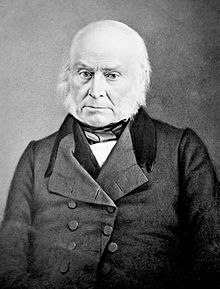


John Quincy Adams


The sixth President was John Quincy Adams (1767-1848). He was an American statesman, a diplomat, a lawyer, and a diarist. He was President of the Untied of the United States from 1825 to 1829. He was the 8th United States Secretary of State from 1817 to 1825. John Quincy Adams was the oldest son of John Adams. He was a Federalist, then a Democratic-Republican Party, and finally was affiliated with the Whig Party. His Vice President was John C. Calhoun. He was the U.S. House of Representatives member from Massachusetts, United States Senator from Massachusetts, a member of the Massachusetts Senate, the 7th United States Minister to the United Kingdom, the 1st United States Minister to Prussia, and the 3rd United States Minister to the Netherlands. Braintree, Massachusetts was the time of his birth. He was named after his mother's maternal grandfather Colonel John Quincy. Quincy, Massachusetts is named after John Quincy too. He was great in learning literary skills, and he formed his diary. He kept it until just before he died in 1848. John Quincy Adams read the works of Thucydides and Hugo Grotius. He also translated classical authors like Virgil, Horace, Plutarch, and Aristotle. John Quincy Adams graduated 2nd in his class from Harvard University in 1787. He spent time with his father, John Adams, in Europe as a child. He also formed a successful legal practice in Boston. President George Washington, in 1794, appointed him the U.S. ambassador to the Netherlands. He left the Federalist Party over foreign policy. John Quincy Adams was part of the American Philosophical Society in Philadelphia by 1818. He worked on the Adams-Onis Treaty and promoted the American acquisition of Florida. John Quincy Adams worked as an ambassador to promote neutrality. He loved his children too. John Quincy Adams opposed Jefferson on many issues, but he agreed with him on the expansionist Louisiana Purchase. John Quincy Adams wanted to confront British aggressive actions on American shipping. This caused him to distance himself from the Federalist Party. He supported the Embargo Act of 1807. 


He won the 1824 election against Andrew Jackson, William H. Crawford, and Henry Clay. John Quincy Adams, as President, wanted a federally funded infrastructure projects, the establishment of a national university, and engagement with the countries of Latin America. As President, John Quincy Adams said that the general welfare clause provided for broad constitutional authority. He wanted internal improvements of roads, ports, and canals. His Vice President was John C. Calhoun and his Secretary of State was Henry Clay. President John Quincy Adams wanted a balanced cabinet from people from the North and the South. He wanted a national university, a national observatory, and other policies. Many of his planned failed. Many canal projects were created from the Chesapeake and Ohio Canal and the Chesapeake and Delaware Canal. He believed in the "gradual assimilation" of Native Americans via consensual agreements. He wanted Westward expansion. This disregarded the concerns of Native Americans. He even suspended the Treaty of Indian Springs after learning that the Governor of Georgia, George Troup, had forced the treaty on the Muscogee. He signed the treaty with the Muscoggee, but ceded most of their lands to Georgia. Troup wanted all Native peoples out of Georgia. 


Congress defeated many of his plans. The Democratic-Republican Party was divided into 2 camps. One camp supported President Adams (called the National Republican Party), and the other camp was led by the racist Andrew Jackson (called the Democratic Party). The Democrats organized politically better than John Quincy Adams. That is why Andrew Jackson defeated Adams in the 1828 Presidential election. 


John Quincy Adams was in the House until his passing in 1848. He joined the Anti-Masonic Party in the early 1830's, because he disagreed with Freemasonry. The nullification crisis was when Southerners wanted to lower tariffs from the federal government. It was a battle of federal vs. states' rights. A compromise was made to lower tariff, but John Quincy Adams viewed the Southerners as having an undue influence on the federal government. He was the member of the Whig Party, and he disagreed with the reactionary extremist Andrew Jackson when he was President. When he was in Congress, John Quincy Adams was increasingly critical of slavery and of the Southern leaders who he believed controlled the Democratic Party. He was opposed to the annexation of Texas, and he opposed the Mexican-American War. Texas was largely settled by Americans from the South. Many of them owned slaves despite an 1829 Mexican law that abolished slavery. John Quincy Adams viewed John Tyler as an agent of pro-slavery expansion. John Quincy Adams opposed Tyler repealing the plan to re-instate a national state. 

Out of the early Presidents (from the 1700's to 1859), he was the most progressive President. He had his imperfections too. Yet, he saw the Mexican American War as a means to extend slavery and its political grip of Congress. He led the repeal of the gag rule which prevented members of the House of Representatives from debating positions to abolish slavery. He wrote that slavery was an evil. He presented citizens petition to end slavery in D.C. John Quincy Adams joined in the case of United States v. The Armistad. He was before the Supreme Court on behalf of African human beings who were kidnapped and revolted plus existed the Spanish ship Armistad. Adams appeared on February 24, 1841, and he spoke for four hours. His arguments won out. The Supreme Court ruled that the African human beings were free, and they returned to their homes. John Quincy Adams supported science.When he passed, Abraham Lincoln was with him. His last words were, "This is the last of Earth. I am content." John Quincy Adams was a very intelligent person by speaking 8 languages of English, Latin, Greek, French, German, Spanish, Italian, Dutch, and Russian.  John Quincy Adams was one of the greatest diplomats and secretaries of state in American history. 
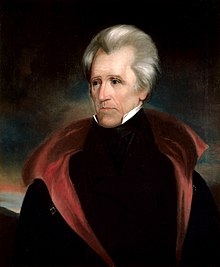


Andrew Jackson


Andrew Jackson was the 7th President of the United States. He was one of the most infamous, wicked Presidents in American history. That is why Trump said that Jackson is his role model. They are very similar indeed. He was President form 1829 to 1837. He was famous for being a General of the United States Army during the War of 1812. He was in both houses of the U.S. Congress. He promoted expansionism, sought to expand the rights of solely white men, and justified his nefarious actions as being against "a corrupt aristocracy." He claimed to want to preserve the Union, but he helped to cause division and tensions in the Union. He was a Senator from Tennessee, he was the 1st Territorial Governor of Florida, and he was a Justice of the state of Tennessee in its Supreme Court. He was a member of the Tennessee U.S. House of Representatives. He was born at Waxhaw Swettlement between North Carolina and South Carolina. Jackson was a frontier lawyer and married Rachel Donelson Robards. He was a wealthy slaveowner too. During the Revolutionary War, Jackson's eldest brother, Hugh, died from heat exhaustion after the Battle of Stono Ferry on June 20, 1779.  Anti-British sentiment intensified following the Waxhaws Massacre on May 29, 1780. Jackson's mother encouraged him and his elder brother Robert to attend the local militia drills.  Soon, they began to help the militia as couriers. They served under Colonel William Richardson Davie at the Battle of Hanging Rock on August 6. Andrew and Robert were captured by the British in April 1781 while staying at the home of the Crawford family. When Andrew refused to clean the boots of a British officer, the officer slashed at the youth with a sword, leaving him with scars on his left hand and head, as well as an intense hatred for the British. Robert also refused to do as commanded and was struck with the sword.  The two brothers were held as prisoners, contracted smallpox, and nearly starved to death in captivity.


By 1801, he was in the Tennessee militias to lead troops. He fought in the Creek War from 1813 to 1814, He helped to defeat the British during the Battle of New Orleans in 1815. He led the First Seminole War against Native people to cause the annexation of Florida from Spain. He helped to found the modern Democratic Party. He accused Adams and Henry Clay of a political bargain. Jackson ran against John Quincy Adams in 1828 to defeat him. He ended the threat of secession of South Carolina during the tariff crisis. Andrew Jackson rejected Henry Clay's proposal to form a Second Bank of the United States. Jackson viewed any national bank as a corrupt institution benefiting the wealthy at the expense of Americans. He vetoed the renewal of its charter. In 1835, he was the only President to pay off the national debt. Jackson wanted to eliminate waste and corruption. Yet, he promoted corruption by harming Native Americans and supporting slavery. In 1830, Jackson signed the Indian Removal Act, which forcibly removed most members of the major tribes of the Southeast to Indian Territory; these removals were subsequently known as the Trail of Tears. The relocation process dispossessed these nations of their land and resulted in widespread death and disease. Jackson opposed the abolitionist movement, which grew stronger in his second term. In foreign affairs, Jackson's administration concluded a "most favored nation" treaty with the United Kingdom, settled claims of damages against France from the Napoleonic Wars, and recognized the Republic of Texas. In January 1835, he survived the first assassination attempt on a sitting president.  On January 30, 1835, what is believed to be the first attempt to kill a sitting president of the United States occurred just outside the United States Capitol. When Jackson was leaving through the East Portico after the funeral of South Carolina Representative Warren R. Davis, Richard Lawrence, an unemployed house painter from England, aimed a pistol at Jackson, which misfired. Lawrence then pulled out a second pistol, which also misfired. Historians believe the humid weather contributed to the double misfiring.  

Jackson, infuriated, attacked Lawrence with his cane, until others present, including Davy Crockett, fearing that the president would beat Lawrence to a pulp, intervened to restrain and disarm Lawrence. He was deemed insane and was institutionalized at the Government Hospital for the Insane in Washington, D.C. During the summer of 1835, Northern abolitionists began sending anti-slavery tracts through the postal system into the South.  Pro-slavery Southerners demanded that the postal service ban distribution of the materials, which were deemed "incendiary," and some began to riot. Jackson wanted sectional peace, and desired to placate Southerners ahead of the 1836 election.  He fiercely disliked the abolitionists, whom he believed were, by instituting sectional jealousies, attempting to destroy the Union.  That was Jackson's lie. Jackson also did not want to condone open insurrection. He supported the solution of Postmaster General Amos Kendall, which gave Southern postmasters discretionary powers to either send or detain the anti-slavery tracts. That December, Jackson called on Congress to prohibit the circulation through the South of "incendiary publications intended to instigate the slaves to insurrection."  A unified Whig Party nominated popular war hero William Henry Harrison and former Jacksonian John Tyler in the 1840 presidential election. The Whigs' campaign style in many ways mimicked that of the Democrats when Jackson ran. They depicted Van Buren as an aristocrat who did not care for the concerns of ordinary Americans, while glorifying Harrison's military record and portraying him as a man of the people. Jackson campaigned heavily for Van Buren in Tennessee. He favored the nomination of Polk for vice president at the 1840 Democratic National Convention over controversial incumbent Richard Mentor Johnson. No nominee was chosen, and the party chose to leave the decision up to individual state electors. Jackson strongly favored the annexation of Texas, a feat he had been unable to accomplish during his own presidency. While Jackson still feared that annexation would stir up anti-slavery sentiment, his belief that the British would use Texas as a base to threaten the United States overrode his other concerns. 


In spite of economic success following Jackson's vetoes and war against the Bank, reckless speculation in land and railroads eventually caused the Panic of 1837. Contributing factors included Jackson's veto of the Second National Bank renewal charter in 1832 and subsequent transfer of federal monies to state banks in 1833 that caused western banks to relax their lending standards. Two other Jacksonian acts in 1836 contributed to the Panic of 1837: the Specie Circular, which mandated western lands only be purchased by money backed by gold and silver, and the Deposit and Distribution Act, which transferred federal monies from eastern to western state banks and in turn led to a speculation frenzy by banks. Jackson's Specie Circular, albeit designed to reduce speculation and stabilize the economy, left many investors unable to afford to pay loans in gold and silver. The same year there was a downturn in Great Britain's economy that stopped investment in the United States. As a result, the U.S. economy went into a depression, banks became insolvent, the national debt (previously paid off) increased, business failures rose, cotton prices dropped, and unemployment dramatically increased. The depression that followed lasted for four years until 1841, when the economy began to rebound.


In his retirement, Jackson remained active in Democratic Party politics, supporting the presidencies of Martin Van Buren and James K. Polk. Though fearful of its effects on the slavery debate, Jackson advocated the annexation of Texas, which was accomplished shortly before his death. His parents were Scots-Irish colonists Andrew Jackson and his wife Elizabeth Hutchinson, Presbyterians who had emigrated from Ulster, Ireland, two years earlier. Jackson's father was born in Carrickfergus, County Antrim, around 1738. Jackson's parents lived in the village of Boneybefore, also in County Antrim. His paternal ancestors originated in Killingswold Grove, Yorkshire, England. Andrew Jackson's age and illness eventually overcame him. On June 8, 1845, he was surrounded by family and friends at his deathbed. He died on that day being 78 years old. 


The End of the Beginning (Conclusion)


The early era of Presidents was born out of controversies and contradictions. These Presidents lived many centuries ago. Yet, living in an time centuries ago is never an excuse for oppression and injustice to transpire. Back then, these Presidents knew right from wrong, and they knew that slavery and genocide against indigenous peoples are evil. Yet, many of those Presidents committed overt injustices like passing Fugitive Slave Laws and refusing to support the Haitian Revolution. The early American nation had to do deal with political polarization, debates on many issues, economic issues, and expansion of its territories. George Washington was the first President, and he didn't want a political war between the Anti-Federalists and the Federalists. Yet, that battle would continue for many decades. By the time of Andrew Jackson being President, the Anti-Federalist movement didn't exist. The origin of the modern day Democrats were formed with the Republican-Democratic Party that Jackson and Jefferson supported. Even during the time of massive atrocities, heroic Americans have stood up back then to resist imperialism, to oppose slavery (that ruined millions of black lives), to reject harm done to Native Americans, and to fight against other evils. As America changed, the increasing tensions of slavery would go into the American Civil War. Even back then, many Presidents and other people knew that it (or a possible civil war in America) was coming. The Southern aristocracy refused to end slavery, and abolitionists were uncompromising in their goal of abolishing slavery forevermore. Also, early America was diverse. Back in the 1700's and 1800's, there were women, black people, Latino people, immigrants, and other diverse folks who made monumental contributions in American society. So, the next era of Presidents from Martin Van Buren to Franklin Pierce described the fight for the abolition of slavery growing. 


By Timothy

Fall 2021


Fall 2021  


As we enter the quarter-century mark of the 21st century, new events and old challenges remain. The Fall of 2021 is here. We live in a time that the Earth is rapidly heating up with an urgency to do something about climate change. We have political polarization and racial tensions. There were heroic souls from Texas who fought against unjust voter suppression in Texas. They came into Washington, D.C. These brave people wanted to inspire the U.S. Congress to pass federal voting rights legislation. We live in a time where controversies flourish, and people debate on cancel culture. Yet, there always remains a remnant of the dedicated human beings who follow justice, compassion, and integrity. Long ago, some of our ancestors stood up against the Maafa and slavery. Some sacrificed their lives for civil, human, and voting rights. We know about the global anti-apartheid activists who fought to defeat a racist apartheid regime in South Africa. Now, we have more people desiring an end to police brutality against black human lives (just recently, there were officers charged in the death of the innocent unarmed black human being named Elijah McClain). Marginalized communities are having their voices despite the far right-wing backlash. The far-right movement is not omnipotent. Therefore, we have every right to reject their cruel agendas (of harming voting rights, of harming the rights of women, scapegoating black people, advancing xenophobia, and loving austerity measures). This Fall of 2021 makes us aware of how valuable life is. We are dealing with the variants of Delta and now Mu. Never wasting time is vital. We are certainly entitled to peace, justice, and equality. We shall see what the future holds involving the 2022 Midterms, the pandemic's future, and the economic situation in the United States of America. I will always maintain my core convictions too. 


Everyone is talking about the Hurricane Ida. It is the most powerful hurricane hitting Louisiana since Hurricane Laura in 2020. Thousands of people have fled the Gulf Coast region in order to try to survive literally. Over 1 million people have lost power in the Gulf Coast region during the initial days after Ida landed in the Gulf Coast. FEMA, the state governments, and the local governments have shown great preparedness in contrast to the federal, state, and local responses to Hurricane Katrina which happened 16 years ago. In fact, this year is the 16th anniversary of the 2005 Katrina natural disaster. The concern is about many issues from flooding, power outages, and other matters. The levees being about 18 feet in New Orleans have given New Orleans added protection. With new technologies from I Phones to social media, communication is quicker and more widespread. Throughout the week, the storm did travel up the Delta into West Virginia, Virginia, and other places of America. This storm was as fast as 150 mph with wind gusts of 185 mph. Ida making landfall is a reality. It was a tropical storm now moving quickly. People are waiting to see if the pumping prevented more damage to New Orleans. The pumps and leeves did work in New Orleans, but the wind damage has been catastrophe in the South. The devastation has been horrendous in Houma, Louisiana. Charities and other organizations are helping the victims of Ida constantly. President Biden has given Louisiana federal aid after the Governor of Louisiana has requested it. 

There should be more of an analysis of the historic flooding of the Northeast, including of New York City by the storm of Ida. The storm was historic in causing New York City to have its first flash flood emergency in history. In New York City, there has been massive flooding in subways, in Queens, in Brooklyn, in the Bronx, and in Central Park. Many people were stuck on trains and in subways without electricity, ventilation, food or water. Thousands of people were stranded. Flooding also existed in Connecticut, New Jersey, and in Philadelphia. More than 11 people have lost their lives via the weather. The weather is a reflection of the climate change reality that has made the world warmer in general. For decades, the Earth's temperature has increased by the increase of CO2 levels. Even back in the 1960's, scientists have warned the public about global warming. New York has a state of emergency. The New York Fire Department rescued hundreds of people from subways stations and in other locations. New York Governor Hochul has shown great leadership in the situation.


Senator Joe Manchin proves once again why many moderates have been disgraceful. Now, he wants a pause before the Biden $3.5 trillion bill is enacted. Manchin doesn't like the price tag. He should tell that to the members of his own state (of West Virginia) suffering or the victims of the storm of Ida in the South and in the North. Moderates don't get that extreme situations cause for progressive measures to rectify problems. Manchin doesn't agree with the time-frame that Democrats have proposed. He doesn't believe that people should spend trillions of new government programs and new stimulus funding when men, women, and children in many cases are evicted from their own homes. Many human beings have their homes destroyed via historic natural disasters tragically. Callousness defines not only reactionary views but moderation. Moderation never did a single thing to end the Confederacy or Jim Crow apartheid. Dr. Martin Luther King Jr., Malcolm X, Harriet Tubman, Steve Biko, and other heroes weren't moderates. They were progressive men and women who sought an end to injustice, so goodness can flourish in the Universe. Senator Krysten Sinema is just like Manchin. The filibuster is nothing more than an equivalent to nullification from the old days. It's archaic, and it should be thoroughly abolished 100 percent. There should be no delay in our freedom. There should be passage of the For the People Act, the John Lewis Voting Rights Advancement Acts, the living wage (of $15 dollars an hour), infrastructure laws, and other things that will help the lives of millions of Americans. We have the largest attacks on our democracy (including racist voter suppression laws) since the American Civil War. It's that serious, as America has more voting rights protections in 1965 than in 2021. That is a shame. Therefore, the urgency is now.


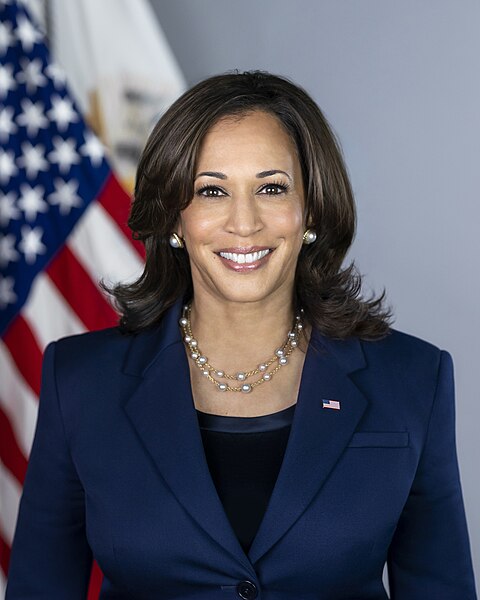
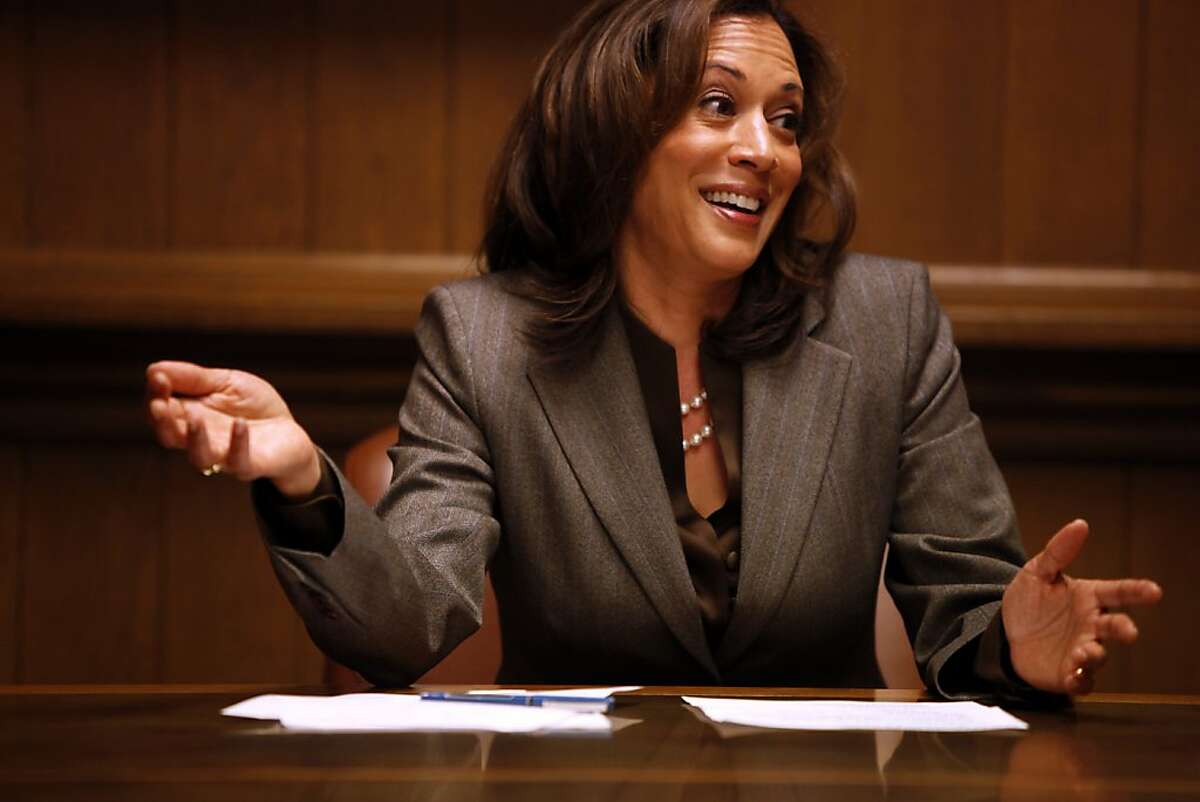
Kamala Harris


History is made by her is real. She led a life filled with rising above the political world. She is a part of America despite what anyone says. Her father is an Afro-Jamaican man, and her mother was an Indian American woman. Kamala Harris has a wide-ranging cultural experience. She worshiped at a Baptist church. Harris sang music at a Hindu Temple. Also, she graduated from the prominent Historically Black University of Howard University. Afterward, Harris earned her legal degree to be a powerful lawyer. Kamala Harris has always been an expert of legal policies and political debates. This work will describe her life, her accomplishments, her errors, and her inspirational power for many women who desire their dreams to be fulfilled. Without women, there is no human life. So, in order for justice to exist, we have to walk side by side women as equal human beings in building up our communities via love for humanity. That is certainly real talk. Over many years, we have had massive changes in American society. No one should sugarcoat her life, and we reject the falsehoods about her life as well. From being a United States Senator to be the first black American and South Asian Vice President of the United States of America, her historical rise to power has been extremely historic. With her charisma, intellect, convictions, and activism, her story has the right to be presented to the world. Also, it is important to promote our independent thinking. We believe in reparations for black people in America, we believe in policies to address economic inequality, we believe in justice for black farmers, and we reject imperialism 100 percent. 


The Beginning of Kamala Harris' Life


To understand Vice President Kamala Harris's life, you have to start from the beginning. In the beginning, Kamala Devi Harris was born in Oakland, California on October 20, 1964. Her mother was Shyamala Gopalan, who was a biologist whose work on the progesterone receptor gene stimulated advances in breast cancer researcher. Shyamala came into America from India in 1958 as a 10 year old graduate student in nutrition and endocrinology at the University of California, Berkeley. Gaopalan received her PhD. in 1964. Harris's father is Donald J. Harris. Donald J. Harris is a Stanford University professor emeritus of economics. He arrived from the United States from Jamaica in 1961 for graduate study at UC Berkeley, receiving a PhD. in economics in 1966. He is of Afro-Jamaican descent. Donald Harris and Shyamala Gopalan met via the Civil Rights Movement. The Civil Rights Movement changed the whole world, beyond changing America alone. Kamala Harris and her younger sister Maya lived in Berkeley, California during and after her parents' studies. They stayed briefly on Milvia Street in central Berkeley, then at a duplex on Bancroft Way in West Berkeley, That area is called the flatlands with a large black population. When Kamala Harris was in kindergarten, she was bused as part of Berkeley's comprehensive desegregation program to Thousand Oaks Elementary School, a public school in a more prosperous neighborhood in northern Berkeley which was previously 95 percent white. After the desegregation plan went into effect, northern Berkeley became 40 percent black American. A neighbor regularly took the Harris girls to an African American church in Oakland where they sang in the children's choir. The girls and their mother also frequently visited a nearby African American cultural center. Their mother introduced them to Hinduism by taking them to a nearby Hindu temple where she occasionally sang. As children, she and her sister visited their mother's family in Madras (now Chennai, India. It said by some that the apostle Thomas meant into India too) many times. Kamala Harris said that she was heavily influenced by her maternal grandfather P.V. Gopalan, a retired Indian civil servant shoe progressive views on democracy and women's rights impressed her. Kamala Harris has always remained in touch with her Indian aunts and uncles all over her adult life. Harris has also visited her father's family in Jamaica. 


When she was 7 years old, her parents divorced. Kamala Harris said that when she and her sister visited their father in Palo Alto on weekends, other children in the neighborhood were not allowed to play with them because they were black. When she was 12, Harris and her sister moved with their mother to live in Montreal Quebec, where Shyamala had accepted a research and teaching position at the McGill University-affiliated Jewish General Hospital. Harris attended a French-speaking primary school, Notre-Dame-des-Neiges, then F.A.C.E. School, and finally Westmount High School in Westmount, Quebec, graduating in 1981. Wanda Kagan, a high school friend of Harris, later told CBC News in 2020 that Harris was her best friend and described how she confided in Harris that she had been molested by her stepfather. She said that Harris told her mother, who then insisted Kagan come to live with them for the remainder of her final year of high school. Kagan said Harris had recently told her that their friendship, and playing a role in countering Kagan's exploitation, helped form the commitment Harris felt in protecting women and children as a prosecutor. After high school, in 1982, Harris attended Howard University, a historically black university in Washington, D.C. While at Howard, she interned as a mailroom clerk for California senator Alan Cranston, chaired the economics society, led the debate team, and joined Alpha Kappa Alpha sorority. Harris graduated from Howard in 1986 with a degree in political science and economics. Kamala Harris then returned to California to attend law school at the University of California, Hastings College of the Law through its Legal Education Opportunity Program (LEOP).  While at UC Hastings, she served as president of its chapter of the Black Law Students Association. She graduated with a Juris Doctor in 1989  and was admitted to the California Bar in June 1990. Therefore, the early part of Kamala Harris's life is characterized by huge accomplishments. 


Her Early Career


Later in Kamala Harris's life, she was a deputy district attorney in Alameda County, California in 1990. This was where she was described as "an able prosecutor on the way up." In 1994, Speaker of the California Assembly Willie Brown appointed her to the state Unemployment Insurance Appeals Boards and later to the California Medical Assistance Commission. It is no secret that Willie Brown once dated Kamala Harris during this time. Harris took a 6 month level of absence in 1994 from her duties. Then, she resumed as prosecutor during the years she sat on boards. Harris has defended her work. By February 1998, San Francisco district attorney Terence Hallinan recruited Harris as an assistant district attorney. Kamala Harris became the chief of the Career Criminal Division. So, she supervised five other attorney where she prosecuted homicide, burglary, robbery, and sexual assault cases. There were three strikes cases too. By 2000, Harris reportedly clashed with Halinan's assistant Darrell Salomon over Proposition 21. This policy granted prosecutors the option of trying juvenile defendants in Superior Court rather than juvenile courts. Kamala Harris campaigned against the measure, which passed. Salomon opposed directing media inquiries about Proposition 21 to Harris. He reassigned Harris or a de facto demotion. Harris filed a complaint against Salomon and quit. By August 2000, Harris took a job at San Francisco City Hall. She worked for city attorney Louise Renee. Harris ran the Family and Children's Services Division representing child abuse and neglect cases. Renne endorsed Harris during her D.A. campaign. 


Being  District Attorney of San Francisco


By 2002, Kamala Harris prepared to run for District Attorney of San Francisco against Hallinan (the incumbent) and Bill Fazio. Harris and Hallinan advanced to the general runoff with 33 and 37 percent of the vote respectively. In the runoff, Harris pledged never to seek the death penalty and to prosecute three-strike offenders only in cases of violent felonies.  Harris ran a "forceful" campaign, assisted by former mayor Willie Brown, Senator Dianne Feinstein, writer and cartoonist Aaron McGruder, and comedians Eddie Griffin and Chris Rock.  Harris differentiated herself from Hallinan by attacking his performance.  She argued that she left his office because it was technologically inept, emphasizing his 52 percent conviction rate for serious crimes despite an 83 percent average conviction rate statewide. Harris charged that his office was not doing enough to stem the city's gun violence, particularly in poor neighborhoods like Bayview and the Tenderloin, and attacked his willingness to accept plea bargains in cases of domestic violence. Harris won with 56 percent of the vote, becoming the first person of color elected as district attorney of San Francisco. Kamala Harris ran unopposed for a 2nd term in 2007. 


Kamala Harris made many contributions as San Francisco district attorney. In 2005, she organized an environmental crimes unit. By 2007, she and city attorney Dennis Herrera investigated San Francisco supervisor Ed Jew for violating residency requirements necessary to hold his supervisor position.  Harris charged Jew with nine felonies, alleging that he had lied under oath and falsified documents to make it appear he resided in a Sunset District home, necessary so he could run for supervisor in the 4th district.  Jew pleaded guilty in October 2008 to unrelated federal corruption charges (mail fraud, soliciting a bribe, and extortion). Ed pleaded guilty the following month in state court to a charge of perjury for lying about his address on nomination forms, as part of a plea agreement in which the other state charges were dropped. Jew agreed to never again hold elected office in California.  Harris described the case as "about protecting the integrity of our political process, which is part of the core of our democracy." For his federal offenses, Jew was sentenced to 64 months in federal prison and a $10,000 fine. For the state perjury conviction, Jew was sentenced to one year in county jail, three years' probation, and about $2,000 in fines. Under Harris, her D.A. office got more than 1,900 convictions for marijuana offenses including people simultaneously convicted of marijuana offenses including serious crimes. The rate at which Harris's office prosecuted marijuana crimes was higher than the rate under Hallinan, but the number of defendants sentenced to state prison for such offenses was substantially lower.  Prosecutions for low-level marijuana offenses were rare under Harris, and her office had a policy of not pursuing jail time for marijuana possession offenses.  Harris's successor as D.A., George Gascón, expunged all San Francisco marijuana offenses going back to 1975.


By the early 2000's, Kamala Harris had to deal with crime. The murder rate in San Francisco per capita outpaced the national average. She had a high rate of convictions for homicides and felony gun violations. She fought for higher bail for criminal defendants involved in gun related crimes. Kamala Harris made a gun crime unit. Harris opposed releasing defendants on their own recognizance if they were arrested on gun crimes, sought minimum 90-day sentences for possession of concealed or loaded weapons, and charged all assault weapons possession cases as felonies, adding that she would seek prison terms for criminals who possessed or used assault weapons and would seek maximum penalties on gun-related crimes. It's not a secret that Harris formed a Hate Crimes Unit to fight hate crimes against LGBT kids and teens in schools. Harris supported the Gwen Araujo Justice for Victims Act (which is named after the 17 year old American transgender human being named Gwen Araujo who was murdered by 2 evil men).  In September 2006, California governor Arnold Schwarzenegger signed A.B. 1160 into law; the law put California on record as declaring it contrary to public policy for defendants to be acquitted or convicted of a lesser included offense on the basis of appeals to "societal bias." Harris supported the ban on gun shows at Cow Palace. It would be until 2019 when the Cow Palace Board of Directors voted to make a statement banning all future gun shows.


Kamala Harris had said that she doesn't agree with the death penalty and wants life without parole as the highest punishment. She believes that it is a cost saving measure. After the officer Isaac Espinoza was shot and killed in San Francisco, Kamala Harris refused to support the death penalty. U.S. Senator Dianne Feinstein, U.S. Senator Barbara Boxer, Oakland mayor Jerry Brown, and the San Francisco Police Officers Association wanted Kamala Harris to support the death penalty. Yet, Harris refused to do so. Polls show that 70 percent of voters supported Harris's decision. When Edwin Ramos, an undocumented person and alleged MS-13 gang member, was accused of murdering a man and his two sons in 2009, Harris sought a sentence of life in prison without parole, a decision Mayor Gavin Newsom backed. There is the recidivism issue. In 2004, Harris recruited civil rights activist Lateefah Simon to form the San Francisco Reentry Division. This was a flagship program part of the Back on Track initiative, a first-of-its-kind reentry program for first-time nonviolent offenders aged 18–30. Initiative participants whose crimes were not weapon- or gang-related would plead guilty in exchange for a deferral of sentencing and regular appearances before a judge over a twelve- to eighteen-month period. The program maintained rigorous graduation requirements, mandating completion of up to 220 hours of community service, obtaining a high-school-equivalency diploma, maintaining steady employment, taking parenting classes, and passing drug tests. At graduation, the court would dismiss the case and expunge the graduate's record.  Over six years, the 200 people graduated from the program had a recidivism rate of less than ten percent, compared to the 53 percent of California's drug offenders who returned to prison within two years of release. Back on Track earned recognition from the U.S. Department of Justice as a model for reentry programs. The DOJ found that the cost to the taxpayers per participant was markedly lower ($5,000) than the cost of adjudicating a case ($10,000) and housing a low-level offender ($50,000). In 2009, a state law (the Back on Track Reentry Act, A.B. 750) was enacted, encouraging other California counties to start similar programs. Adopted by the National District Attorneys Association as a model, prosecutor offices in Baltimore, Philadelphia, and Atlanta have used Back on Track as a template for their own programs.


There was the truancy issue too. By 2006, there was an initiative to reduce the city's skyrocketing homicide rate. Harris led a city wide effort to stop truancy for at risk elementary school youth in San Francisco. This program would be debated to this very day in 2021. Declaring chronic truancy a matter of public safety and pointing out that the majority of prison inmates and homicide victims are dropouts or habitual truants, Harris's office met with thousands of parents at high-risk schools and sent out letters warning all families of the legal consequences of truancy at the beginning of the fall semester. Kamala Harris said that she would prosecute the parents of chronically truant elementary students; penalties included a $2,500 fine and up to a year in jail. The program was controversial when introduced. In 2008, Harris issued citations against six parents whose children missed at least fifty days of school, the first time San Francisco prosecuted adults for student truancy. San Francisco's school chief, Carlos Garcia, said the path from truancy to prosecution was lengthy, and that the school district usually spends months encouraging parents through phone calls, reminder letters, private meetings, hearings before the School Attendance Review Board, and offers of help from city agencies and social services. Two of the six parents entered no plea, but said they would work with the D.A.'s office and social service agencies to create "parental responsibility plans" to help them start sending their children to school regularly. By April 2009, 1,330 elementary school students were habitual or chronic truants, down 23 percent from 1,730 in 2008, and down from 2,517 in 2007 and from 2,856 in 2006. Harris's office prosecuted seven parents in three years, with none jailed.


Kamala Harris as Attorney General of California


Nearly 2 years before the 2010 election, Kamala Harris announced that she planned to run for the Attorney General of California. She also said that she would only run if then-Attorney General Jerry Brown didn't seek re-election for that position. Brown chose to run for Governor, and Harris gained support from California Democrats. Both of California's senators, Dianne Feinstein and Barbara Boxer, House Speaker Nancy Pelosi, United Farm Workers cofounder Dolores Huerta, and mayor of Los Angeles Antonio Villaraigosa all endorsed her during the Democratic primary. On the date of the June 8, 2010 primary, she was nominated with 33.6 percent of the vote, defeating Alberto Torrico and Chris Kelly. During the general election, she faced Republican Los Angeles County district attorney Steve Cooley. Cooley led most of the race. Cooley ran as a nonpartistan person, and he distanced himself from the gubernatorial candidate Meg Whitman's campaign. The election was held November 2 but after a protracted period of counting mail-in and provisional ballots, Cooley conceded on November 25. Harris was sworn in on January 3, 2011. Kamala Harris was the first woman, the first African American, and the first South Asian American to hold the office of Attorney General in the state's history. Harris announced her intention to run for re-election in February 2014 and filed paperwork to run on February 12.  The Sacramento Bee,  Los Angeles Daily News,  and Los Angeles Times endorsed her for re-election. On November 4, 2014, Harris was re-elected against Republican Ronald Gold, winning 57.5 percent of the vote to 42.5 percent.


One of the greatest accomplishments of Attorney General Kamala Harris was her policies on consumer protection. In 2011, Harris announced the creation of the Mortgage Fraud Strike Force. This came during the 2010 United States foreclosure crisis. In that year of 2011, Harris obtained two of the largest recoveries in the history of California's False Claims Act – $241 million from Quest Diagnostics and then $323 million from the SCAN healthcare network – over excess state Medi-Cal and federal Medicare payments. In 2012, Harris leveraged California's economic clout to obtain better terms in the National Mortgage Settlement against the nation's five largest mortgage servicers – JPMorgan Chase, Bank of America, Wells Fargo, Citigroup and Ally Bank.  The mortgage firms were accused of illegally foreclosing on homeowners. After dismissing an initial offer of $2–4 billion in relief for Californians, Harris withdrew from negotiations. The offer eventually was increased to $18.4 billion in debt relief and $2 billion in other financial assistance for California homeowners.


Kamala Harris worked with Assembly speaker John Perez and Senate President pro tem Darrell Steinberg in 2013 to introduce the Homeowner Bill of Rights. It was considered one of the strongest protections nationwide against aggressive foreclosure tactics. The Homeowner Bill of Rights banned the practices of "dual-tracking" (processing a modification and foreclosure at the same time) and robo-signing and provided homeowners with a single point of contact at their lending institution. Then California Attorney General achieved multiple nine figure settlements for California homeowners under the bill mostly for robo-signing and dual track abuses. She prosecuted instances in which loan processors failed to promptly credit mortgage payments, miscalculated interest rates, and charged borrowers improper fees. Harris secured hundreds of millions in relief, including $268 million from Ocwen Financial Corporation, $470 million from HSBC, and $550 million from SunTrust Banks. From 2013 to 2015, Harris pursued financial recoveries for California's public employee and teacher's pensions, CalPERS and CalSTRS against various financial giants for misrepresentation in the sale of mortgage-backed securities. She secured multiple nine-figure recoveries for the state pensions, recovering about $193 million from Citigroup, $210 million from S&P, $300 million from JP Morgan Chase, and over half a billion from Bank of America. 


By 2013, she didn't authorize a civil complain draft by state investigators who accused One West Bank (owned by Steven Mnuchin) of violation of California foreclosure laws. Harris received a donation from Mnuchin. She was criticized as Mnuchin was accused of being profited form the subprime mortgage crisis via OneWest Bank. She voted against his confirmation as treasury secretary in February 2017. In 2019, Harris's campaign stated that the decision not to pursue prosecution hinged on the state's inability to subpoena OneWest. Her spokesman said, "There was no question OneWest conducted predatory lending, and Senator Harris believes they should be punished. Unfortunately, the law was squarely on their side and they were shielded from state subpoenas because they're a federal bank." Kamala Harris worked on criminal justice reform too as Attorney General of California too. Kamala Harris was a trailblazer  California Attorney General indeed. 


In November 2013, Harris launched the California Department of Justice's Division of Recidivism Reduction and Re-Entry in partnership with district attorney offices in San Diego, Los Angeles, and Alameda County  In March 2015, Harris announced the creation of a pilot program in coordination with the Los Angeles County Sheriff's Department called "Back on Track LA". Like Back on Track, first time, non-violent, non-sexual, offenders aged between 18 and 30. 90 men participated in the pilot program for 24–30 months. Assigned a case manager, participants received education through a partnership with the Los Angeles Community College District and job training services. Some people have criticized Harris's record on wrongful conviction cases as Attorney General. 


Law professor Lara Bazelon contends Harris "weaponized technicalities to keep wrongfully convicted people behind bars rather than allow them new trials." After the 2011 United States Supreme Court decision in Brown v. Plata declared California's prisons so overcrowded they inflicted cruel and unusual punishment, Harris fought federal supervision, explaining "I have a client, and I don't get to choose my client."  Harris declined to take any position on criminal sentencing-reform initiatives Prop 36 (2012) and Prop 47 (2014), arguing it would be improper because her office prepares the ballot booklets.  John Van de Kamp, a predecessor as attorney general, publicly disagreed with the rationale. In September 2014, Harris's office argued unsuccessfully in a court filing against the early release of prisoners, citing the need for inmate firefighting labor. When the memo provoked headlines, Harris spoke out against it, saying she was unaware that her office had produced the memo.  Since the 1940s, qualified California inmates have the option of volunteering to receive comprehensive training from the Cal Fire in exchange for sentence reductions and more comfortable prison accommodations; prison firefighters receive about $2 a day, and another $1 when battling fires. Kamala Harris is a known supporter of LGBT rights. She opposed Prop. 8 that defined marriage as only being a man and woman.  In June 2013, the Supreme Court ruled, 5–4, that Prop 8's proponents lacked standing to defend it in federal court.  The next day Harris delivered a speech in downtown Los Angeles urging the Ninth Circuit to lift the stay banning same-sex marriages as soon as possible.  The stay was lifted two days late.


The anti-truancy efforts have been debated. Critics charged that local prosecutors implementing her directives were overzealous in their enforcement and Harris's policy adversely affected families.  In 2013, Harris issued a report titled "In School + On Track", which found that more than 250,000 elementary school students in the state were "chronically absent" and the statewide truancy rate for elementary students in the 2012–2013 school year was nearly thirty percent, at a cost of nearly $1.4 billion to school districts, since funding is based on attendance rates. Attorney General Kamala Harris deserves high marks for environmental protection. She secured a $44 million settlement for deal with damages an costs for the Cosco Busan oil spill. She supports Planned Parenthood, and opposed sex crimes. Harris, as Attorney General, targeted crime groups for fraud schemes, smuggling, drug trafficking, etc. like the Tijuana Cartel (2011),  the Nuestra Familia, Norteños, and the Vagos Motorcycle Club (2011),  the Norteños (2015),  the Crips (2015),  the Mexican Mafia (2016),  and businesses in the Los Angeles Fashion District accused of operating a major money-laundering hub for Mexican narcotics traffickers (2014). Therefore, Attorney General Kamala Harris has been involved in many historic issues. 


United States Senator Kamala Harris


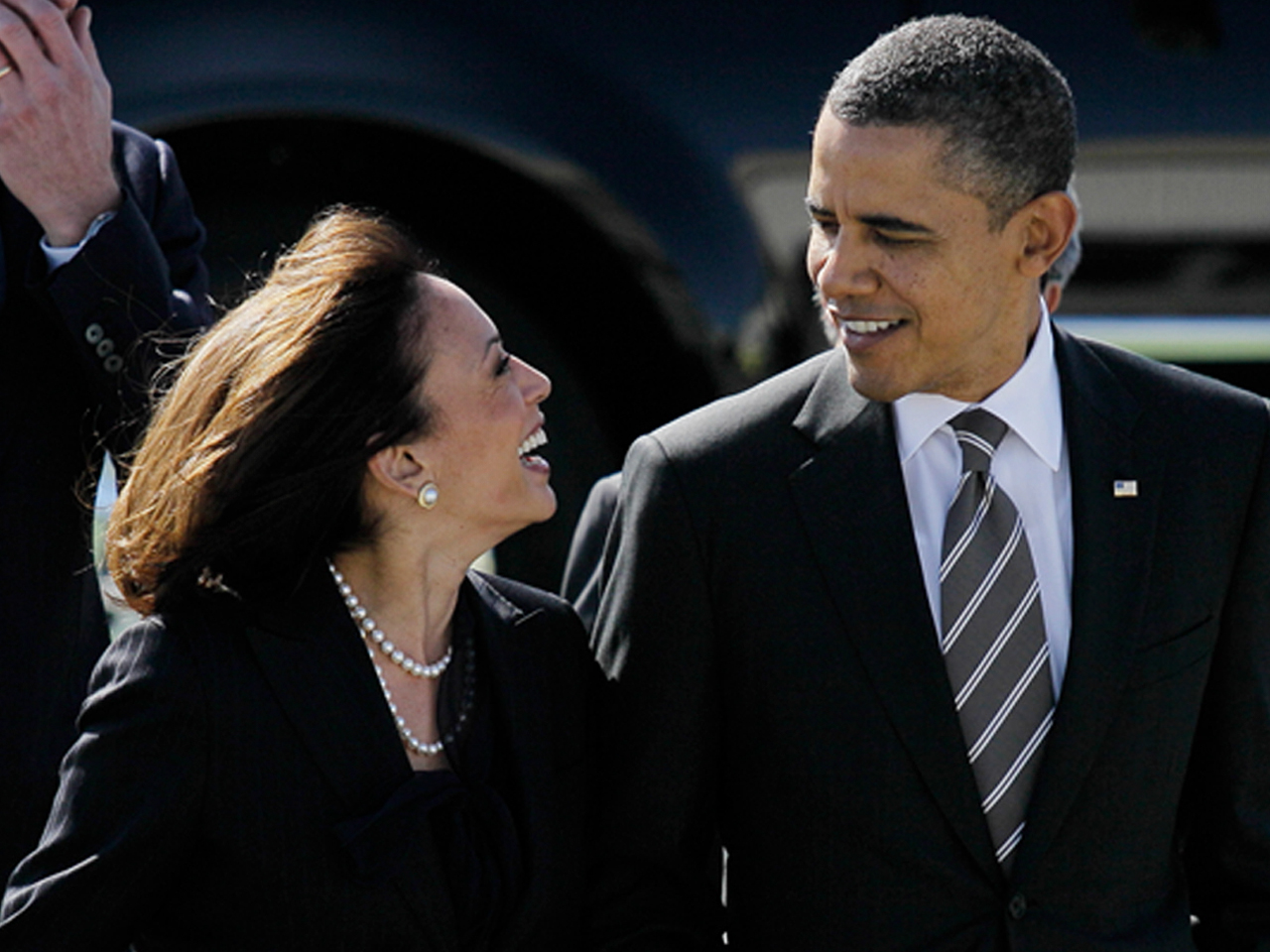
After more than 20 years as a U.S. Senator in California, Senator Barbara Boxer said in January 2015 that she would not run for re-election in 2016. Kamala Harris then announced her candidacy for the Senate seat the following week. Harris was a top contender from the start of her Senate campaign. It was Kamala's time. By this time, the 2016 California Senate election used California's new top two primary format where the top candidates in the primary would advance to the general election regardless of party. In February 2016, Kamala Harris won 78% of the California Democratic Party vote at the party convention, allowing Harris's campaign to receive financial support from the party. Three months later, Governor Jerry Brown endorsed her. During the June 7 primary, Kamala Harris came in first with 40% of the vote. She won with pluralities in most counties. During the general election, she faced Congresswoman and fellow Democrat Loretta Sanchez. It was the first time a Republican didn't appear in a general election for the Senate since California began directly electing senators in 1914. On July 19, 2016,  President Barack Obama and Vice President Joe Biden endorsed Harris. In the November 2016 election, Harris defeated Sanchez, capturing over 60% of the vote, carrying all but four counties.  Following her victory, she promised to protect immigrants from the policies of President-elect Donald Trump and announced her intention to remain Attorney General through the end of 2016. Kamala Harris was always an outspoken Senator from 2017 onward. She was sworn into office by Vice President Joe Biden on January 3, 2017. 


By 2017, Senate Kamala Harris criticized the Executive Order 13679 (from Trump) that barred citizens from several Muslim-majority countries form entering America for 90 days. She said that the xenophobic order was a Muslim ban. It existed on January 28, 2017 being supremely xenophobic and horrendous. She told White House Chief of Staff John F. Kelly that she opposed the unjust executive order. She disagreed with Secretary of Education Betsy DeVos and U.S. Attorney General Jeff Sessions on many issues. In early March, she called on Sessions to resign, after it was reported that Sessions spoke twice with Russian Ambassador to the United States Sergey Kislyak. She voted against the confirmation of Neil Gorsuch to the U.S. Supreme Court. Kamala Harris visited California troops in Iraq and the Zaatari refugee camp in Jordan, the largest camp for Syrian refugees. In June, Harris garnered media attention for her questioning of Rod Rosenstein, the deputy attorney general, over the role he played in the May 2017 firing of James Comey, the director of the Federal Bureau of Investigation. The prosecutorial nature of her questioning caused Senator John McCain, an ex official member of the Intelligence Committee, and Senator Richard Burr, the committee chairman, to interrupt her and request that she be more respectful of the witness. They are wrong, because Kamala Harris interviewing people in seeking the truth is the epitome of being respectful. A week later, she questioned Jeff Sessions, the attorney general, on the same topic. In December, Harris called for the resignation of Senator Al Franken, asserting on Twitter, "Sexual harassment and misconduct should not be allowed by anyone and should not occur anywhere."


In 2018, Kamala Harris was appointed to the Senate Judiciary Committee.  Later that month, Harris questioned Homeland Security Secretary Kirstjen Nielsen for favoring Norwegian immigrants over others and claiming to be unaware that Norway is a predominantly white country. Even when I was a teen, I knew that Norway has mostly white people residing in it. In May, Harris questioned Secretary Nielsen about the Trump administration family separation policy, under which children were separated from their families when the parents were taken into custody for illegally entering the U.S.  In June, after visiting one of the detention facilities near the border in San Diego,  Harris became the first senator to demand Nielsen's resignation. By September and October of 2018, Kamala Harris questioned Brett Kavauangh during the Supreme Court confirmation hearings. One question was about a meeting he may have had regarding the Mueller Investigation with a member of Kasowitz Benson Torres, the law firm founded by the President's personal attorney Marc Kasowitz. Kavanaugh was unable to answer many questions and repeatedly deflected (making bizarre comments about beer).  Harris also participated in questioning the FBI director's limited scope of the investigation on Kavanaugh regarding allegations of sexual assault. She voted against his confirmation. Kamala Harris was a target of the October 2018 United States mail bombing attempts. In December, the Senate passed the Justice for Victims of Lynching Act (S. 3178), sponsored by Harris.  The bill, which died in the House, would have made lynching a federal hate crime. In March of 2019, (after Special Counsel Robert Mueller submitted his report on Russian interference in the 2016 election), Kamala Harris called for U.S. Attorney General William Barr to testify before Congress in the interests of transparency. Kamala Harris also team up with Kristen Gillibrand to urge the Trump administration to investigate the allegations of Uyghur genocide by the Chinese Communist Party. In November 2019, Harris called for an investigation into the death of Roxsana Hernández, a transgender human being and immigrant who died in ICE custody. In December, Harris led a group of Democratic senators and civil rights organizations in demanding the removal of White House senior adviser Stephen Miller after emails published by the Southern Poverty Law Center revealed frequent promotion of white nationalist literature to Breitbart website editors. In 2020, Kamala Harried opened the impeachment trial of Donald Trump on January  16, 2020. She said that she wanted the American justice system to have integrity. She voted to convict the President Trump on charges of abuse of power and obstruction of Congress. She worked on bipartisan bills with Republican co-sponsors, including a bail reform bill with Senator Rand Paul,  an election security bill with Senator James Lankford,  and a workplace harassment bill with Senator Lisa Murkowski. Following her election as Vice President of the United States, Harris resigned from her seat on January 18, 2021,  prior to taking office (as the Vice President of the United States of America) on January 20, 2021, and was replaced by California Secretary of State Alex Padilla. Kamala Harris is part of the Congressional Black Caucus, the Congressional Asian Pacific American Caucus, and the Congressional Caucus for Women's Issues. 


Her 2020 Presidential Campaign


As early as 2018, there has been words about Harris being considered a top contender for the 2020 Democratic nomination for President. Kamala Harris said that she wasn't ruling it out in June of 2018. In July 2018, it was announced that she would publish a memoir, a sign of a possible run.  On January 21, 2019, Harris officially announced her candidacy for president of the United States in the 2020 United States presidential election. In the first 24 hours after her candidacy announcement, she tied a record set by Bernie Sanders in 2016 for the most donations raised in the day following an announcement. More than 20,000 people attended her formal campaign launch event in her hometown of Oakland, California, on January 27, 2019, according to a police estimate. Kamala Harris' 2020 campaign was huge and a big deal. She was in the first Democratic debate in June 2019. She criticized Joe Biden for the remarks he made speaking  fondly of senators who opposed integration efforts in the 1970s and working with them to oppose mandatory school busing. Kamala Harris, as a child, was involved in the busing program to go into an integrated school. Harris's support rose by between six and nine points in polls following that debate.  In the second debate in August, Harris was confronted by Biden and Congresswoman Tulsi Gabbard over her record as Attorney General. It is no secret that Tulsi Gabbard and Kamala Harris don't like each other even before that debate. Harris accused Tulsi of being an Assad puppet, and Gabbard accused Harris of not doing enough to fight the prison industrial complex. The San Jose Mercury News assessed that some of Gabbard's and Biden's accusations were on point, such as blocking the DNA testing of a death row inmate, while others did not stand up to scrutiny. In the immediate aftermath, Harris fell in the polls following that debate.  Over the next few months her poll numbers fell to the low single digits. Many progressives during that time had concerns about Kamala's views on the criminal justice system. For example, in 2014, she decided to defend California's death penalty in court. Kamala's supporters said that her record has been distorted and taken out of context. Since  Kamala Harris was a victim of racist and sexist attacks by extremists, the KHive group existed on Twitter to defend her record. 

On December 3, 2019, Harris withdrew from seeking the 2020 Democratic nomination, citing a shortage of funds. In March 2020, Harris endorsed Joe Biden for president. Also, we know that Gabbard is very much hypocritical. She claims to be the progressive superhero, but she opposes the Iran nuclear deal and has an obsession with "radical Islam." She respects the far irhgt Indian leader Narendra Modi. Gabbard said that she is a hawk in the war on terrorists and a dove on regime change. She supports the use of drones. In 2014, she introduced a bill that halted the is a waiver program for countries whose citizens had gone to fight with extremists claiming that the program puts American lives at danger. Trump had talks with Gabbard which were set up by extremist Steve Bannon (who expressed admiration for Gabbard). Gabbard met with and praised the Egyptian dictator Adbel Fattah el-Sisi. Kamala Harris never did these acts at all. Gabbard is progressive on many issues to her credit, but Kamala Harris has a strong progressive record too. That is why Kamala Harris rose above the fray. 


Making History as Vice President of the United States of America


As early as May of 2019, senior members of the Congressional Black Caucus endorsed the idea of a Biden/Harris ticket. In late February of 2020, Biden won a landslide victory in the 2020 South Carolina Democratic primary with the endorsement of House whip Jim Clyburn, with more victories on Super Tuesday. By early March of 2020, Clyburn suggested that Biden choose a black woman as a running mate. He said that "African American women needed to be rewarded for their loyalty." Black women are deserving of getting all of the praise in the world for birthing the human race and being a beacon of light for the Universe. In March 2020, Biden committed to choosing a woman for his running mate. On April 17, 2020, Harris responded to media speculation; Harris mentioned that she would be honored to be Biden's running mate. In late May of 2020, concerning the murder of George Floyd and the protests plus demonstrations, Biden faced renewed calls to select a black woman to be his running mate. Many people highlighted the law enforcement credentials of Kamala Harris and Val Demings. The New York Times reported on June 12, 2020, that Kamala Harris was emerging as the frontrunner to be Biden's running mate. She was one of many African American women with the political experience typical of vice President. On June 26, CNN reported that more than a dozen people close to the Biden search process considered Harris one of Bidens top four contenders. Their names are Elizabeth Warren, Val Demings, and Keisha Lance Bottoms. Joe Biden announced that he had chosen Kamala Harris as his running mate on August 11, 2020. She was the first African American, the first Indian American, and the third woman after Geraldine Ferraro and Sarah Palin to be picked as a Vice Presidential nominee for a major party ticket.  


Kamala Haris was recorded calling Biden saying, "We did it! We did it, Joe. You're going to be the next President of the United States." This was one of the top 10 tweets of 2020. After the 2020 election of Joe Biden as U.S. President, Harris assumed office as Vice President of the United States on January 20, 2021. Kamala Harris is the first woman vice President and the highest-ranking woman elected official in U.S. history. She is the first African American and the first Asian-American vice President. She is the 2nd person of color to hold that position. The first was Charles Curtis, a Native American and member of the Kaw Nation, who served under Herbert Hoover from 1929 to 1933. She is the third person of color to get one of the highest offices of the executive branch after Curtis and former President Barack Obama. Harris resigned her Senate seat on January 18, 2021, two days before her swearing-in as vice president. Her first act as vice President was swearing-in her replacement Alex Padilla and Georgia senators Raphael Warnock and Jon Ossoff, who were elected in the 2021 Georgia runoff elections. Kamala Harris cast her first of two tie-breaking votes on February 5, 2021. In February and March, Harris's tie-breaking votes in her role as President of the Senate were crucial in passing the American Rescue Plan Act of 2021 stimulus package proposed by President Biden since no Republicans in the Senate voted for the package. In April 2021, Harris indicated that she was the last person in the room before President Biden decided to remove all U.S. troops from Afghanistan and commented that the president has "an extraordinary amount of courage" and "make(s) decisions based on what he truly believes ... is the right thing to do." Vice President Kamala Harris conducted her first international trip as Vice President in June 2021, visiting Guatemala and Mexico in an attempt to address the root causes of an increase in migration from Central America to the United States. During her visit, in a joint press conference with Guatemalan President Alejandro Giammattei, Harris issued an appeal to potential migrants, stating "I want to be clear to folks in the region who are thinking about making that dangerous trek to the United States-Mexico border: Do not come. Do not come." Kamala Harris said that America is not a racist obvious. I disagree. History and just life experiences prove that America is a racist nation. In 2005, the National Black Prosecutors Association awarded Harris the Thurgood Marshall Award. That year, she was featured along with 19 other women in a Newsweek report profiling "20 of America's Most Powerful Women."


The Legacy of Kamala Harris and Epilogue


It has been long decades since the end of the Cold War. We witness a new chapter of American society where demographic changes are heavily abundant as documented by the 2020 U.S. Census report. We are still dealing with the pandemic, the aftermath of the 1/6 terrorist incident, and other events. The story of Kamala Harris has been an American story. She stood up to bullies when she was in Kindergarten. She has traveled the world. She was a legal expert who used her knowledge to confront polluters, domestic violence abusers, and other corrupt entities. She recognizes and loves her black heritage and her Indian heritage too. That is why Kamala Harris has a great amount of empathy of human beings. Now, she is the Vice President of the United States of America. When Pence interrupted her, Kamala Harris just gave him a look and said, "I'm speaking." That is part of our culture as black Americans. There are a lot of unsung contributions to society that Kamala Harris did that many folks don't know about. There have been many distortions of her record. The reality is that Kamala Harris reduced truancy in San Francisco by 20 percent during her tenure.  Kamala Harris opposed Proposition 21 (that made new criminal penalties for youth offenders), co-founded the Coalition to End the Exploitation of Kids, changed the treatment of underage people from being treated as prostitutes/criminals to being treated as victims, helped to create the Center for Youth Wellness, and invested in re-entry programs that has helped many lives. She is not perfect (as her imperfections should never be omitted) like her statement on America not being a racist nation, but she is not the caricature that the far right portrays her as. She is a black woman on a mission to improve the lives of us. Her legacy is about seeing how a historic black woman has risen into the heights of power by her own merit in American society. She may run for President during the near future. Only time will tell. Yet, it is true that we have to continuously work to defend our human rights and build in our communities progressively. 


By Timothy


Labor Day 2021 Information.


STEM Fields remains a major lifeblood of modern day society. From driving vehicles to going out to studying the weather (which deals with radar systems, mathematics, and an understanding of science in an indepth way), you have to respect STEM subjects all of the time. By the year of 1600, there was the stocking frame. With the Industrial Revolution and the stem engine, more inventions grew rapidly in constructing building and having more transportation from trains to large factory machines. Around this time, there was the evil Maafa and the international slave trade that ruin millions of innocent human lives. In fact, the blood of black people helped to built America and much of the modern Western world as we know it. That is why reparations for black Americans is a necessity. Advances in math, science, engineering, and technology increased in the 18th century, the 19th century, the 20th century (with the modern airplane and car vehicles), and in the 21st century. The time after World War II (which was the most destructive war in human history) saw a tremendous amount of inventions in the modern world. In that era alone, we saw the computer chip, international air travel, the Internet, video games, and I Phones. It is also important to note that there is a digital gap where oppressed communities don't receive the same opportunities as more affluent communities in terms of access to STEM technologies. That should end completely. STEM if a lifelong reality. When we get older, we need medical devices to monitor our health, we need transportation to move around, and we have access to security systems to protect our homes. That is why people worldwide should live in a war filled with justice and liberation. Empowerment relates to eliminating structures of oppression and creating a system of justice in its place. STEM has great power, and we have to harness that power in constructive ways (from establishing clean energy to deal with climate change to expanding futuristic high speed rail systems). 


James K. Polk (1795-1849) was the 11th President of the United States. He served one term from 1845 to 1849. He had many positions like the Speaker of the House of Representatives, the Governor of Tennessee, and he was a protege of the bigot Andrew Jackson. That is why James Polk loved the Jacksonian democracy model being a member of the Democratic Party. Polk worked to expand the territory of the United States via the Mexican-American war during his Presidency. He was born in Pineville, North Carolina. Polk was the first of 10 children born to a family of farmers. His father was Samuel Polk, and James was named after James Knox. Samuel was a farmer, slaveholder, and surveyor of Scots-Irish descent. The Polks immigrated to America by the late 1600's. They lived in the Eastern Shore of Maryland. Then, the moved into south central Pennsylvania and then to the Carolina hill country. His family were Presbyterians. Polk's mother was a Presbyterian, but his father including his grandfather Ezekiel Polk was a deist, rejecting dogmatic Presbyterianism. Nevertheless, James' mother "stamped her rigid orthodoxy on James, instilling lifelong Calvinistic traits of self-discipline, hard work, piety, individualism, and a belief in the imperfection of human nature", according to James A. Rawley's American National Biography article. James Polk had an illness as a child. He was enrolled at a Presbyterian academy in 1813, and he was a member of Zion Church near his home in 1813. He entered Bradley Academy in Murfreesboro, Tennesse where he was a promising student. 


James Polk was admitted into the University of North Carolina at Chapel Hill as a second semester sophomore on January 1816. He studied law after graduation under the renowned trial attorney Felix Grundy, who was his first mentor. He was a successful lawyer. He handled many cases that came from the Panic of 1819, which was a huge depression. Polk supported Andrew Jackson. As Andrew Jackson's disciple, James Polk opposed the progressive policies from the John Quincy Adams administration. Jackson and Polk didn't want investments in national infrastructure programs, because they believe in an extremist philosophy on the economy. Working on Jackson's behalf, Polk successfully opposed federally-funded "internal improvements" such as a proposed Buffalo-to-New Orleans road. He was pleased by Jackson's Maysville Road veto in May 1830, when Jackson blocked a bill to finance a road extension entirely within one state. That state was Kentucky, and Polk deemed it unconstitutional. Polk abhorred the Second Bank of the United States. Like many Southerners, Polk favored low tariffs on imported goods, and initially sympathized with John C. Calhoun's opposition to the Tariff of Abominations during the Nullification Crisis of 1832–1833, but came over to Jackson's side as Calhoun moved towards advocating secession. Thereafter, Polk remained loyal to Jackson as the President sought to assert federal authority. Polk condemned secession and supported the Force Bill against South Carolina, which had claimed the authority to nullify federal tariffs. The matter was settled by Congress passing a compromise tariff. He later was the Speaker of the House and Governor of Tennessee. James Polk defeated Clay in the 1844 Presidential election. People debated the future of Texas. 


Clay had an anti-annexation of Texas view, but Polk supported it. This caused some even Southern Whig leaders to support Polk. With a slender victory in the popular vote, but with a greater victory in the Electoral College (170–105), Polk proceeded to implement his campaign promises. He presided over a country whose population had doubled every twenty years since the American Revolution and which had reached demographic parity with Great Britain. Polk said that he wanted to deal with technology. He wanted to get the Oregon County, acquire California and its harbors from Mexico, reduce tariffs, and reestablish the Independent Treasury System. His cabinet included people from the North and the South. President Polk was 49 years old when he was inaugurated. The inaugural ceremony was the first one to be reported by telegraph and first to be shown in a newspaper illustration (in The Illustrated London News). Polk supported the annexation of Texas. James Buchanan was the Secretary of State and Robert J. Walker was the Secretary of the Treasury. Once, Britain controlled the Oregon Country. Lewis and Clark visited the area. This land was stolen from the indigenous peoples of the region. The United States and Britain negotiated to allow America to control much of the Oregon Country without going to war each other over it. Polk had refrained in his address from asserting a claim to the entire territory, which extended north to 54 degrees, 40 minutes north latitude, although the Democratic Party platform called for such a claim. Polk claimed the Rio Grande, but Mexico claimed the Nueces River as the border. This dispute lead into the Mexican American War. Polk signed a resolution annexing Texas to make it the 28th state of the Union. Mexico didn't have diplomatic relations with America by 1845. 


Mexico didn't recognize Texas independence. War was coming, so Polk send Brigadier General Zachary Taylor to prepare for conflict. Polk wanted negotiations (via diplomat John Slidell and others) to prevent a war, but war came. General Taylor wanted to guard at the Rio Grande. This dispute caused the war. Polk signed the Congressional declaration of war calling for 50,000 volunteers in the military. Many in the Senate opposed the war claiming that it existed under questionable circumstances like Calhoun and Abraham Lincoln. The Senate approved the resolution 40-2. The war ended in an American victory. Mexican forces under General Mariano Arista fought gallantly, but it was too much fire power from the American side. Many Northern Whigs opposed the war. Army Captain John C. Fremont led settlers in California to overthrow the Mexican government there.  A freshman Democratic Congressman, David Wilmot of Pennsylvania, previously a firm supporter of Polk's administration, offered an amendment to the bill, the Wilmot Proviso. The Wilmot Proviso bill would ban slavery in any land acquired using the money. The appropriation bill, with the Wilmot Proviso attached, passed the House, but died in the Senate. Debates on the war caused Polk to have one term in office. General Santa Ana fled. America once captured Mexico City. War opponents were also active; Whig Congressman Abraham Lincoln of Illinois introduced the "exact spot" resolutions, calling on Polk to state exactly where American blood had been shed on American soil to start the war, but the House refused to consider them. The Treaty of Guadalupe Hidalgo ended the war and expanded American territory along with the Gadshen Purchase too. When Congress reconvened in December 1848, Polk asked it in his annual message to establish territorial governments in California and New Mexico, a task made especially urgent by the onset of the California Gold Rush. Debates on slavery continued. Polk dealt with trade in the Caribbean. Polk didn't want a national bank, and Polk supported lowering tariffs. One of Polk's last acts as president was to sign the bill creating the Department of the Interior (March 3, 1849). This was the first new cabinet position created since the early days of the Republic. Polk had misgivings about the federal government usurping power over public lands from the states. Nevertheless, the delivery of the legislation on his last full day in office gave him no time to find constitutional grounds for a veto, or to draft a sufficient veto message, so he signed the bill. Polk didn't seek one term. 


Polk's Presidency was stressful and his health suffered. He died on June 15 at his home in Nashville, Tennessee. Polk's funeral was held at the McKendree Methodist Church in Nashville. Following his death, Sarah Polk lived at Polk Place for 42 years and died on August 14, 1891, at the age of 87. He owned human beings as a slaveowner whose names are Elias Polk, Mary Polk, and Mtailda Polk. Elias and Mary Polk both survived slavery. Matilda died in 1849 at the age of about 110 years old. James Polk expanded American territories. Many of the generals and military leaders of the Mexican American War would be future participants in the U.S. Civil War like Robert E. Lee, Ulysses S. Grant, Stonewall Jackson, George Meade, and Jefferson Davis. James Polk's house, Polk Place, was demolished in 1901, a decade after Sarah's death.


The 12th President of the United States of America was Zachary Taylor  (1784-1850). He was a military leader of the U.S. Army who was a major general during the Mexican-American War. He was born in Barboursville, Virginia. His ancestors came from England. He was the third of five surviving sons in his family (a sixth died in infancy) and had three younger sisters. His mother was Sarah Dabney (Strother) Taylor. His father, Richard Taylor, had served as a lieutenant colonel in the American Revolution. Taylor was a descendant of Elder William Brewster, a Pilgrim leader of the Plymouth Colony, a Mayflower immigrant, and a signer of the Mayflower Compact; and Isaac Allerton Jr., a colonial merchant, colonel, and son of Mayflower Pilgrim Isaac Allerton and Fear Brewster. Taylor's second cousin through that line was James Madison, the fourth president. He was also a member of the famous Lee family of Virginia, and a third cousin once removed of Confederate General Robert E. Lee. His family moved from Virginia to Louisville, Kentucky on the Ohio River.


His mother taught him how to read and write. Zachary Taylor attended Middletown, Kentucky academy run by Kean O'Hara (who came from Ireland). In June 1810, Taylor married Margaret Mackall Smith, whom he had met the previous autumn in Louisville. "Peggy" Smith came from a prominent family of Maryland planters—she was the daughter of Major Walter Smith, who had served in the Revolutionary War. They had 6 children together. Taylor served in the military for decades. He was involved in the War of 1812 and other conflicts. He was involved in the Black Hawk War and the Second Seminole War. Taylor commanded American forces at the Battle of Palo Alto and the nearby Battle of Resaca de la Palma. Though greatly outnumbered, he defeated the Mexican "Army of the North" commanded by General Mariano Arista, and forced the troops back across the Rio Grande. He humanely treated Mexican soldiers prior to the prisoner exchange with General Arista. 


Zachary Taylor was a nationalist, supported the Second Bank of the United States, and didn't want slavery to expand into the West (for economic not moral reasons). Taylor also opposed secessionism. He had Millard Filmore on his ticket as Vice President. As support for Taylor's candidacy grew, he continued to keep his distance from both parties, but made it clear that he would have voted for Whig Henry Clay in 1844 had he voted. In a widely publicized September 1847 letter, Taylor stated his positions on several issues. He did not favor chartering another national bank, favored a low tariff, and believed that the president should play no role in making laws. Taylor did believe that the president could veto laws, but only when they were clearly unconstitutional. Taylor was also a slave owner. Taylor supported the Wilmot Proviso too. Most abolitionists didn't support Taylor as he was a slave owner. Martin Van Buren ran for President in the anti-slavery Free Soil Party who didn't want an extension of slavery in more territories. That took votes from the Democratic nominee Lewis Cass, and Taylor won the 1848 election. Zachary Taylor was the last Whig to be elected President in America, and he was the last person elected President who wasn't a Democrat or Republican. He elected diverse people from America to be in his cabinet.  For the position of Postmaster General, which also served as a center of patronage, Taylor chose Congressman Jacob Collamer of Vermont.


President Taylor didn't want entangling alliances as George Washington condemned too. He dealt with the issue of slavery. Southern racists didn't like Northerners giving aid to slaves who ran from the South. As the threat of Southern secession grew, he sided increasingly with antislavery Northerners such as Senator William H. Seward of New York, even suggesting that he would sign the Wilmot Proviso to ban slavery in federal territories should such a bill reach his desk. Taylor wanted California to be a state. California would later be a free state. While this was going on, the Latter Day Saint settlers came into Utah to form the provisional State of Deseret. These were the Mormons. This land evolved into Utah Territory. Taylor promised the Mormons to have religious freedom, even being a federal territory. Taylor dealt with New Mexico wanting to be a new state too. On foreign policy matters, many in Taylor's cabinet supported the Revolutions of 1848 in opposition to autocrats. Taylor stopped Narciso Lopez to conquer Cuba. The Missouri Compromise existed, and a strict Fugitive Slave Law was created that harmed human lives. Taylor threatened to use troops to stop secession. He ate a large amount of raw fruit and ice milk during a fund raising event at the Washington Monument (that was under construction on July 4, 1850). His digestive system was sick. It is said that he died of cholera morbus because of the open sewers in D.C. back then. His food might have been contaminated. President Zachary Taylor died on July 9, 1850 at the age of 64 years old. After his death, Vice President Fillmore assumed the presidency and completed Taylor's term, which ended on March 4, 1853. Soon after taking office, Fillmore signed into law the Compromise of 1850, which settled many of the issues faced by the Taylor administration. 


A Joint Special Committee was appointed by the Common Council of the city of New York, to make the necessary arrangements for the funeral in honor of the late Taylor, which took place in New York City, on Tuesday July 23, 1850. A procession moved from the Park and proceeded down Broadway, to Chatham Street to the Bowery; down to Union Square; and then in front of the City Hall. The procession included the firing of three volleys by the 7th National Guard Regiment. There were thirty pallbearers, which was the number of states in the Union at that time. Taylor was interred in the Public Vault of the Congressional Cemetery in Washington, D.C., from July 13, 1850, to October 25, 1850 (which was built in 1835 to hold remains of notables until either the grave site could be prepared or transportation arranged to another city). His body was transported to the Taylor family plot where his parents were buried on the old Taylor homestead plantation known as "Springfield" in Louisville, Kentucky. President Taylor saw an evolution of the tensions of the North and the South grow into the U.S. Civil War. He was the last President to own slaves while he was in office. He had deals with many foreign powers, and the antebellum period would end in war. 


The War on Drugs have existed more than 50 years. Billie Holiday was a victim of the evil War on Drugs back in the 1950's. This is about the modern day War on Drugs that was born on June 18, 1971 by President Nixon. From the days of the Opium Wars to the modern age of 2021, the War on Drugs has been filled with controversy. One positive news is that a huge majority of Americans in recent years now oppose the War on Drugs. Back in the day, it was taboo to talk about solutions to drug addiction that are in opposition to the War on Drugs. Now, we have a new day when new laws in various states invest in drug treatment programs, education, community development, and other progressive means to improve the confines of society. As recently as 2015, the Drug Policy Alliance has called for an end to the War on Drugs costing $51 billion annually in the States plus costing cumulative in ca. $1 trillion. The War on Drugs is interrelated to the prison industrial complex, gentrification, racism, and other unjust laws. Sentencing disparities based on race and class are real. You can't claim to be for justice and take a blind eye to the corruption found in the racist prison industrial complex. Drug addiction doesn't discriminate either. It's found among people of every color from Los Angeles, NYC, and to rural places with meth plus oxycotin addiction. Scholars and political leaders have spoken about this issue like John L. Potash, Gary Webb, Mike Ruppert, Cynthia McKinney, Maxine Waters, etc. Nothing is new under the sun. Today, we have books, the Internet, and other sources documenting the viciousness of government corruption and the destructive nature of the War on Drugs in general. That is why progressive alternatives to the War on Drugs remains a necessity. 


Modern gospel music has existed from 1997 to the present in 2021. For over 24 years, we have witnessed gospel music change in many ways. We live in a new time from the days of the Jubliee Singers. Gospel now is filled with tons of younger artists. Many of these gospel musicians consist of influences from hip hop and R&B music. Also, there are many older gospel legends making songs and albums too. The Stellar Awards presents the reality of the diversity of new school artists of this generation fully. In our time, Jekayln Carr has many tons of music involving gospel. Tye Tribbett is known for dancing and having massive energy with his spiritual music. We know about the Clark Sisters and going strong after decades of being in the gospel music industry. Kierra Sheard-Kelly has sung gospel music for a while. A younger singer named Jonathan McReynolds gave shown many conscious messages in his gospel songs too. At the 2021 Stellar Awards, the Clark Sisters accepted the Lifetime Achievement Awards. Tramaine Hawkins accepted the Aretha Franklin icon award during the 2021 Stellar Awards too. Aretha Franklin was a huge artist involving gospel music. Other artists who continue to inspire human beings in 2021 are: Jason Clayborn, Hezekiah Walker, Pastor Mike Jr., Yolanda Adams, CeCe Winans, Terrian, Mali Music, J.J. Hairston, Tamela Mann, Jokia, Maverick City Music, Fred Hammond, Marvin Sapp, Kirk Franklin, Anthony Brown, Nia Allen, Capria McClearn, and other human beings. The group Mary Mary have made albums, and each woman have created solo projects too during the 21st century. Also, this era has been filled with debate. One extreme group of people want gospel music to compromise their principles entirely, and the other group of extremists want a totally rigid form of music that makes no effort to guide the young. We have to promote a balance where integrity is promoted in gospel music and creativity is advanced too. Therefore, music is universal, and there is nothing wrong with diverse sounds in praising God legitimately. 


There is this New York City connection to my genealogy. Many of my distant cousins live in New York City. One person born in New York City is my 4th cousin named Sean E. McGee. He was born on December 23, 1964. He is a descendant of Zilphy Claud via Frank Claud. His parents are the military veteran John McGee (b. 1927) and Sallie Hobbs Claud (1931-2009). Sallie Claud's parents are Willie Lloyd Claud (1907-1974. Willie Lloyd Claud's parents are Frank Thomas Claud (1861-1948) and Elizabeth Whitehead (b. 1868). Sean E. McGee had many children like Tiffany McGee (b. 1992) and Jiselle McGee. My late 2nd cousin Ida Sexton Brown (1920-2000) is related to me by both of us sharing the same ancestor of Morefield Hurst Turner and Milly Bozeman. Ida Brown's parents are Robert Goodman (1888-1948) and Mahala Lue Sykes (1895-1994). Ida Brown's siblings are: Linwood Brown (1916-1930), Ledora B. Ellis (1918-1986), McKinley Brown (1919-1958), Cleveland Brown (1922-2005), Herbert Isom Brown (1923-1987), Mary Lue Brown (b. 1924), Robert Lee Brown (1926-2005), and Kenneth Harold Brown (1934-1990). Ida Sexton Brown married Melvin R. Overby on June 13, 1942 at Surry, Virginia. Their children are Mrs. Kathryn Green Overby Blamoville (b. 1949) and Melvin R. Overby Jr. These 2 children are my 3rd cousins. Ida Brown lived in Jamaica Queens, NYC. Mrs. Blamoville lives in New York state. 


The Hurricane of Ida has harmed many areas all over America in Louisiana, New York, Philadelphia, etc. In Louisiana, many homes have been devastated. Some parts of Louisiana will take long weeks fro electricity to come to various locations. People are recovering in Lafource, Plaquemines, St. Charles, Terrebonne, and other locations. Entegry Louisiana provides electric services to more than 1 million customers. Flood waters are slowly receding in the region. Many victims of Ida are living in northern Louisiana and Texas. That is why we need federal infrastructure legislation to help fellow human beings in America. This isn't time for tokenism or ban aids. It's time for real, comprehensive solutions. Gas was in short supply in many places. Ida's record rainfall in New York City and in the Northeast showed the disaster of world capitalism. Capitalism is built on human exploitation. Massive floods have hit Penn Station. New York City ironically is the wealthiest city on Earth with the world's highest concentration of billionaires in the world. Much of the infrastructure in the Northeast have been decades behind from storm protection assets, transportation system drainage system, and power supply. A housing complex was destroyed in Elizabeth, New Jersey by floodwaters killing 4 residents (and left 600 people homeless). Many people were drowned in NYC basement apartments. For decades, the elites refused to provide funding for critical infrastructure, buildings, and other entities to deal with climate change. So, change must come to save human lives literally and to improve our environment in general. 


By Timothy


Friday, September 03, 2021

Black Legendary People.

 https://sittingbull1845.blogspot.com/2013/07/black-social-history-african-american_21.html


https://sittingbull1845.blogspot.com/2013/07/black-social-history-african-american_31.html


https://sittingbull1845.blogspot.com/2013/08/black-social-history-african-american_3259.html


https://sittingbull1845.blogspot.com/2013/07/black-social-history-african-american_21.html 


https://sittingbull1845.blogspot.com/2013/07/black-social-history-afro-canadian-r.html


https://sittingbull1845.blogspot.com/2013/07/dehashia-tonnek-deedee-trotter-december.html

Early September 2021 News on Friday.


There should be more of an analysis of the historic flooding of the Northeast, including of New York City by the storm of Ida. The storm was historic in causing New York City to have its first flash flood emergency in history. In New York City, there has been massive flooding in subways, in Queens, in Brooklyn, in the Bronx, and in Central Park. Many people were stuck on trains and in subways without electricity, ventilation, food or water. Thousands of people were stranded. Flooding also existed in Connecticut, New Jersey, and in Philadelphia. At least 11 people have lost their lives via the weather. The weather is a reflection of the climate change reality that has made the world warmer in general. For decades, the Earth's temperature has increased by the increase of CO2 levels. Even back in the 1960's, scientists have warned the public about global warming New York has a state of emergency. The New York Fire Department rescued hundreds of people from subways stations and in other locations. New York Governor Hochul has shown leadership in the situation.


Steve Bannon and other extremists want another hate rally in September 18, 2021 at the U.S. Capitol. These racists have united with election deniers in their plans for the future rally. Also, there has been the rise in hate crimes against our community (black people), Asian people, and other groups of people. There is a heightened alert of white racist groups in America. That is why the most immediate threat to American society are not terrorists from another country like ISIS-K. That threat are white racists who seek to destroy America's multiracial democracy. These reactionaries are hypocrites too. They claim to be for family values, but they agree with austerity policies that harm families. Many of them have been caught up in various sexual scandals like Matt Gaetz. They claim to be spiritual and believe in God, but they follow Trump who said that I don't ask God for forgiveness over anything (also Trump curses out peaceful protesters, is a racist, is a sexist, and is a xenophobe). They claim to be for freedom, but they adhere to policies that deprive voting rights freedoms and other freedoms from human beings overtly. Therefore, the torch has been passed to a new generation of Americans (who are us), and we have this august responsibility and duty to stand up plus speak up for justice for all.


There are continued discussions about the January 6 investigation by the House. McCarthy has threatened telecommunication companies if they send records to the House investigators. Obviously, that threat is illegal. House January 6 committee members have asked companies to preserve records of phone calls between Trump and GOP members of Congress (related to the January 6 terrorist attack). This is done to see if any GOP members were complicit in the coordination of the attacks. If any member of Congress was complicit in any way, that person should be arrested and banned from Congress permanently. The 1/6 terrorist attack comes after Trump lost the electoral votes and the popular votes after the 2020 election. Many GOP members have a long history of promoting disinformation. Many Republicans seek to obstruct the investigation. Many of them claim to be for democracy, but they are doing everything possible to either whitewash or sugarcoat the January 6, 2021 terrorist attack. It is illegal to threaten anyone involving a person cooperating with a Congressional committee. The House Committee want phone records from many GOP members. Rep. Madison Cawthorn warns of "bloodshed" if future elections don't go his way and calls the January 6th terrorists "political prisoners." This is treason from Cawthorn. There is no other way to put it. Many GOP extremists are provoking violence. 


I think that Chrisette Michele made a great recent point about double standards. She was criticized for trying to sing at the Trump inauguration, but she never wore a MAGA hat, never called slavery a choice, and never ran a covert campaign to low key try to make Trump win re-election. Yet, many people are more forgiving to Kanye West than Chrisette Michele. Michele never disrespected our black ancestors. Chrisette Michele is one of the greatest singers of our generation in the 21st century too. In that sense, we have to be consistent and show a lot more compassion to Chrisette Michele than people like Larry Elder and Clarence Thomas who make it their business to try to eliminate progressive blessings that people fought for. 


Senator Joe Manchin proves once again why moderates have been disgraceful. Now, he wants a pause before the Biden $3.5 trillion bill is enacted. Manchin doesn't like the price tag. He should tell that to the members of his own state (of West Virginia) suffering or the victims of the storm of Ida in the South and in the North. Moderates don't get that extreme situations cause for progressive measures to rectify problems. Manchin doesn't agree with the timeframe that Democrats have proposed. He doesn't believe that people should spend trillions of new government programs and new stimulus funding when men, women, and children in many cases are evicted from their own homes. Callousness defines not only reactionary views but moderation. Moderation never did a single thing to end the Confederacy or Jim Crow apartheid. Senator Krysten Sinema is just like Manchin. The filibuster are nothing more than an equivalent to nullification from the old days. It's archaic, and it should be thoroughly abolished 100 percent. There should be no delay in our freedom. There should be passage of the For the People Act, the John Lewis Voting Rights Advancement Acts, the living wage (of $15 dollars an hour), infrastructure laws, and other things that will help the lives of millions of Americans. We have the largest attacks on our democracy (including racist voter suppression laws) since the American Civil War. It's that serious, as America have more voting rights protections in 1965 than in 2021. That is a shame. Therefore, the urgency is now.


By Timothy