Thursday, November 23, 2017

Thanksgiving 2017 Part 3

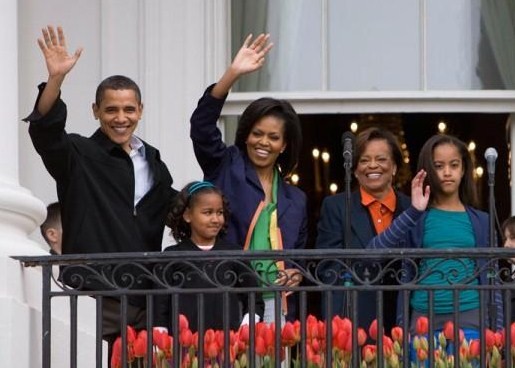
 File:Family of Barack Obama.jpg


African American History Part 7: The Third Era

The Age of Obama (2008- 2017)

One thing about black people is that we are always in involved in historic events. The historic campaign and election of Barack Obama as the first African American President of the United States of America represented a new era of our history. The end of the Bush administration was marred with economic recession, failures from the Iraq War, NSA warrantless wiretapping, the Katrina disaster aftermath, and other problems. Barack Obama spoke to the frustration of black people and others who desired a new way out of a situation caused by far right wing policies. Barack Obama’s gift was his usage of extraordinary intellect, oratory, and charisma to advance story, consensus among different groups, and using structure plus detail to advance his ideas. He was elected with massive support among black people, other people of color, white progressives, the youth, women, college educated people, those who lived in urban areas, first time voters, and other human beings.

Some even promoted the myth that the election of the center-left politician Barack Obama would mean the establishment of a post racial era. Now, we see that to be a myth completely. Barack Obama would represent ironies and paradoxes. Barack Obama, on many occasions, would give middle of the road speeches on race and education (many of which are those that I don't agree with), yet reactionaries would still slander him as a racist and a person who is a socialist. Barack Obama would speak about personal responsibility and family parenting (which conservatives love to hear) involving schools, but that wasn’t good enough for those who viewed him as far left (which he wasn’t). Barack Obama would both execute legitimate policies (like the Lily-Leadbetter Act, the economic compensation to black farmers, the Iranian nuclear deal, normalizing relations among Cuba and America, many reforms in the criminal justice system, etc.) while also executing blatantly bad, neoliberal plus imperial policies (like the Wall Street bailout, the continuation of the NDAA, the massive prosecution of whistleblowers, and the massive drone strikes overseas). He in fact is the representation of the achievements of Black Americans in many areas and how far we have to go in achieving justice and human liberation. One cornerstone of the Obama legacy is his signing the Affordable Care Act, which was a national overhaul of the health care system (filled with legitimate policies and imperfections).

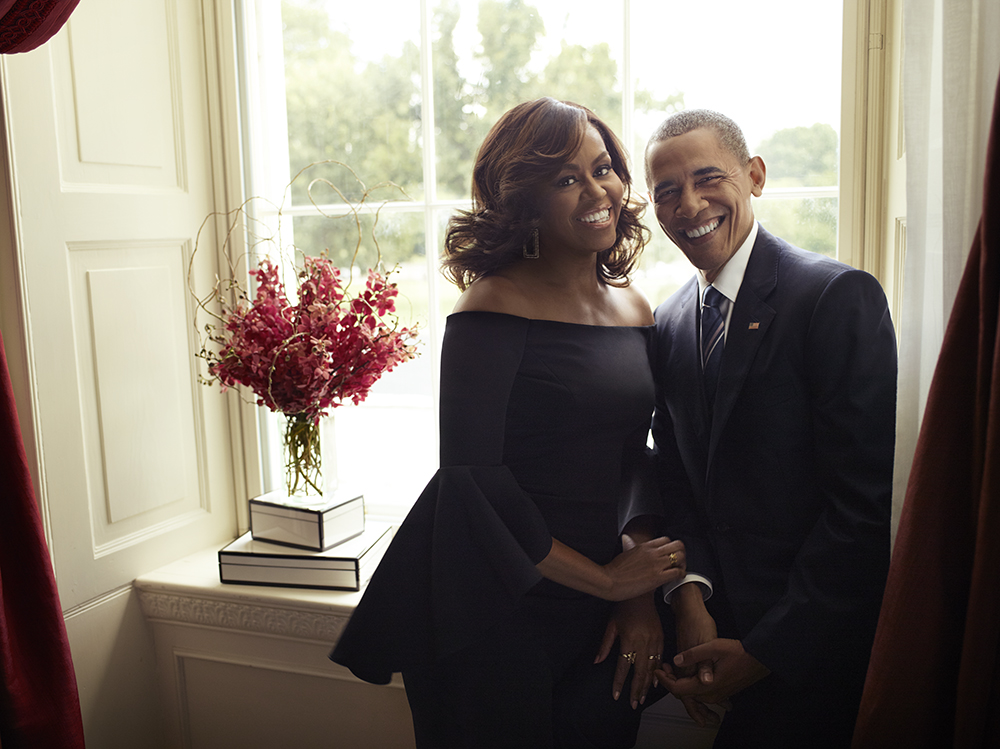
In a sense, how many conservatives view Reagan, many liberals view the same for Obama. Barack Obama is the man who is the paradox of having massive genius intellectually, while we (as black Americans) saw increases of economic inequality, problems of infant mortality, decreases of black Americans wealth during the peak of the Great Recession (as a product of the recession and a fallible capitalist system), and a continued epidemic of police terrorism against black people (especially against poor and working class black people). This is caused by a system which has existed long before Obama was elected, but he is responsible for some of these policies. This reality has been caused by a neoliberal capitalist system that can never solve the problems of poverty and economic exploitation period. Part of the Age of Obama was the inspirational words from First Lady Michelle Obama (she is a black woman with great intelligence and she has heroically advanced the importance of health plus exercise). She told the truth that White House was built by slaves. Michelle Obama is easily the greatest First Lady in history.  The two extreme views (which has been promoted by some) of Obama being nearly perfect (and being immune from any critique as advanced by black bourgeois political figures especially) or Obama being evil incarnate (as advanced by white supremacists especially) must be rejected. We ought to fairly evaluate the Age of Obama as both filled with crisis and filled with a renewed fight among a new generation of social activists for social change. By the end of the Age of Obama, the unemployment rate declined with millions of jobs being created. In terms of LGBT rights, he is the most pro-LGBT President in American history. The Age of Obama did saw the birth of the progressive Black Lives Matter Movement (which I will describe in more detail in the future) and the Occupy Wall Street movement. It saw both the tragedy in Ferguson including in Charleston and it saw more activism by heroes in opposing bigotry, police terrorism, and any injustice. Therefore, we have to look at the Age of Obama in comprehensive terms as a new era of Black America.

Image result for barack obama iowa caucus victory speechImage result for barack obama philadelphia jeremiah wright speech

Obama's Election

The campaign of Barack Obama grew after he announced his candidacy on February of 2007. It was a long campaign with social media being heavily involved from Myspace, Facebook, and to the rest of the Internet. He fought against Hillary Clinton and John Edwards during the Democratic primary among other candidates. By the end of June 2007, Barack Obama out-raised then Senator Hillary Clinton for funds with a $31 million haul. Barack Obama’s campaign was based on “hope and change.” He advocated a withdrawal of American troops from the Iraqi territory (by the end of 2008). He was a previous opponent of the Iraq War. Chris Dodd, Bill Richardson, and others ran for President too.  On September 18, 2007, Barack Obama advocated an $80 billion in tax cuts for the middle class while eliminating part of the Bush tax cuts on the super wealthy. Oprah Winfrey publicly supported Barack Obama on December 8, 2007. Massive crowds would hear him speak and almost 30,000 people came to see Oprah and Obama in Columbia, South Carolina. The historic Democratic Iowa caucus had its results. Obama won the Iowa caucus on January 3, 2008. This sent shock waves all over the world. People celebrated. Hillary Clinton won the New Hampshire primary. Obama won the South Carolina primary later. The South Carolina primary results caused Bill Clinton to compare Obama’s victories to Jesse Jackson’s campaigns in 1984 and 1988 (and Bill Clinton said that Obama would be making him coffee back then according to the late Edward Kennedy). That comment from Bill Clinton caused rightful anger in the African American community. Barack Obama surged in popularity. First Lady Michelle Obama also spoke throughout the campaign. By February 27, 2008, Georgia Democratic Representative and civil rights hero John Lewis reversed his endorsement from Clinton to Obama. Small donations caused Obama to receive massive support. Axelrod was a great apolitical advisor to him too. There were controversies too. There was the Tony Rezko scandal.

There was the March release of news clips of the sermons of Rev. Jeremiah Wright (who was Obama’s pastor for 20 years) at Trinity United Church of Christ in Chicago. Ironically, Wright told the truth on many issues from exposing imperialism, disagreeing with social injustice, and criticizing the overt war crimes of dropping bombs in Hirsohima (plus Nagasaki). Past Jeremiah Wright rightfully abhorred the many evils against black people and Native Americans like slavery and genocide. Yet, it was taboo for anyone to say these comments in public, because courageous black preaching against imperialism has been demonized by the enemies of truth. Jeremiah Wright said “God d___ America.” Barack Obama gave his Philadelphia speech where he denounced Wright’s remarks while saying that black people’s legitimate grievance against racial injustice must be respected. His speech tried to appealed to people’s better natures and it was very conciliatory and moderate. His historic speech on race was called, “A More Perfect Union.” Barack Obama was a genius political figure during the 2008 campaign. Obama talked about some people clinging to guns, religion, and anti-immigrant sentiment. Hillary Clinton criticized this comment, but we know now that many people falsely scapegoat immigrants in explaining why neoliberal policies have caused jobs to be outsourced unfortunately. Debates about Ayers persisted, but he won the Democratic nomination for President among the Democratic Party.

Related image

By June 3, 2008, Barack Obama became victorious to be a Democratic Presidential nominee. His Democratic National Convention speech in 2008 was in Denver. It was powerful and historic. He appealed to black people, working people, and other Americans. He called for energy independence, economic reforms, health care improvement, and other progressive positions. He wanted to end the Iraq War. The Republican candidate John McCain was his political opponent. He debated him in many debates. The Presidential campaign was fierce. Barack Obama equated McCain to the failed policy of the Bush administration. Barack Obama won the election in November of 2008. People cheered. Jesse Jackson cried. Oprah Winfrey celebrated. John McCain gave a very gracious concession speech. Barack Obama gave his victory speech in Grant Park of Chicago, Illinois with his wife and children. He was inaugurated on January 20, 2009 to a large crowd of people. Parades existed and hopes were high for the future of America.

Image result for barack obama inauguration 2009

Political News

During his first 100 days in office, President Barack Obama passed the American Recovery and Reinvestment Act of 2009. It promoted emergency assistance. The stimulus law gave 40 percent of the money to tax cuts and credits to individuals and businesses. It wasn’t a direct government jobs program modeled on the 1930’s era Works Progress Administration. The stimulus package stopped a massive plunge into a worse depression. The unemployment rate continued to increase for a while. He signed the Lilly Ledbetter Fair Pay Act that promoted gender equality involving pay. He promoted an expanded S-CHIP or the State’s Children’s Health Insurance Program. President Barack Obama appointed Sonia Sotomayor (who is the first Latina American on the Supreme Court) and Elan Kagan to the Supreme Court. On October 8, 2009, he signed the Matthew Shepard and James Byrd Jr. Hate Crimes Prevention Act. This is a measure that expanded the 1969 United States federal hate-crime law to include crimes motivated by a victim's actual or perceived gender, sexual orientation, gender identity, or disability. On October 30, 2009, Obama lifted the ban on travel to the United States by those infected with HIV, which was celebrated by Immigration Equality. He repealed Don’t Ask, Don’t Tell in December 22, 2010. On March 11, 2009, Obama created the White House Council on Women and Girls, which forms part of the Office of Intergovernmental Affairs, having been established by Executive Order 13506 with a broad mandate to advise him on issues relating to the welfare of American women and girls. He continued to expanded military involvement in the Afghanistan war while withdrawing military forces from Iraq involving combat missions. President Barack Obama had discussions about Israel, Russia, and the Muslim world. He gave his historic speech promoting tolerance to the Muslim world in Cairo during his first term, but he executed drones strikes and other militarist policies in the Muslim world. So, political news was definitely part of his administration.

Image result for the great recession

The Great Recession

The Great Recession harmed the Black American community in such bad ways, that we have not fully recovered from it to this very day. In essence, the Great Recession was caused by many factors not just one. It involved a massive economic decline in many world markets from the late 2000's to the early 2010's. It was the worse global recession since the Great Depression according to the IMF. The causes of the Great Recession related directly to the financial crisis of 2007, and the U.S. subprime mortgage crisis of 2007-2009 too. Under the economy definition of recession (which is about 2 or more consecutive quarters of GDP decline), it lasted from December of 2007 to June or July of 2009. Yet, the African American community suffered economic hurt to this very day. Subprime loan losses in 2007 expanded the economic crisis. Loses continued and Lehman Brothers fell on September 15, 2008. Neoliberal politicians passed bailouts in their minds to save the largest banks from total financial collapse. During the Great Recession, international trade, and commodity prices declined. Unemployment grew and many human beings foreclosed on their housing since they couldn’t afford to pay their mortgage payments. Household debt increased also. The housing bubble nearly tripled the prices of homes and other real-estate from 1999 to 2007. This huge increase was due in part to the uncontrolled credit given by the American banks that engaged in such practices, and which further increased demand in the housing sector. On December 30, 2008, the Case-Shiller home price index reported the largest price drop in its history. Increased foreclosure rates in 2006–2007 among U.S. homeowners led to a crisis in August 2008 for the subprime, collateralized debt obligation, mortgage, credit, hedge fund, and foreign bank markets.

As early as October 2007, the U.S. Secretary of the Treasury had called the bursting housing bubble "the most significant risk to our only economy.” Economic inequality further grew. The distribution of household incomes in the United States has become more unequal during the post-2008 economic recovery, a first for the U.S but in line with the trend over the last ten economic recoveries since 1949. Income inequality in the United States has grown from 2005 to 2012 in more than 2 out of 3 metropolitan areas. Median household wealth fell 35% in the US, from $106,591 to $68,839 between 2005 and 2011. The U.S. Financial Crisis Inquiry Commission found that some of the causes were the failures of financial regulation (like the Federal Reserve’s failure to stop the spread of toxic mortgages. Back then, many aspects of the derivatives trading lacked transparency and basic regulatory controls) and the financial firms acting too reckless and taking too much risk. Other factors that caused the Great Recession included the following: excessive borrowing and risk by households and Wall Street that permitted this risky reality, and many policy makers failing to prepare for the crisis. Many conservatives blamed the crisis on the actions of Fannie & Freddie since they were involved in government policy in dealing with much of American housing. Liberals, of course, disagree with that assumption. The capitalist system was filled with risky practices, excessive leverage, and instability that contributed to the recession. African American suffered greatly during this era.

The Economic Policy Institute mentioned that in 2010, black unemployment reached above 10 percent. There was the 2001 recession too (as a result of the dot com bubble). Many black workers suffered discrimination, loss of wealth, and massive economic troubles. Bailouts existed for big Wall Street corporations (when no major Wall Street banker have been convicted of financial malfeasance) while the leadership of both parties refused to bailout state and local governments during the Great Recession (and afterwards because many of them believe in the neoliberal, faulty  philosophies of austerity and free market fundamentalism). During the Great Recession, Black household wealth fell to one-twentieth that of median white households. After debts were subtracted from assets, the median white household was worth a little over $113,000, while Black households could lay claim to only $5,600 in assets. Half of Black households were worse off than that, and about half of those had virtually no family worth at all. Studies have documented racial discrimination against black Americans involving many financial situations. Wall Street oligarchs and their allies received the majority of the economic benefits post-Great Recession. That’s the sad part.

Image result for the great recessionRelated image

There has been economic growth since 2009, but that growth has been uneven. The US gained 1.058 million jobs in 2010, 2.083 million in 2011, 2.236 million in 2012, 2.331 million in 2013, and 3.116 in 2014. GDP grew roughly 2.5% in 2010, 1.6% in 2011, 2.3% in 2012, 2.2% in 2013, and 2.4% in 2014. May of 2014 also marked the recovery of all jobs lost during the recession. Over 12.1 million jobs have been created since job losses stopped in February 2010 as of June 2015. However, these new jobs are not equal in pay to those medium-paying jobs lost: roughly 40% are high-paying jobs and 60% are low-paying jobs, further widening the income gap between poor and affluent Americans. Government attempts to reduce deficits via the sequester budget cuts will remain a drag on the economy for as long as the Budget Control Act of 2011 remains in place. I don’t agree with sequester, because of obvious reasons. Economics are complex, so every aspect of an economy can’t be blamed on any President completely. Goods and services spread in the economy while Wall Street banking interests have used hedge funds including derivatives to establish record profits. Only a revolutionary policy can be a real solution. In essence, Americans (and other people worldwide) were victims of an imperfect economic system while the financial oligarchs were heavily involved in exacerbating the Great Recession in the first place. One aspect of the Great Recession was that it has inspired many progressive activists (from Occupy Wall Street to Black Lives Matter) to advance the goal of economic justice.

Image result for Shirley SherrodRelated image

Shirley Sherrod

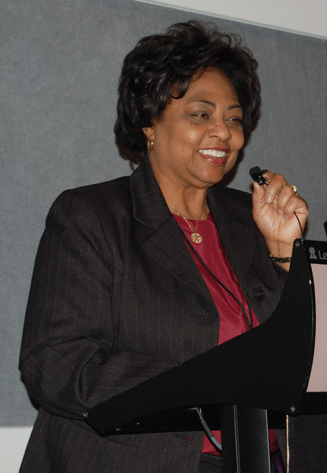
Shirley Sherrod is one of the most heroic black women of our generation. She fought against racial injustice and economic exploitation for decades. On the date of July 19, 2010, Shirley Sherrod was pressured to resign from the U.S. Department of Agriculture (as Georgia State Director). The reason was that she was falsely accused of being racist towards white Americans (in a March 2010 event of the National Association for the Advancement of Colored People). The speech was about overcoming personal prejudices. She helped out a white farmer in 1986 named Roger Spooner. She, at first, thought that he had a superior attitude towards her (and she recalled the murder of her father in the South back in 1965 in Georgia). Later, they became friends. She said that poverty affected all races of people. Sherrod explained that her father’s murder led her to a decision: “I couldn't just let his death go without doing something in answer to what happened. I made the commitment on the night of my father's death, at the age of 17, that I would not leave the South, that I would stay in the South and devote my life to working for change. And I've been true to that commitment all of these 45 years.” The right wing blogger Andrew Breitbart (who died years ago) took her words out of context and edited them in order for him to lie about Sherrod. In regard to the NAACP, Sherrod told CNN, “The NAACP has not tried to contact me one time … I would have appreciated—when you look at my history of civil rights, I would have appreciated having the NAACP at least contact me …contact me to try to get the truth about what happened…That hurts, because if you look at my history, that's what I'm saying. I've done more to advance the causes of civil rights in this area than some of them who are sitting in those positions now with the NAACP. They need to learn something about me. They need to know about my work. They need to know what I've contributed through the years.” Shirley Sherrod was so disrespected that the Obama administration (which included United States Secretary of Agriculture Tom Vilsack, other White House officials, and NAACP officials) apologized to her. Back in 2010, there has been massive coverage of the incident. The situation further caused more debates about racism in American society. I’m glad that Sherrod filed a defamation lawsuit against Breitbart and co-defendant Larry O’Connor. By 2015, the suit was settled in undisclosed terms. Shirley Sherrod is a heroic black woman and a great human being.


Image result for The 2010 Fair Sentencing Act

The 2010 Fair Sentencing Act


Involving black American history, the War on Drugs has harmed so many communities that the 2010 Fair Sentencing Act was passed. For a long time, sentencing disparities have existed among those who use crack cocaine and those who have use powdered cocaine. Also, there are sentences being different among people of different races even if everyone was convicted of the same offense. By the 2010’s, many people from across the political spectrum have called for reforms involving drug policy. People reject the act of massive incarceration as that alone is no solution as families have been ruined as a product of the War on Drugs. The disparities of drug convictions are racist. Even the U.S. Sentencing Commission (USSC) found out in a report in 1995 that showed that almost 90 percent of defendants sentenced under crack cocaine rule were black people.  The USSC, hardly a bastion of antiracism, advocated for the elimination of the 100-to-1 rule, issuing four reports over 20 years that concluded there was indisputable racial bias in the disparity between the mandatory minimum sentencing. Their recommendations were ignored by both Republican and Democratic administrations (who wanted to promote the “tough on crime” rhetoric). The Fair Sentencing Act of 2010 dropped the disparity to 18 to 1. This new law didn’t apply retroactively. Many federal inmates (who are serving time for past crack cocaine convictions) could apply for reduced prison terms. Yet, inmates with criminal histories or those who possessed or use a gun will not be eligible for sentence reductions. So Telisha Watkins, sentenced to 20 years in prison in 2007, won't be eligible for a reduction because of a prior criminal conviction for drug possession. Her likely release date is 2024. Nor will Derrick Cain, sentenced to 10 years for selling cocaine and possession of a firearm. Derrick's gun was legally registered and wasn't used in connection with cocaine sales, but he'll be in prison until 2017. 

The War on Drugs continues even though we know that prohibition doesn’t work and discrimination exists in the criminal justice system among all levels. The Fair Sentencing Act of 2010 also eliminated the five-year mandatory minimum sentence for simple possession of crack cocaine, among other provisions. Some progressives wanted the entire act to be retroactive. According to Gil Kerlikowske, Director of the Office of National Drug Control Policy, "there is no scientific basis for the disparity and by promoting laws and policies that treat all Americans equally, and by working to amend or end those that do not, we can only increase public confidence in the criminal justice system and help create a safer and healthier nation for us all." The sentencing disparity should be eliminated completely. The 2010 Fair Sentencing Act does not reduce sentences for those prosecuted under state law, and state prosecutions account for a vast majority of incarcerations for drug-related offenses. The law represents the further need to end the War on Drugs once and for all (and implement creative alternatives to help society).

Image result for Dr. Martin Luther King Jr. MemorialImage result for Dr. Martin Luther King Jr. Memorial

The Dr. Martin Luther King Jr. Memorial

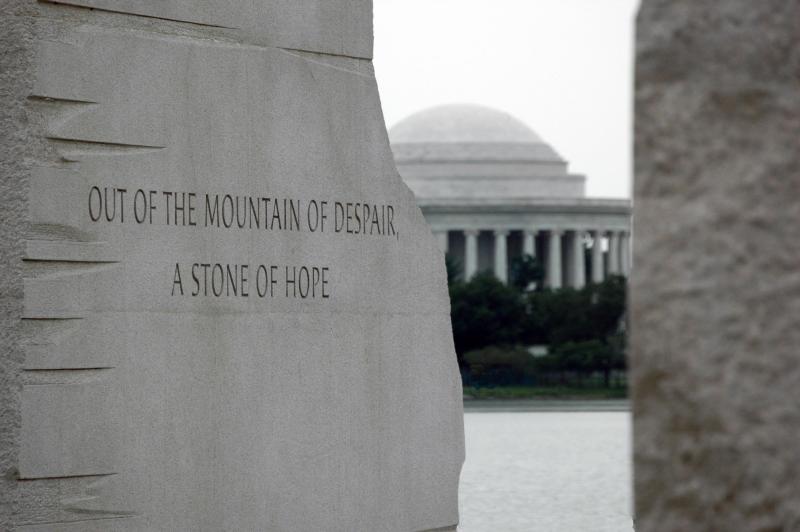
One of the greatest events of African American history during the 21st century was the opening of the Dr. Martin Luther King Jr. Memorial on Washington, D.C. on the date of August 22, 2011. It is found near the National Mall. It is found in 4 acres of land. Lei Yixin was the sculptor who created the Stone of Hope for the granite statue of the Civil Rights leader Dr. King. It existed after long decades of planning, fundraising, and construction. The location is found at the northwest corner of the Tidal Basin near the Franklin Delano Memorial on a sightline linking the Lincoln Memorial to the northwest and the Jefferson Memorial to the southeast. The official address of the monument is 1964 Independence Avenue, S.W. which honors the year when the Civil Rights Act of 1964 became law. This memorial is the first memorial near or on the National Mall that memorializes an African American. The memorial, which is first to honor an African American in Washington, D.C., is the Mary McLeod Bethune bronze statue. It is administered by the National Park Service. The Vision statement of the King Memorial is very clear on how Dr. King wanted freedom and democracy for all. Harry E. Johnson is the President and Chief Executive Officer of the memorial foundation. The Dr. King Memorial has quotes from King’s speeches and sermons. They are found on the Inscription Wall. SCLC staff photographer Bob Fitch and others were involved in the design and construction of the memorial. The official dedication ceremony took place on October 16, 2011 after much delay because of Hurricane Irene. President Barack Obama gave his speech about how the work for justice is not done, but we are still going forward. He linked the civil rights movement from the past to the 21st century events of the Great Recession. Barack Obama talked about Dr. King’s legacy and the need for economic justice. Jesse Jackson, Andrew Young, Al Sharpton, Martin Luther King III spoke at the ceremony. Many singers performed like Aretha Franklin, Stevie Wonder, Sheryl Crow, James Taylor, Jennifer Holiday, and Sweet Honey in the Rock.
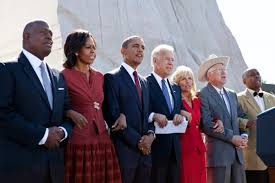
Image result for Dr. Martin Luther King Jr. Memorial ceremony

Over 10,000 people attended. First Lady Michelle Obama, Vice President Joe Biden, Congresswoman Nancy Pelosi, Congressman John Lewis, Congressman Elijah Cummings and former Congressman Walter E. Fauntroy were there too.  Now, it is also important to make other points as well. We have to reject the notion that Dr. King wasn’t a great radical, because many people want to sanitize his message and legacy. The truth is that Dr. King was a revolutionary who wanted a redistribution of wealth. He praised democratic socialism and he admitted that many of the civil rights reforms were limited mainly to the black middle class. So, he wanted to use the Poor Peoples Campaign in order to fight against economic injustice. While both major parties (the Democratic and Republican Parties) are in league with the interests of the military industrial complex, Dr. Martin Luther King Jr. publicly denounced the Vietnam War and exposed the U.S. for its war crimes in Vietnam.
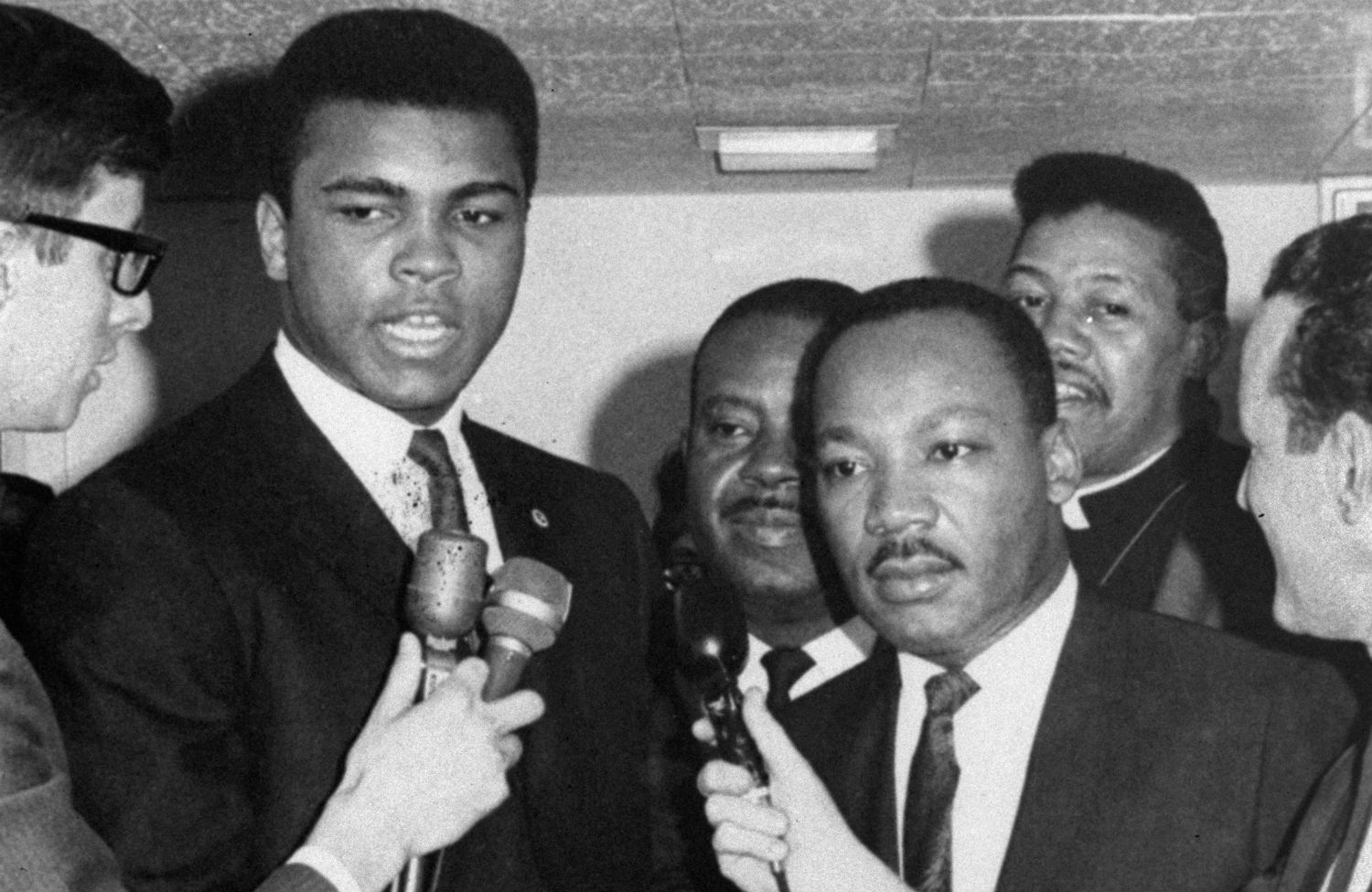
Image result for dr king muhammad aliImage result for dr king coretta scott king

Dr. Martin Luther King Jr. and Muhammad Ali were great friends. Each opposed the Vietnam War and wanted freedom, justice, and equality for black people. Also, Coretta Scott King loved Dr. King a great deal. Coretta Scott King also was a social activist who promoted peace, social justice, and equality. She was a singer too. 

He also branded the United States government “the greatest purveyor of violence in the world today” during his Riverside Baptist Church speech in 1967. Dr. King was a pacifist preacher. The former President Barack Obama have been very aggressive in punishing whistleblowers, giving record bailouts to large banks (while not giving equivalent resources to homeowners, workers, and the poor), and maintaining the growth of the military industrial complex. Dr. Martin Luther King Jr. said the following:  “…I knew that I could never again raise my voice against the violence of the oppressed in the ghettos without having first spoken clearly to the greatest purveyor of violence in the world today – my own government.” So, Dr. King wanted peace in the world.  He spoke out against racism, materialism, and militarism. Therefore, we are in favor of justice, which is about promoting housing, living wages, jobs, and human justice. We certainly need a revolution of values in our public life as Dr. King has eloquently stated. This is why it is always important to endorse black liberation, social justice, environmental justice, and gender justice 100 percent. Our eyes are on the prize. 

Related imageImage result for trayvon martin protests


Trayvon Martin

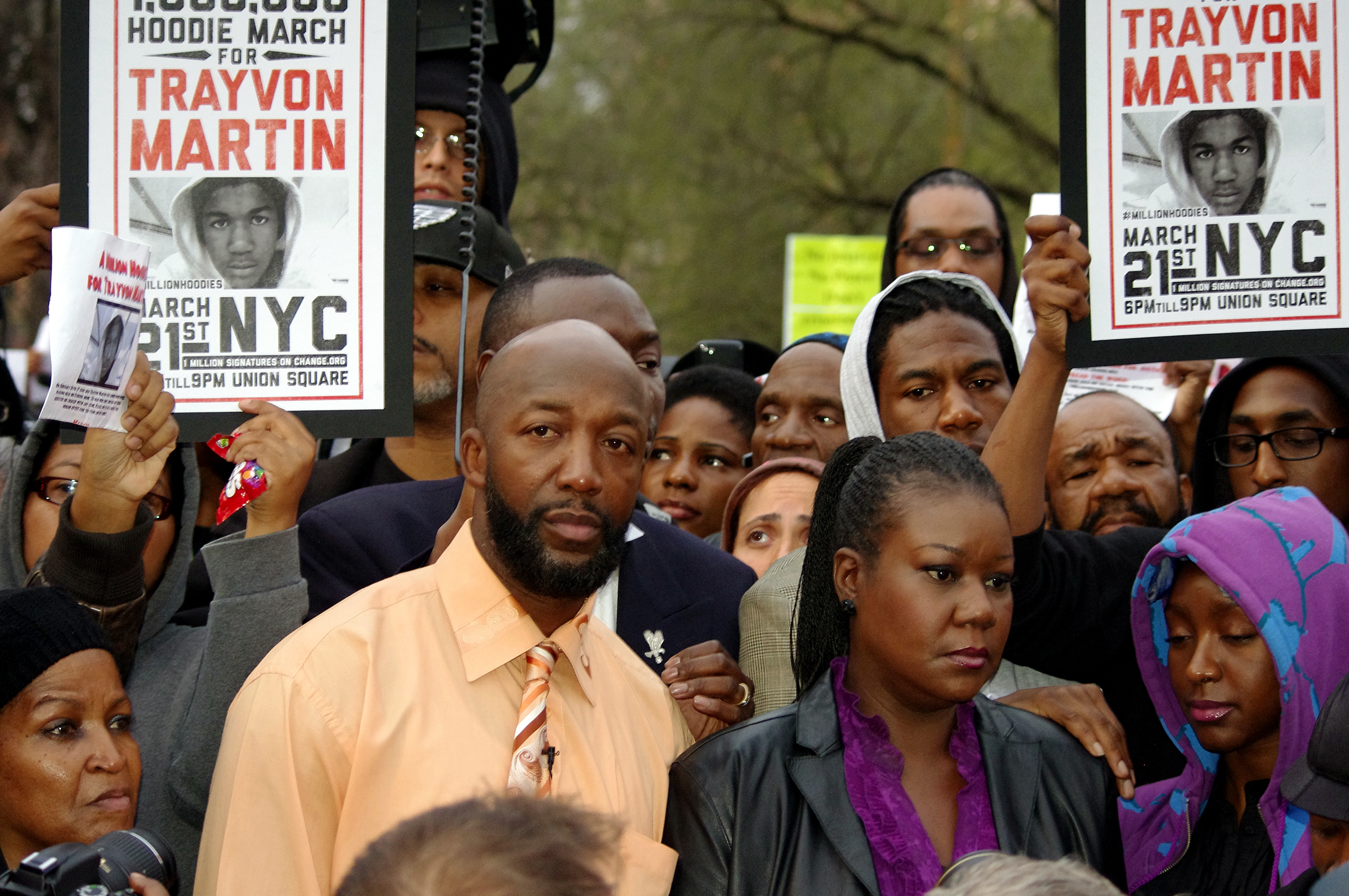
Trayvon Martin’s death was one of the biggest tragedies in American history. He was a young teenager whose life was cut short by a coward named George Zimmerman. Trayvon Martin was killed in Sanford, Florida. Trayvon Martin was trying to return home. Zimmerman stalked him and the police told him not to follow Martin. Yet, he proceeded to do so. He met up with Martin and struggle occurred. Then, Zimmerman used his gun to kill Trayvon Martin. Pressure came in order for authorities to investigate the case. Zimmerman was arrested and a trial commenced. By July 2013, a mostly white jury acquitted Zimmerman. This caused protests nationwide and it inspired the creation of the Black Lives Matter Movement. The Trayvon Martin tragedy makes known of how racism, savage vigilantism, and police brutality continues to exist in our generation. We have to be made aware of the uncomfortable truth that the system of racism/white supremacist was created to harm us and the system must be replaced with a real system of justice. Trayvon Martin’s black life was valuable as any other human life.


Image result for barack obama inauguration 2013


2012 re-election of Obama (and the 2013 inauguration)

The 2012 election or the 57th quadrennial United States Presidential election was the most difficult election of Barack Obama. He worked hard and many of his supporters continued to ally with him. His opposition included Republicans and the new Tea Party movement. The Tea Party movement were made up heavily of right wing conservatives and deficit hawks who believed in the false notion that trickled down economics was a panacea to the end economic problems in America. The 2012 election was about health care, the economy, foreign policy matters, and what would be best for the future. On January 21, 2010, the Supreme Court in a 5-4 decision on Citizens United made the bad decision of allowing corporate funding of independent political broadcasts in candidate election to be unlimited. By November 2010, the Republicans gained control of the House. Many Republican candidates existed like Jon Huntsman Jr., Michele Bachmann, Herman Cain, Newt Gingrich, Ron Paul, Rick Santorum, Tim Pawlenty, Thaddeus McCotter, and others. They debated each other on many social and foreign policy issues. Barack Obama was the Democratic candidate and Mitt Romney won the Republican nomination. Paul Ryan was the Republican vice Presidential candidate. The 2012 Republican National Convention was held in Tampa, Florida in August of 2012 while the Democratic National Convention was held in Charlotte, North Carolina in September 2012. Barack Obama and Mitt Romney debated each other 3 times. The first Presidential debate was at University of Denver in Denver, Colorado. The second one was in Hofstra University in Hempstead, New York and the third one was at Lynn University in Boca Raton, Florida. Barack Obama struggled in the first debate and did a much greater job in the last 2 debates.

By late October 29, 2012, Hurricane Sandy pummels the East Coast. President Barack Obama’s response to the East Coast was praised by Democrats and Republicans. Barack Obama won the election and he was re-elected as President with 51% of the vote. Most African Americans voted for his re-election too. The second inauguration of Barack Obama happened in January of 2013. This was the time of the 150th Year Anniversary of the Lincoln Emancipation Proclamation and the  completion of the Capitol dome in 1863. During the public inauguration on January 21, 2013, the invocation was expressed by Myrlie Evers-Williams, who is the widow of the civil rights leader Medgar Evers. Barack Obama spoke about human rights, climate change, immigration reform, and gun control. About 1 million people came into the inauguration. Later, there was a performance of "The Battle Hymn of the Republic" by the Brooklyn Tabernacle Choir. Vice President elect Biden took his oath from Associate Justice Sonia Sotomayor. After completing his oath of office as the Vice President, Biden received in his honor the first playing of four ruffles and flourishes and the march "Hail, Columbia" by members of the armed forces. This was followed by a performance of "America the Beautiful" by James Taylor. 

 Related imageImage result for obama barack michelle essence kiss


After the performance of "America the Beautiful", Chief Justice John Roberts administered the oath of office to President elect Obama. The Obama family marched in a parade and was part of a National prayer service. The Obama couple danced in many inauguration balls too. President Barack Obama’s 2nd inauguration address was historic since it was an embrace of many causes, especially on social issues. It was his expression of what he wanted to do and why he wanted to do it. He eloquently showed the linkages of many social movements and why it is important to promote equal rights for all. After the inauguration, President Barack Obama will make more decisions that affected Black Americans forever.


Image result for voting suppression laws map


The Supreme Court's gutting of the Voting Rights Act on June 25, 2013

That date of June 25, 2013 was a date of infamy. It’s a date that I will remember for the rest of my life. This is a milestone of the attack on the courage and sacrifice of activists who caused the Voting Rights Act of 1965 to exist in the first place. The people who protested in Selma for voting rights were of many races. Many were poor, many were working class, some were clergymen, some were clergywomen, and they continued to fight. This act of a wrong judicial decision is an attack of democratic rights. The margin of victory was 5-4. Yes, Clarence Thomas was in favor of the gutting of part of the Voting Rights Act too. Chief Justice John Roberts defended the decision. Even Anthony Kennedy supported the evil decision. The law gutted Section 4, which tried to prevent voting discrimination in various states of the Union. Even today in the 21st century, there are countless pieces of evidence of racially motivated discrimination involving voting from the efforts to purge of the rolls of black voters, the redrawing of electoral boundaries, and the Voter ID laws which limit the times and types of ID used to vote. Shelby County v. Holder has gone down in history as one of the most disgraceful decisions of the Supreme Court.

Section 5 of the Voting Rights Act required Alaska and eight southern states, plus parts of seven other states, to pre-clear (or get federal government approval from the Department of Justice and show that they don’t have a discriminatory purpose or effect) any changes in voting procedures with the federal government. To their credits, Justice Ruth Bader Ginsburg and the ACLU have expressed dissent with the decision. Voting rights continue to be under attack. Many Voter ID laws restrict when people can vote, what types of ID people can use, and the locations in which people can vote. Social activists in North Carolina especially have opposed the Voting ID law in that state. According to the Sentencing Project, "1 of every 13 African Americans of voting age is disenfranchised, a rate more than four times greater than non-African Americans. Nearly 7.7 percent of the adult African American population is disenfranchised compared to 1.8 percent of the non-African American population." Nineteen states passed more than 24 measures in 2011 and 2012 that make it harder to vote--"the biggest rollback in voting rights since the Jim Crow era," according to the Brennan Center's Myrna PĂ©rez and Lucy Zhou, writing in the Christian Science Monitor. The 19 states are all over the country, including New Hampshire, Rhode Island, Pennsylvania and Wisconsin. This is a national problem not just a Southern problem. Black Americans continue to fight for voting rights to this very day.
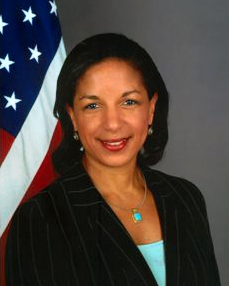

Image result for susan riceImage result for lynch and holder

Black Cabinet members (during the Obama years)

There were many African Americans in the Cabinet of the Obama administration from 2009 to 2017. Eric Holder was the first black Attorney General in American history. The first black woman Attorney General was Loretta Lynch. Both human beings were superbly qualified and dealt with a diversity of issues from legal cases to issues of police brutality (including the criminal justice system). Jeff Johnson was the first black Secretary of Homeland Security in history. John King Jr. was the Secretary of Education. Anthony Foxx was the Secretary of Transportation. Valerie Jarrett was a key advisor in the Obama administration. She has been a long supporter of the Obama family and a businesswoman. She was Assistant to the President for Public Engagement and Intergovernmental Affairs. Susan Rice was Obama’s National Security Advisor. Her expertise dealt with the complexities of foreign policy affairs. Deesha Dyer was the Special Assistant to the President and Social Secretary.  Ashley Allison was the Deputy Director of the Office of Public Engagement. Ashley Etienne was the Special Assistant to President and Cabinet Communications Director.


Image result for beyonce lemonadeImage result for kanye west yeezusImage result for solange table
Image result for macy gray the selloutImage result for rihannaImage result for mary j blige 2014

African American music and culture of the 2010's

African American music and culture during the 2010’s represented new music, diverse cultures, and creative expressions of the diversity of the black experience. During this decade of the 2010’s, indie pop grew. Also, instruments like banjos, ukulele, and other instruments were common. Experimental music had a comeback and hip hop music further evolved with experimentation and the new genre of mumble rap. Electronica were used heavily during the early 2010’s. Gospel music continued to be popular and youth gospel musicians have shown their gifts to the world. By January of 2010, Teddy Pendergrass (who was a R&B soul legend) passed away at the age of 59. For decades, he has performed the world to express his music about love, introspection, and joy in life. Many artists (on January 22, 2010) from Wyclef Jean to Mary J. Blige are involved in the Hope for Haiti Now telethon, which dealt with helping people who suffered from the Haitian earthquake. Haitians fought Western imperialism to create Haiti as the first black Republic of the Americas by 1804. So, we have a great love for Haiti forever. Hope for Haiti Now becomes the first digital-only album to top Billboard 200 albums chart and the largest pre-order album on iTunes until broken in 2012 by Madonna's album MDNA. The January 31, 2010 52nd Annual Grammy Awards took place at the Staples Center in Los Angeles.

BeyoncĂ© broke a record winning 6 Grammys in one night including Song of The Year for "Single Ladies (Put a Ring on It).” It was announced that within 6 months after the death of Michael Jackson sales increased 75% sold in just 6 months 57.5 million records. BeyoncĂ© played at a sold out crowd of 60,000 people in SĂŁo Paulo, Brazil at Morumbi Stadium. A lot of Beyonce's songs were soundtracks of women empowerment. By February 12, 2010, there was the remake of the 1985 song "We Are the World" for victims of the earthquake debuts during the opening ceremonies of the 2010 Winter Olympics. On March 18, 2010, Rihanna’s “Rude Boy" reaches No. 1 on the Billboard Hot 100, becoming her sixth no. 1. This tied her fifth among females to reach no. 1 in the US. Also, it made her the female with the most no. 1 singles since 2000. On May 2010, Bone Thugs-n-Harmony released their reunion album with all original five members entitled Uni5: The World's Enemy.

Macy Gray (on June 2010) released The Sellout to critical acclaim. It is her first studio album in over three years. Drake continued to perform music. On November 22, 2010, Kanye West releases his fifth studio album, My Beautiful Dark Twisted Fantasy, which becomes the best-reviewed album of the year, according to Metacritic. Kanye West is known as a very talented producer and a hip hop artist who expands boundaries about his expression. The 53rd Grammy Awards happen on December 1, 2010. Many artists were nominated and won. 2011 comes about and new music exists. By March of 2011, Chris Brown topped the charts for the first time ever after the release of his fourth studio album F.A.M.E. I don’t agree with Chris Brown on many issues, so I want to make that clear. On August 8, 2011, Jay Z and Kanye West released their anticipated collaborated album called, “Watch the Throne.” On January 20, 2012, Etta James died of leukemia at the age of 73. Etta James was one of the greatest singers of the 20th century and she was a woman who inspired so many artists in our time too. During the Super Bowl XLVI, Nicki Minaj, Cee Lo Green, and other artists performed at its halftime show. The twelve-minute performance becomes the most watched television event of all time, gathering a record 118 million viewers, six more than the game itself.
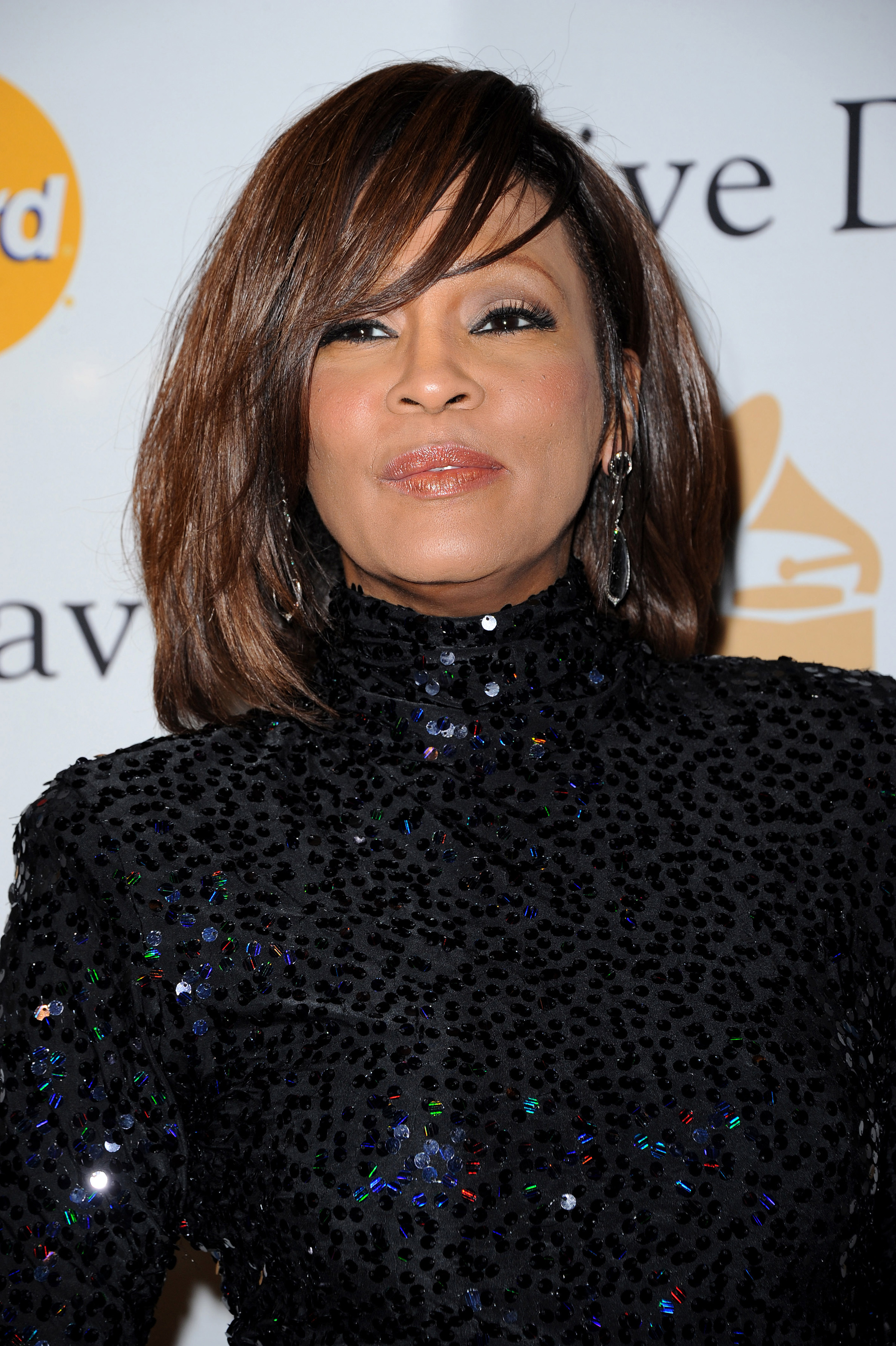
Image result for whitney houston 2011

Whitney Houston in 2011. Rest in Power Sister Whitney Houston. 

On February 11, 2012, the iconic singer Whitney Houston passed away at the age of 48 in her Los Angeles hotel room. This was hours before a pre-Grammy party hosted by Clive Davis. She suffered heart diseases and a drowning. Whitney Houston was a legend and I felt shocked when she passed.  Sales of her albums spike, and "I Will Always Love You" re-enters the top ten of the Billboard Hot 100. Whitney Houston was more than a singer. She was a woman who loved her spirituality and she greatly loved her family plus fans. She was born and raised in Newark, New Jersey. Whitney Houston was heavily awarded and she was the greatest vocalist singer of our generation period.

On the February 12 Grammys, Kanye West won 4 Grammy awards. Donna Summer passed away in May 17, 2012 at the age of 63. On June 29, 2012, Chris Brown goes to number 1 on the charts a second time after the release of his fifth studio album Fortune. This was the year when Snoop Dogg changed his name to Snoop Lion. On November 19, 2012, Rihanna released her new album Unapologetic scoring her first #1 album on the US charts. In January 2013, Jay Z tours. Alicia Keys sang the National Anthem and BeyoncĂ© performed during the Super bowl XLVII halftime show on February 3, 2013. On June of 2013, Kanye West released his sixth studio album (filled with controversy and unique sounds) called Yeezus. Yeezus was unlike any hip hop album in history. 

On September 2013, Sister Janelle Monae related her critically acclaimed album, "The Electric Lady." It was very popularity and it showed the myriad of musical skills from Janelle Monae. It outlined important messages about creativity, tolerance, acceptance, and a love of music. As music can unite people, Janelle Monae wants her music to unite people, especially among those who feel left out or oppressed. She is a great dancer too. She was born in Kansas City, Kansas in the Midwest. Electric Lady has influences from  hip hop soul, funk, gospel, jazz and rock. Songs like Electric Lady, Q.U.E.E.N., Victory, etc. outline her intentions and her gifts of expression. She continues to advocate for Black Lives Matter, STEM fields for human beings, and artistic growth among humanity in general. 

By December of 2013, one of BeyoncĂ©’s most acclaimed albums and her surprise fifth studio album was called BeyoncĂ©. It is a visual album and it has 14 songs and an accompanying music video for each song. The album debuts at #1 based on 3 days of digital sales, maybe BeyoncĂ© the first female artist, and second artist overall to debut at the top spot with her first five studio efforts. The album of BeyoncĂ© shows anthems of women empowerment, sexuality, and many diverse issues. It includes contemporary R&B with electronic and soul music. One of her greatest songs on her album was "Pretty Hurts" which promotes human self esteem. On January 26, 2014, the 56th Annual Grammy Awards existed. It was located in Staples Center in Los Angeles. By May 13, 2014, Michael Jackson released his second posthumous album of previously unreleased songs. The album is called Xscape. On August 24, 2014, there was the 31st Annual MTV Video Music Awards take place in Inglewood, California. BeyoncĂ© won 4 awards that night and also received the Michael Jackson Video Vanguard Award, presented to her by her husband Jay Z and her daughter Blue Ivy following her 16-minute performance to close the show. TLC released their first single in nine years called "Gift Wrapped Kiss" (on December 15, 2014).

Image result for janet jackson unbreakable tourImage result for beyonce superbowl black panthers

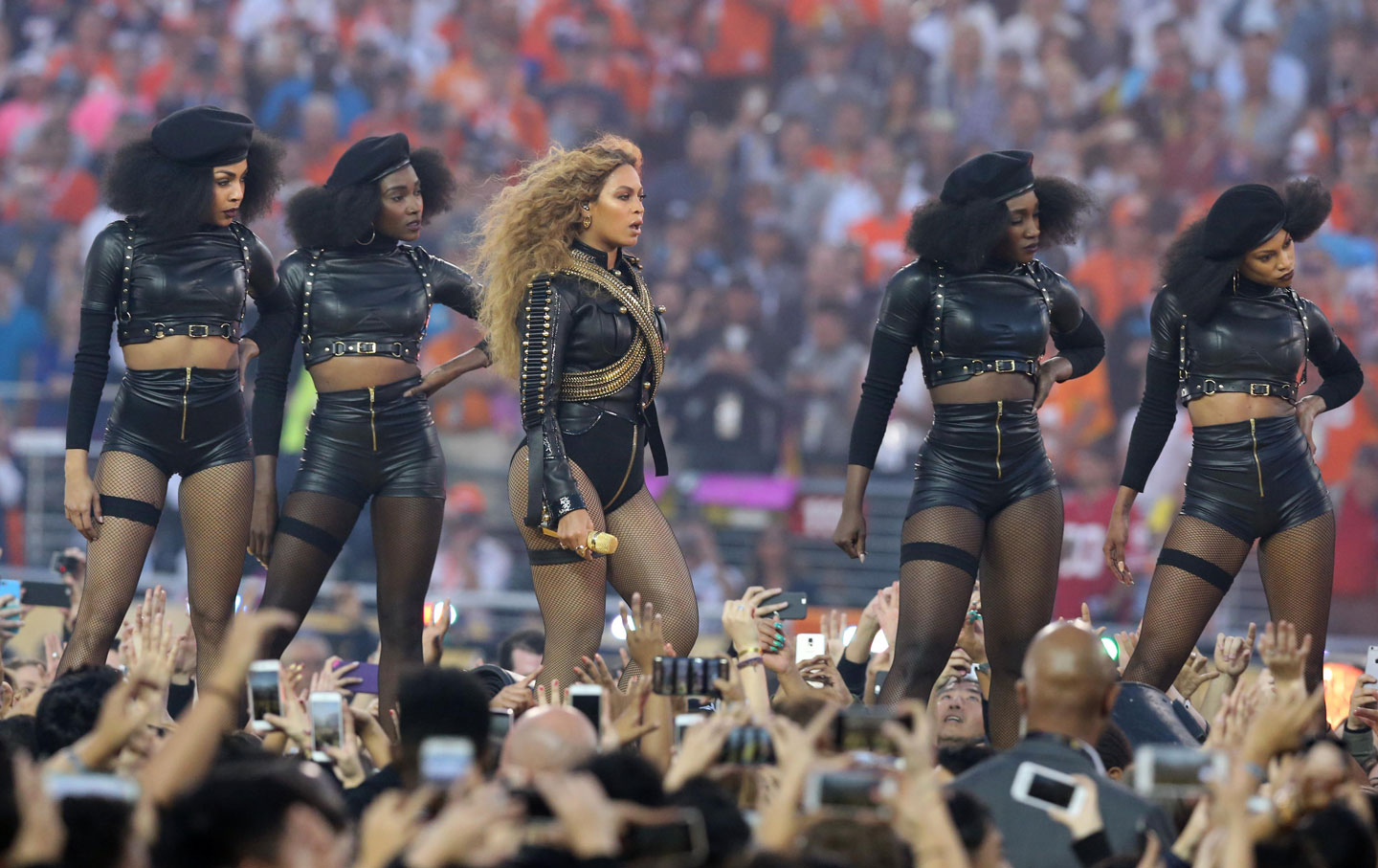
On October 2, 2015, Janet Jackson releases Unbreakable her first album since 2008's Discipline to widespread critical acclaim. The album goes on to top the Billboard 200 chart. In 2015, Kendrick Lamar grows in popularity with his lyricism and diverse messages in his songs. On January 11, 2016, Ciara performed the National Anthem at the second College Football Playoff Championship. On January 28, 2016,  Rihanna released her eighth studio album Anti. Two days following its release, the album was certified platinum by the Recording Industry Association of America (RIAA) after receiving 1 million free downloads in 15 hours due to a deal with Samsung. This was the fastest certified platinum album in history. BeyoncĂ© performs in the halftime show of the Super Bowl 50 in Santa Clara, California on February of 2016. BeyoncĂ© pays homage to the Black Panthers, BLM, and pro-black movements in general with her performance. We know that is truly sacrosanct to praise Blackness and to acknowledge great social activism from the past and during the present too. Kanye West released his seventh studio album, The Life of Pablo, as a Tidal exclusive. After a couple of months being exclusive to the streaming service it was made available for purchase in an updated format (on February 14, 2016).

The 58th Annual Grammy Awards took place at the Staples Center in Los Angeles on February 15, 2016. Lamar won the most awards of the night with five. On March 5, 2016, Rihanna's single "Work" became the first dancehall song to top the Billboard Hot 100 since Sean Paul's "Temperature" in 2006. La’Porsha Renae continues to do music from 2016 to the present. Prince passed away on April 21, 2016. It was a shock. He won the Grammy Awards seven times. He could sing, play instruments, and dance. Prince broke down taboos and still was himself while he was doing it. He passed away in his recording studio in Minnesota.


Related imageImage result for kendrick lamar 2017Related image

Kendrick Lamar and SZA are certainly black artists of the present and the future. 

On April 23, 2016, BeyoncĂ© premiered her sixth studio album Lemonade on HBO with an hour-long film. The album was released on Tidal, where it remained exclusively available to stream for 24 hours, until it was uploaded to all formats, including iTunes. Upon the album debuting at number-one on the Billboard 200 chart, BeyoncĂ© became the first act in Billboard history to have their first six albums debut at number one. I saw the whole Lemonade film on HBO for free. It was very creative, innovative, and showed the diverse experiences of black women in general. Lemonade is her signature album and it will be analyzed for generations. On September 30, 2016, Solange released her critical acclaim album “A Seat at the Table. “ It was unapologetic in promoting Blackness, women empowerment, mental health awareness, and self-determination. It showed her showing emotion, joy, love, and anger at injustice. “Cranes in the Sky” is one song that was honest in showing feeling. Other songs like 'F.U.B.U.,' 'Mad,' 'Don't Touch My Hair' outline the truth that a black woman’s autonomy, wisdom, and passion for change must always be honored and respected.

On November 11, 2016, A Tribe Called Quest released We Got It from Here... Thank You 4 Your Service, their first studio album since 1998 and also their final studio album. The album was tribute to Phife, who was the heart and soul voice of the group A Trible Called Quest. He recently passed away on March 22, 2016. He was 45 years old and he was born in St. Albans, Queens, NYC.

Rest in Power Brother Phife.


Related imageImage result for erykah badu janelle monae

In 2017, artists continued to perform and innovative involving music. On January of 2017, Bell Biv DeVoe released their first album in sixteen years, Three Stripes. On February 12, 2017, the 59th Annual Grammy Awards took place at the Staples Center in Los Angeles.  Chance the Rapper became the first ever unsigned artist to win a Grammy. The awards he won are Best New Artist, Best Rap Performance, and Best Rap Album. On March 5, 2017, the iHeartRadio Music Awards took place at the Forum in Inglewood, California. Chrisette Michelle, Jill Scott, Tamia, Deborah Cox, Coco, Ledisi, and other artists are amazing singers of the 21st century as well.
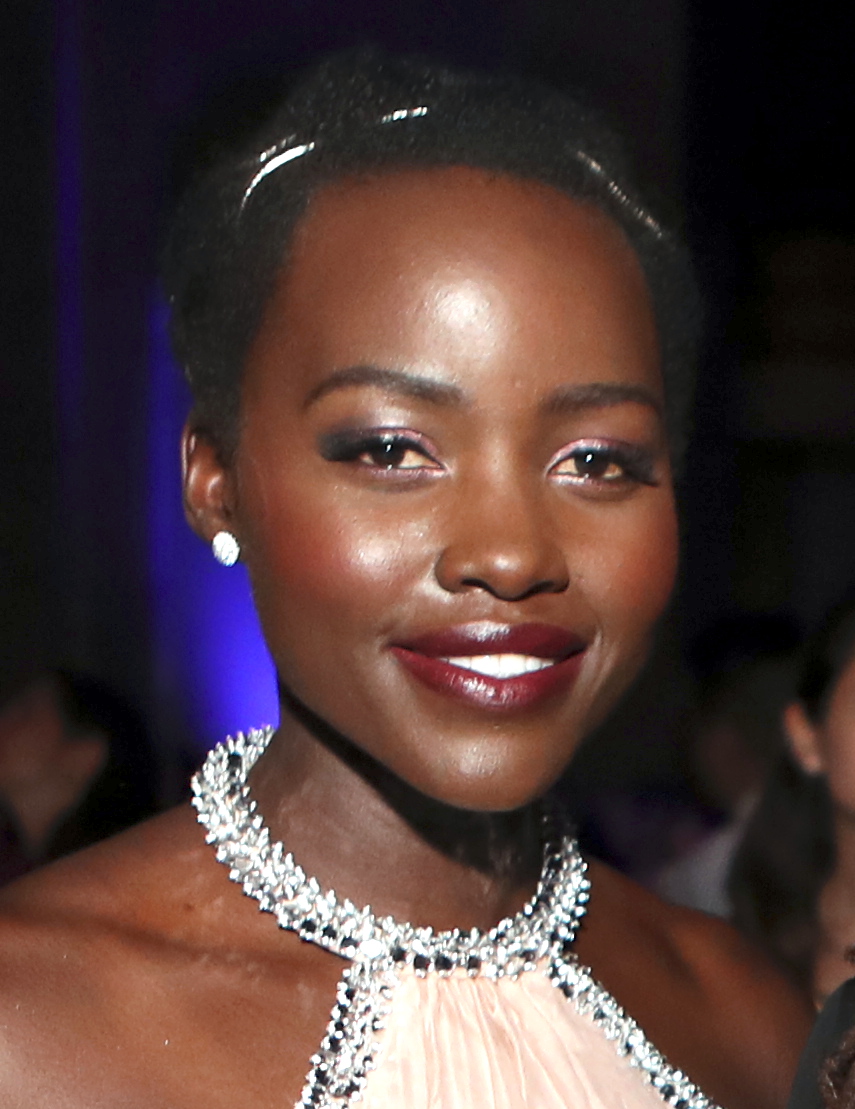

Image result for 20 years a slave movieImage result for lupita nyong'oRelated image
Related imageImage result for insecure issaImage result for rebel bet

Also, African American culture became more diverse and interesting during the decade of the 2010’s. This is the age of massive social media from Snapchat, Facebook, and to Instagram. That is why many of my relatives have Facebook accounts. In 2010, For Colored Girls was released about the pain, adversity, and triumphs of black American women. It is a very emotional film. The movie Night Catches Us is about a drama dealing with 1970’s Philadelphia (involving the Black Panthers, love, and decisions to make).  The film was directed and written by Tanya Hamilton and stars Kerry Washington, Anthony Mackie, Jamie Hector, Wendell Pierce and Novella Nelson. The Walking Dead premiered in 2010 on AMC. The Walking Dead is an unique show since fans of the show exist among every color, every socioeconomic background, and every background in general. In 2011, movies like Pariah, The Help, etc. came out. These films deal with romance, sexuality, the civil rights movement, and courage. Also, the Black Power Mixtape 1967-1975 came out in 2011 too. I have watched the film and the documentary gives an eye opening look at the Black Power movement. It gives an up-close insights into the era of the Black Panthers, Kwame Ture, Dr. King, and other activists for change. Commentaries include words from poets and hip hop artists like Erykah Badu and Talib Kweli. Gina Torres is a well-known actress of Suits which started in 2011. In 2012, Red Tails, and Men in Black 3 came out. Middle of Nowhere is a 2012 independent feature film written and directed by Ava DuVernay (who is a great director and a conscious black woman) and starring Emayatzy Corinealdi, David Oyelowo, Omari Hardwick and Lorraine Toussaint. The film was the winner of the Directing Award for U.S. Dramatic Film at the 2012 Sundance Film Festival. The movie is about a Registered Nurse must come to terms with her husband receiving an eight-year prison sentence. Ava Duvernary wanted to show the turmoil many women go through when their lovers are incarcerated. She also wanted to show love among black people, which is very important. Scandal came about in 2012 and its stars Kerry Washington.

2013 was a monumental years of black movies without question. This year had 12 Years a Slave, Fruitvale Station, the Butler, 42 (or the story of Jackie Robinson, which I have seen before), The New Black documentary, Black Nativity (which has an ensemble cast of black people telling the story about a family trying to survive in a cruel world and it shows the real value of family and togetherness), etc. Orange is the New Black has African American people in it from Uzo Aduba, Lorraine Toussaint, Samira Wiley, Vicky Jeudy, Laverne Cox, Danielle Brooks, etc. It is a series on Netflix about the experiences of women in prison. In 2014, Dear White People, Selma, Annie, Black Coffee, and other films came out. In 2014, How to Get Away with Murder and Gotham premiered. By September 24, 2014, the critically acclaimed show Black-ish was released. It has an ensemble cast of black people like Anthony Anderson, Tracee Ellis Ross, Yara Shahidi, Marcus Scribner, Miles Brown, Jenifer Lewis, Laurence Fishburne, and other people.

The comedy is about an upper middle class African American family who navigates the complex world of American society. The show tackles issues of race, culture, school, class, sex, police brutality, etc. One episode talked about the Black Lives Matter movement in emotional, important terms too. The show has received a Golden Globe Award for Best Actress for Tracee Ellis Ross, Emmy and Golden Globe nominations for Outstanding Comedy Series, and a TCA Award for Outstanding Achievement in Comedy. Black came out in 2015 including the Black Panther documentary from Stanley Nelson. Rosewood came out in 2015. It is about doctors in Miami, Florida. Empire on FOX was released in 2015. In 2016, Fences, Moonlight, and Fifty Shades of Black (which is a comedy) were released in 2016.

Image result for afropunk festivalImage result for afropunk festival

These human beings are in an Afropunk festival. 

On September 26, 2016, the HBO TV series Insecure was released. It stars actress Issa Rae. It is about the experiences of a black woman in post-modern American society. It was created by Issa Rae and Larry Wilmore. Raphael Saadiq created original music for the first season. Solange Knowles served as music consultant; she was introduced to Rae by Matsoukas, who directed the music video for Knowles's song "Losing You.” Other actors and actresses on the series include Jay Ellis, Yvonne Orji, Lisa Joyce, Natasha Rothwell, Amanda Seales, Y’lan Noel, and other people.  On September 2016, the Netflix action series Luke Cage (relating to Marvel) was released. It stars Mike Colter as Luke Cage, who fights crime in Harlem, NYC with his superpowers. Other people in Luke Cage include Alfre Woodard, Rosario Dawson, Mahershala Ali, Simone Missck, Mustafa Shakir, Gabrielle Dennis, etc. Atlanta, the TV series was released in 2016. The 2010’s saw the continuation of reality TV shows. Many of them show some of the most anti-black stereotypes around.  

In 2017, BET released new shows like Rebel (which is about a black woman private investigator, once Oakland police officer, fighting police brutality while trying to find the killer of her brother) and the Quad (about HBCUs in the modern generation of the 2010's). BET also shown the movie Madiba, which was a film about the life story of the heroic legend Nelson Mandela. Nelson Mandela was played by Laurence Fishburne. Actress Danielle MonĂ© Truitt was cast as lead character of the show Rebel, while Giancarlo Esposito, Mykelti Williamson, Method Man, and Brandon Quinn also were cast as series regulars in Rebel. In July of 2017, Snowfall premiered in FX. It is a show about the crack epidemic, drug dealers, the CIA, and Southern California. In 2017, the documentary about the role of HBCUs involved in the Civil Rights and racial equality movements was finished. It is called, “Tell Them We are Rising: The Story of Black Colleges and Universities.” Many of my relatives graduated from HBCUs, so this documentary is very personal with me. The filmmakers include an all-star cast of directors and producers like: Stanley Nelson (producer and director), Maroc Williams (co-producer and co-director), Stacey L. Holman (producer), and Cyndee Readdean (a producer). Time goes onward and culture is an exciting aspect of our humanity. 


By Timothy


Thanksgiving 2017 Part 2


Image result for st. louis


St. Louis


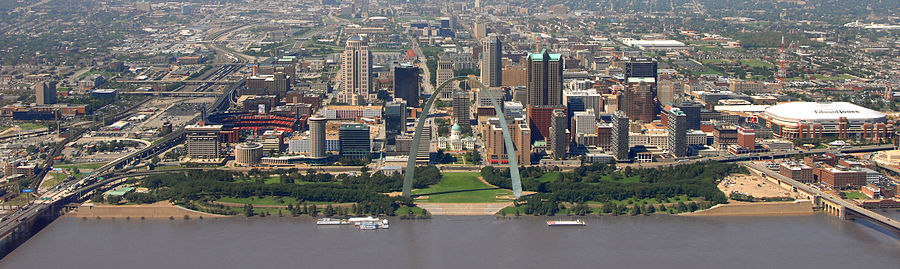
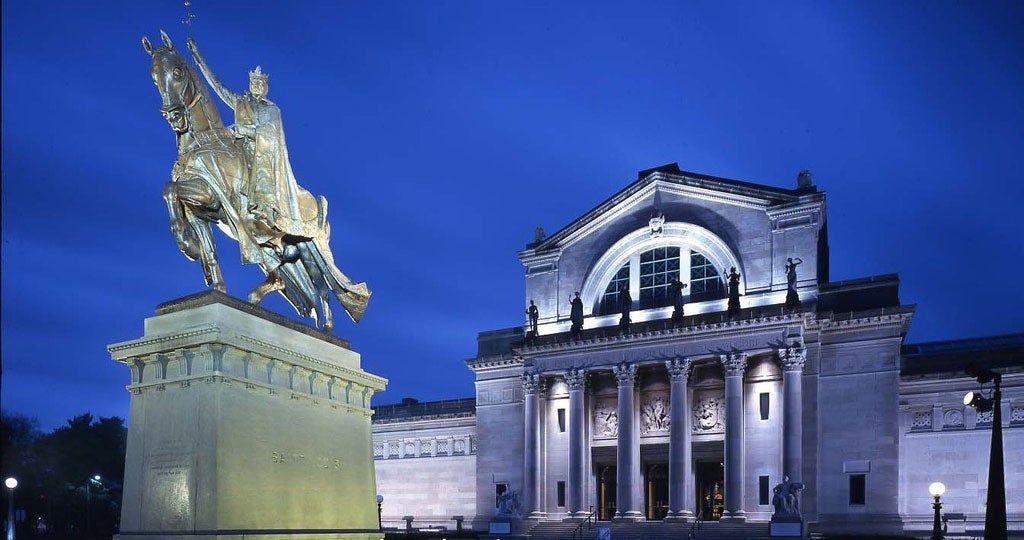
The Midwestern city of St. Louis has a long history and vibrant culture. It is a major port in the state of Missouri and it's fond on the western bank of the Mississippi River. It is a city that borders Illinois. It has over 310,000 people and its metropolitan area has almost 3 million people. St. Louis has a diverse history too. Like other Midwestern cities, it has a culture that is diverse filled with immigrants, black people, great art, excellent cuisine, and lively institutions. Like other cities, it was once a depot of segregation and other injustices that courageous people in St. Louis fought to end. It is a city with gorgeous architecture and down to Earth human beings. From 1764 (when it was founded by the French fur traders Pierre Laclède and Auguste Chouteau. The city was named after the King Louis IX of France) to the present, St. Louis is filled with a history of development and growth. St. Louis has the Forest Park Jewel Box, MetroLink, the St. Louis Art Museum, the Gateway Arch, etc. The economy of St. Louis deals with service, manufacturing, trade, transportation of goods, and tourism. Many corporations are in the metro area of St. Louis like Anheuser-Busch, Express Scripts, Boeing Defense, Scottrade, Go Jet, etc. It has a large medical, pharmaceutical, and research presence too. Its current mayor is Lyda Krewson. It is a city of 66 square miles. To the East of St. Louis is found East St. Louis, Illinois. South of St. Louis include Cahokia and Columbia (which are both found in Illinois). North of St. Louis are Castle Point and Jennings (both found in Missouri). Ferguson and Florissant are found northwest of St. Louis. Clayton, Chesterfield, and Richmond Heights are found to the West of St. Louis. It's a home to architects, musicians, social activists, teachers, other scholars, scientists, engineers, doctors, nurses, athletes, lawyers, judges, politicians, and other contributors to society. St. Louis is here to stay and we will always respect the great culture and the great people of St. Louis, Missouri.


Image result for st. louis early native americans


Early St. Louis

St. Louis has a long history. In the beginning, the first people of St. Louis were Native Americans. Native Americans built the complex, highly advanced Mound builder civilization.  The people of the Mississippian culture created more than two dozen burial mounds around the area of the city of St. Louis. These mounds existed in ca. 1050 A.D. Some settlements of early St. Louis are preserved at the Cahokia Mounds site in Illinois. The mounds in St. Louis were almost all demolished. Only one mound remains within the city called Sugarloaf Mound. Although, St. Louis maintained the nickname of “The Mound City” well into the 19th century. Many Native Americans settled along the Mississippi River and its tributaries, especially the Missouri River. Many Native Americans created canoes for transportation out of the large forests in the region. The end of the Mississippian culture by the 14th century resulted in a new era of history in the area. There were French Canadian settlers and Siouan speaking groups like the Missouri and the Osage migrating into the Missouri valley. They lived in villages along the Osage and Missouri rivers. Both groups had conflict with the northeastern tribes like the Sauk and the Fox. All four of these groups confronted the earliest explorers of Missouri. Europeans explored the area almost a century before the city of St. Louis was officially founded. By the early 1670’s, Jean Talon, went along the Mississippi River after hearing of rumors that it connected to the Pacific Ocean. So, explorer Louis Joliet and Jesuit priest Jacques Marquette came into the Mississippi River on June 1673. They traveled past the confluence of the Missouri and Mississippi to the mouth of the Arkansas River. At this point Joliet returned north after determining the river would not reach the Pacific and fearing attack by Spanish settlers. Nine years later, the French explorer La Salle led an expedition south from the Illinois River to the mouth of the Mississippi. He claimed the entire valley for France.

La Salle named the Mississippi river basin Louisiana after King Louis XIV. That region was between and near the confluence of the Ohio and Mississippi was named Illinois Country. Many forts existed in the Mississippi valley. In 1699, the French built a settlement on the east bank of the Mississippi at Cahokia, Illinois, near the Cahokia Mounds complex. During the next year, the Kaskaskia tribe formed a village at a small river. It was within the present day area of St. Louis. There were two Jesuit priests, Pierre-Gabriel Marest and Francois Pinet, who built a small mission at the site, naming the river the River Des Peres (River of the Fathers). However, by 1703 the site was abandoned as the Kaskaskia moved to the east bank and further south to a new settlement named Kaskaskia, Illinois. A powerful monopoly involving trade was sent to Antoine Crozat in the Mississippi Valley. He wanted to find and mine precious stones, gold, and silver. Yet, Crozat’s venture failed by 1717, because of Spanish interference. He relinquished his charter. The next company to be granted a trade monopoly for the region was led by John Law. Law was a Scottish financier. In 1717, Law convinced Louis XIV to provide the Company of the West a 25-year monopoly of trade and ownership of all mines, while promising to settle 6,000 whites and 3,000 black slaves (as a way to build churches throughout the region). The company founded New Orleans as the capital of Louisiana in 1718, and merged with other companies in 1719 to form the Company of the Indies. There was a financial crisis. Law was ousted in 1720. The Company of the Indies formed its capital of the Illinois Country (in upper Louisiana) at Fort de Chartres. That location was 15 miles north of Kaskaskia on the east bank of the Mississippi.

There was another early settlement. It was near present day St. Louis. It was called Ste. Genevieve, Missouri. It was built in 1732 across from the Kaskaskia village as a convenient port for salt and ore was mined on the western side of the Mississippi. The Company of the Indies began making trade ties with the Missouri River tribes during the early 1720’s and the 1730’s. French economic policy dealt with trade with the Spanish colony of New Mexico to the southwest. Many trade expeditions between New Mexico and the Mississippi valley occurred between 1739 and the Seven Years’ War of 1756-1763. The war destroyed the wealth of many French trading firms and merchants based in New Orleans. The French governor of Louisiana began granting trade monopolies in several areas at the conclusion of the war to stimulate growth.

Image result for Jean-Jacques Blaise d’AbbadieDrawing of the St. Louis street grid from the 1780s showing the river and a small village

The founding of St. Louis

The St. Louis founding existed during the 18th century. Jean-Jacques Blaise d’Abbadie was the new governor of Louisiana in June of 1763. He changed colonial policies. He moved to grant trade monopolies in the middle Mississippi Valley to stimulate the economy. Among the new monopolists was Pierre Laclede, who along with his stepson Auguste Chouteau set out in August 1763 to build a fur trading post new the confluence of the Missouri and Mississippi rivers. The settlement of St. Louis was established at a site south of the confluence of the west bank of the Mississippi on February 15, 1764, by Chouteau and a group of about 30 men. Laclede arrived at the side by mid-1764 and provided detailed plans for the village, including a street grid and market area. French settlers started to arrive form settlements on the east bank of the Mississippi River in 1764. They were afraid of British control. This was after the transfer of eastern land to Great Britain after the Treaty of Paris. The local French lieutenant governor moved into St. Louis in 1765. He started to award land grants to people.

There were peace negotiations to end the Seven Years’ War. It caused Spain to gain control of Louisiana according to the secret Treaty of Fontainebleau in 1762. Due to travel times and the Louisiana Rebellion of 1768, the Spanish took official control in St. Louis only in May 1770. After the transfer, the Spanish confirmed French land grants and the Spanish provided local security. Most settlers in St. Louis were involved in farming. By the 1790’s, almost 6,000 acres were cultivated around St. Louis. Far trading was the major commercial focus of many residents. It was much more lucrative than agriculture during that period. The residents were not religious per se, but most of them were Roman Catholic. Most French people in America during that time were Roman Catholic. The first Catholic Church in St. Louis was built in mid-1770 and St. Louis had a resident priest by 1776. It caused Catholic religious observance a more customary component of life. The French settlers had both black and Native American slaves in St. Louis. Most of them worked as domestic servants. Some were agricultural laborers.

By 1769, the Spanish prohibited Native American slavery in Louisiana. Yet, it was still done among the French Creoles in St. Louis. Spanish governors ended the Native American slave trade. Yet, they allowed the retention of current slaves and any children born to them, which was evil. In 1772, a census determined the population of the village to be 637, including 444 whites (285 males and 159 females) and 193 African slaves, with no Indian slaves reported due to their technical illegality.  During the 1770's and 1780's, St. Louis grew slowly and the Spanish commanders were replaced often. During the beginning of the American Revolutionary War, the Spanish governor Bernardo de Galvez (in New Orleans) helped the American rebels with weapons, food, blankets, tents, and ammunition. The Spanish lieutenant governors at St. Louis aided the colonists too. They especially helped the forces of George Rogers Clark during the Illinois campaign. On June 1779, the Spanish Empire came into the American Revolutionary War on the side of the Americans and the French. The British prepared to invade St. Louis and other Mississippi outposts. Yet, St. Louis was warned of the plans and residents fortified the town. On May 26, 1780, British and Indian forces attacked the town of St. Louis, but were forced to retreat due to the fortifications and defections of some Indian forces.

Painting of the Battle of St. Louis of 1780 showing attacking Native Americans and the defending town 


In spite of their defeat, the British and their allies destroyed much of St. Louis' agricultural lands and cattle stock, killed 23 residents, wounded 7, and captured between 25 and 75 as prisoners (some might have been murdered after their capture). A subsequent counterattack launched from St. Louis against British forts in the Midwest ended the threat of another attack on the town. After the British were defeated, more French Creole families evaded Anglo-American rule by moving to the Spanish-controlled land on the west bank, including wealthy merchants Charles Gratiot, Sr. and Gabriel Cerre. Both the Gratiot and Cerre families intermarried with the Chouteau family to create a Creole-dominated society in the 1780's and 1790's. The families also had marital ties to Spanish government officials, including the lieutenant governors Piernas and Cruzat. During the 1790’s, towns near St. Louis grew. This was when small farmers sold their lands to the Cerres, Gratiots, Soulards, and the Chouteaus. These farmers moved into towns like Carondelet, St. Charles, and Florissant. Only 43% of the district’s population lived within the village by 1800 (1,039 of 2,447). The Spanish government secretly returned the unprofitable Louisiana territory to France in October of 1800 in the Treaty of San Ildefonso. The Spanish officially transferred control in October 1802. Yet, the Spanish administrators were in charge of St. Louis throughout the time of French ownership. Later, a team of American negotiators purchased Louisiana, including St. Louis. On March 8 or 9, 1804, the flag of Spain was lowered at the government buildings in St. Louis and, according to local tradition; the flag of France was raised. On March 10, 1804, the French flag was replaced by that of the United States.

 St-Louis-slave-auction-thumb

This picture shows an evil slave auction in a St. Louis courthouse. Black people, many German immigrants, and others were strongly anti-slavery in St. Louis. 

The Antebellum period

By the antebellum period, St. Louis experienced many changes. The governor of the Indiana Territory by the beginning of the 1800’s governed Louisiana District (which included St. Louis). The district’s organizational law forbade the slave trade and reduced the influence of St. Louis in the region. Wealthy St. Louisans petitioned Congress to review the system. By July of 1805, Congress reorganized the Louisiana District as the Louisiana territory with its territorial capital at St. Louis and its own territorial governor. From the division of the Louisiana Territory in 1812 to Missouri statehood in 1821, St. Louis was the capital of the Missouri Territory. St. Louis’ population grew slowly after the Louisiana Purchase. Yet, the expansion increased desire to incorporate St. Louis as a town. This allowed it to create local ordinances without the approval of the territorial legislature. On November 27, 1809, the first Board of Trustees was elected. The Board passed slave codes. It formed a volunteer fire department. It also formed an overseer to improve street quality. The Board enforced the town ordinances by creating the St. Louis Police Department and a town jail was established in the fortifications built for the Battle of St. Louis. After the end of the War of 1812, the population of St. Louis and the Missouri Territory began expanding quickly. During this expansion, land was donated for the Old St. Louis County Courthouse. The population increase stirred interest in statehood for Missouri. By 1820, Congress passed the disgraceful Missouri Compromise. This authorized Missouri admission as a slave state, which was evil. The state constitutional convention and first General Assembly met ion St. Louis in 1820. St. Louis was incorporated as a city on December 9, 1822. The first mayor the St. Louis was William Carr Lane. He was a Board of Aldermen, who replaced the earlier Board of Trustees. Early city government focused on improvements to the riverfront and health conditions. There was a street paving program and the aldermen voted to rename the streets. 

After the transfer of Louisiana to the United States, the Spanish ended subsidies to the Catholic Church in St. Louis. As a result of this, Catholics in St. Louis had no resident priest until the arrival of Louis Williams Valentine Dubourg in early January 1818. When he arrived in St. Louis, he replaced the original log chapel with a brick church, recruited priests, and established a seminary. By 1826, a separate St. Louis diocese was created. Joseph Rosati became the first bishop in 1827. Protestants had received services from itinerant ministers in the late 1790’s, but the Spanish required them to move into American territory until after the Louisiana Purchase. After the purchase, the Baptist missionary John Mason Peck built the first Baptist church in St. Louis in 1818. Methodist ministers reached town during the early years after the purchase, but only formed a congregation in 1821. The Presbyterian Church in St. Louis began as a Bible reading society in 1811 and in December 1817 members organized a church and built a chapel late the next year. A fourth Protestant group who took root was the Episcopal Church, founded in 1825. During the 1830s and 1840s, other faith groups also came to St. Louis, including the first Jewish congregation in the area, the United Hebrew Congregation, which was organized in 1837. Followers of Mormonism arrived in 1831, and in 1854, they organized the first LDS church in St. Louis. Despite these events, during the pre-Civil War era most of the population were culturally Catholic or uninterested in organized religion.

St. Louis back then focused on the fur trade. Operations in St. Louis involving this trade were led by the Chouteau family and its alliance with the Osages and by Manuel Lisa and his Missouri Fur Company. Due to its role as a major trading post, the city was the departure point of the Lewis and Clark Expedition in 1804. American and other immigrant families began arriving in St. Louis and opening new businesses. These businesses were printing and banking which started in the 1810’s. Among the printers were Joseph Charless. He published the first newspaper west of the Mississippi, the Missouri Gazette on July 12, 1808. In 1816 and 1817, groups of merchants formed the first banks in town, but mismanagement and the Panic of 1819 led to their closure. The effect of the Panic of 1819 and subsequent depression did slow commercial activity in St. Louis until the mid-1820’s. St. Louis businesses started to recover by 1824 and 1825. This was done largely as a product of the introduction of the steamboat. It first arrived in St. Louis by August 2, 1817. Its name was the Zebulon M. Pike. Rapids north of the city made St. Louis the northernmost navigable port for many large riverboats and the Pike and other ships soon transformed St. Louis into a massive inland port.  More goods became available in St. Louis during the economic recovery. This was because of the new steamboat power. Wholesalers, new banks, and other retail stores opened starting during the late 1820’s and early 1830’s. The fur trade was a big industry in the area into the 1830’s. By 1822, Jedediah Smith joined William H. Ashley’s St. Louis fur trading company. Smith would later be known for his explorations of the West and for being the first European American to travel overland to California. New fur trade companies like the Rocky Mountain Fur Company pioneered trails west. Although beaver fur lost its popularity in the 1840’s, St. Louis continued as a hub of buffalo hide and other furs. 

 There was the construction of the County Courthouse during the late 1820’s. St. Louis grew in an addition of western lots to Ninth Street and a new Hall adjacent to the river in 1833. The military post far north of the city at Fort Bellefontaine moved nearer to the city to Jefferson Barracks in 1827, and the St. Louis Arsenal was built in south St. Louis the same year. The 1830s included dramatic population growth: by 1830, it had increased to 5,832 from roughly 4,500 in 1820. By 1835, it reached 8,316, doubled by 1840 to 16,439, doubled again by 1845 to 35,390, and again by 1850 to 77,860. The rapid population growth in part caused cholera to be a significant problem in St. Louis. By 1849, there was a major cholera epidemic that killed nearly 5,000 people. This caused the creation of a new sewer system and the draining of a mill pond. Cemeteries were removed to the outskirts of Bellefontaine Cemetery and Calvary Cemetery to reduce groundwater contamination. In the same year, a large fire broke out on a steamboat on the levee. It spread to 23 other boats. It destroyed a large section of the city. The St. Louis landing was significantly improved during the 1850’s. Using the engineering planning of Robert E. Lee, levees were constructed on the Illinois side to direct water toward Missouri to eliminate sand bars that threatened the landing. Another infrastructure improvement was the city's water system, which was begun in the early 1830s and was continually improved and expanded in the 1840’s and 1850’s.

 Image result for missouri compromisePainting of Dred Scott

By the 1810’s, most early St. Louisans were illiterate. Many wealthy merchants purchased books for private libraries. Early St. Louis schools were fee based. Most of them conducted lessons in French. The first substantial educational effort came about under the authority of the Catholic Church. By 1818, it opened Saint Louis Academy, later renamed Saint Louis University. In 1832, the college applied for a state charter, and in December 1832, it became the first chartered university west of the Mississippi River. Its medical school opened in 1842, with faculty that included Daniel Brainard (founder of Rush Medical College), Moses Linton (founder of the first medical journal west of the Mississippi River in 1843), and Charles Alexander Pope (later president of the American Medical Association).  However, the university primarily catered to seminary students rather than the general public, and only in the 1840's did the Catholic Church offer large scale instruction at parochial schools.  In 1853, William Greenleaf Eliot founded a second university in the city – Washington University in St. Louis.  During the 1850's Eliot founded Smith Academy for boys and Mary Institute for girls, which later merged and became Mary Institute and St. Louis Country Day School.

Public education in St. Louis back then was provided by the St. Louis Public Schools. It started in 1838. They had 2 elementary schools. The system expanded greatly during the 1840’s. By 1854, the system had 27 schools and served almost 4,000 students. It opened a high school to fanfare by 1855. The high school was called Central VPA High School. It was the first public high school west of the Mississippi River. In 1860, nearly 12,000 students had enrolled in the district. The district also opened a normal school in 1857, which later became Harris-Stower State University. Entertainment options increased during the pre-Civil War period. In early 1819, the first theater production was opened in St. Louis. There was a musical accompaniment too. In the late 1830’s, a 35 member orchestra briefly played in St. Louis and in 1860, another orchestra opened that played more than 60 concerts throughout 1870. 


Image result for civil war in st. louisImage result for civil war in st. louis

The image to right shows the Commercial District, St. Louis, Missouri. Courtesy of the Library of Congress.

The Civil War


Before the Civil War, Missouri was a slave state. By the 1840’s, the number of slaves increased, but their percentage relative to the population declined. During the 1850’s, both the number and percentage declined. There were about 3,200 free black people and slaves living in St. Louis in 150. They worked domestic servants, artisans, crew on the riverboats and stevedores. Some slaves were allowed to earn wages and some were able to save money to purchase their freedom or that of their relatives. Others were manumitted, which happened more frequently in St. Louis than in the surrounding rural area. Others tried to escape via the Underground Railroad or attempted to gain their freedom via freedom suits. The first freedom suit in St. Louis was filed by Marguerite Scypion in 1805. More than 300 suits were filed in St. Louis before the Civil War. Among the most famous case was that of Dred Scott and his wife Harriet. This was a case heard at the Old Courthouse. The suit was based on their having traveled and lived with their slave-owner in free states. Although the state ruled in his favor, an appeal to the U.S. Supreme Court resulted in an 1857 ruling against them. The court ruled that slaves could not be counted as citizens, which is a racist decision.

The ruling overturned the basis of the Missouri Compromise and it inflamed national debates about slavery. Economic expansion of the 1830’s caused Irish and Germany immigrants to come into St. Louis in a higher level. The writings of Gottfried Duden encouraged German immigration. Many Irish were motivated by the Irish potato famine of 1845-1846. There was the failed Irish uprising of 1848 too. Other Irish settlers came because of St. Louis’ reputation as a Catholic city. Nativist sentiment increased in St. Louis during the late 1840’s. Nativism is bigotry against an immigrant. There were mob attacks and riots in 1844, 1849, and 1852 over nativist views. The 1844 riots derived from popular outrage and resentment toward human dissection, which was then taking place at the Saint Louis University Medical College. The discovery of human remains prompted rumors of grave robbing, and a mob of more than 3,000 residents attacked the medical college, destroying most of its interior facilities.  The worst nativist riot in St. Louis took place in 1854. The local militia was used to end the fighting. 10 people were killed, 33 wounded, and 93 buildings were damaged. Regulations on elections prevented fighting in future elections in 1856 and 1858.

Before the Civil War, the core of St. Louis leadership shifted from the Creole and Irish families to a new group. This group was dominated by anti-slavery Germans. Among this new class of leaders was Frank P. Blair Jr. He led an effort to create a local militia loyal to the Union after Missouri Governor Claiborne Fox Jackson hinted about secession. The local militia allied itself with the Union army forces at Jefferson Barracks under the leadership of Nathaniel Lyon. On May 10, 1861, Lyon cleared a Confederate encampment outside the city in which would become known as the Camp Jackson Affair. While the Confederates were being marched back into town, a group of citizens attacked the Union and militia forces, costing 28 civilian lives. Throughout the entirety of the Civil War, St. Louis was under pressure as it was considered a city on the borderline. Though many people were confident in abolition, many were concerned about the economic effect of losing their free work force. In addition, St. Louis was still a developing city, and so a war could lead to utter destruction and ruin. However, with all the necessity of ammunition, St. Louis survived and transformed into a leader among cities. 

After the Camp Jackson Affair, there were no more military threats to Union control until 1864, although guerrilla activity continued in rural areas for the duration of the war. Union General John C. FrĂ©mont placed the city under martial law in August 1861 to suppress sedition; after Fremont's dismissal, Union army forces continued to suppress pro-Confederate demonstrations. The war significantly damaged St. Louis commerce, especially after the Confederacy blockaded the Mississippi shutting off St. Louis's connection to eastern markets. War also slowed growth during the 1860s, with an increase of only 43,000 residents from 1860 to 1866. 

Photograph of the Eads Bridge under construction in 1874 showing its girders and piers


Its Growth

 After 1866, St. Louis experienced rapid growth. St. Louis increased so much that it became the fourth largest city in America back then after New York City, Philadelphia, and Chicago. St. Louis grew its infrastructure fast. Its transportation and heavy industry grew. During the Civil War, the infrastructure of St. Louis suffered because of neglect. There was another cholera epidemic in 1866 and typhoid fever existed in areas. That cholera epidemic killed more than 3,500 people. This caused the forming of the St. Louis Board of Health. This organization gave power to create and enforce sanitary regulation and monitor the actions of many polluting industries. There was a new waterworks being formed in north St. Louis in 1871 in order to hand water problems. There was a large reservoir at Compton Hill and a standpipe at Grand Avenue. Yet, water quality problems existed due to high demand and the dumping of waste upriver from the waterworks. The gas light system also saw improvements during the 1870’s when the Laclede Gaslight Company was formed to serve the south side of the city. By the early 1870’s, new industries grew in St. Lois. There was the cotton compressing devises which used raw cotton to be compressed for easier shipment. By 1880, St. Louis had the third largest raw cotton market in America. Most of it was transported by railroad. The Cotton Belt Railroad (which was created in St. Louis in 1879) from smaller lines that connected the region to cotton producers in Texas. St. Louis’ parks grew in St. Louis from the 1860’s to the 1870’s. Lafayette Park existed in 1868 and Tower Grove Park existed in 1868 (by Henry Shaw donating land). One park in 1876 was said to be integrated, but Jim Crow laws restricted the use of the park by African Americans.

After the Civil War, property values were used to fund schools. School taxes increased. Public and parochial school expanded from 24,347 students in public schools and 4,362 students in parochial schools. By the 1870’s, William Torrey Harris’s discipline and curriculum focused on rigorous obedience and training in grammar, philosophy, and mathematics was adopted by St. Louis schools. Harris also promoted kindergarten in America. Susan Blow promoted it in 1874. Kindergarten back then was very popular in St. Louis. It served about 7,800 students by the end of the 1870’s. Segregated schools for African Americans started in the 1820’s by ministers John Mason Peck and John Berry Meachum. Yet, these schools were closed by the local police. Local black churches opened schools since they ran them secretly and Missouri legislature banned education for free black people in St. Louis before the Civil War. Starting in 1864, an integrated group of St. Louisans formed the Board of Education for Colored Schools, which established schools without public finances for more than 1500 pupils in 1865.

Black people fought for black high schools to be funded like Sumner High School. That was the first high school for black stude4nts west of the Mississippi. Inequality remained rampant in St. Louis schools. The Missouri Constitution of 1865 required municipalities to support black education; in response, the St. Louis Board of Education appropriated .2% of its budget for that purpose. However, this sum amounted to $500, meaning that facilities were quite poor; long walking distances from schools were common, and teacher salaries were roughly half of those in white schools. Railroads grew in St. Louis too. James B. Eads was a self-taught engineer who built structures like the bridge from the Missouri side. The Eads Bridge was finished in 1874, which was the first Mississippi River Bridge to St. Louis. Union Station was built in 1894 to promote railroad service in St. Louis. By December 1876, there was the separation of St. Louis from St. Louis County. This made St. Louis an independent city.


St. Louis industrialized heavily in brewing, flour milling, slaughtering, machining, and tobacco processing. Paint, bricks, bag, and iron were other industries in St. Louis. The city grew during the 1880’s in its population from 350,518 to 451,770, making it the country's fourth largest city; it also was fourth measured by value of its manufactured products, and more than 6,148 factories existed in 1890. The Panic of 1893 slowed manufacturing. The beer industry is historically known to be in existence in St. Louis. The two largest St. Louis brewers, Anheuser-Busch (the world's largest brewery) and Lemp Brewery, together produced 1.5 million barrels in 1900. St. Louis breweries also were innovators: Anheuser-Busch pioneered refrigerated railroad cars for beer transport and was the first company to market pasteurized bottled beer. There was pollution as a product of rapid industrialization.  Many people complained to the St. Louis Board of Health about decaying animals converted to products. There were noxious fumes being health hazards. One of the few health policies to be carried out began in 1880; in the new policy, nuisance regulations would be enforced strictly in some areas while little in others, thereby encouraging offending industries to concentrate in certain areas. Skyscrapers existed in 1892 with the Wainwight Building. Nikola Tesla conducted a public demonstration of his wireless lighting and power transmission system here in 1893. Addressing the National Electric Light Association, he showed "wireless lighting" in 1893 via lighting Geissler tubes wirelessly. Tesla proposed this wireless technology could incorporate a system for the telecommunication of information.

Ragtime composer Scott Joplin lived in St. Louis from 1901 to 1907. Blues music was found all over St. Louis. The home Joplin rented in 1900-1903 was recognized as a National Historic Landmark in 1976 and was saved from destruction by the local African American community. In 1983, the Missouri Department of Natural Resources made it the first state historic site in Missouri dedicated to the African American heritage After the Civil War, baseball was played. The baseball team the St. Louis Brown Stockings was founded in 1875. The Brown Stockings were a founding member of the National League and became a hometown favorite, defeating the Chicago White Stockings (later the Chicago Cubs) in their opener on May 6, 1875. However, the original Brown Stockings club closed in 1878, and an unrelated National League team with the same name was founded in 1882. This team changed its name multiple times, shortening to the Browns in 1883, then becoming the Perfectos in 1899, and settling on the St. Louis Cardinals in 1900. The 1904 World’s Fair took place in St. Louis. This comes 100 years after the Louisiana Purchase. The Government Building at the 1904 World’s Fair was held in St. Louis Forest Park. The infrastructure of St. Louis was modernized to make way for the World’s Fair. The fair celebrated American expansionism, which is a coded phrase for American imperialism. It showed exhibits of French fur trading and Eskimo including Filipino villages. Concurrently, the 1904 Summer Olympics were held in St. Louis, at what would become the campus of Washington University in St. Louis. Historical artifacts relating to St. Louis history were collected and exhibited by the Missouri Historical Society.

Photograph of ragtime composer Scott Joplin


The early 20th century

During the early 1900’s, segregation continued. There were massive building programs. It involved developing residential neighborhoods and growing parks and playgrounds. The Parks Commissioner and former professional tennis player Dwight F. Davis continued to develop recreational locations. By the early 1910’s, he expanded tennis locations. There was a public 18 hole golf course in northwest Forest Park. The St. Louis Zoo existed during the 1910’s under the leadership of Mayor Henry Keil. The 1939 smog in St. Louis caused the ban on burning low quality coal back in December 1939. There was natural gas to heating homes and cleaner fuels in existence by the 1940’s. The 1904 St. Louis World Fair saw ballooning. The first airplane in St. Louis that flew was in 1909. More airfields existed. In 1925, Lambert Field expanded its facilities. The St. Louis primary airport today is Lambert Field. Jim Crow laws existed in St. Louis. Racism was prevalent just like in the American South. The St. Louis black community continued to work and fight for justice. They lived along the riverfront or near the railroad yards. Due to an influx of refugees from East St. Louis and the general effects of the Great Migration of blacks from the rural South to industrial cities, the black population of St. Louis increased more rapidly than the whole during the decade of 1910 to 1920. Many St. Louis German and Irish communities wanted neutrality when World War I commenced in 1914. Many Americans back then mistreated German St. Louisans because of the war. Some St. Louisans repressed elements of German culture. Many plants were closer to the Atlantic back then. After World War I, the nationwide prohibition of alcohol in 1919 brought heavy losses to the St. Louis brewing industry. Other industries, such as light manufacturing of clothing, automobile manufacturing, and chemical production, filled much of the gap, and St. Louis's economy was relatively diversified and healthy during the 1920’s. St. Louis suffered as much or more than comparable cities in the early years of the Great Depression. Manufacturing output fell by 57 percent between 1929 and 1933, slightly more than the national average of 55 percent, and output remained low until World War II. Unemployment during the Depression was high in most urban areas, and St. Louis was no exception (see table). Black workers in St. Louis, as in many cities, suffered significantly higher unemployment than their white counterparts. To aid the unemployed, the city allocated funds starting in 1930 toward relief operations. In addition to city relief aid, New Deal programs such as the Public Works Administration employed thousands of St. Louisans. Civic improvement construction jobs also reduced the number of persons on direct relief aid by the late 1930’s.

Photograph of Edward O'Hare

World War II and the suburbs


 St. Louis has a big role in World War II. The Japanese attacked Pearl Harbor in 1941. St. Louis later prepared for war. They sent soldiers to protect local military and munitions installations. These installations include the St. Louis Army Ammunition Plant at Goodfellow and Bircher, Lambert Field, and the Curtiss-Wright aircraft factory. The St. Louis police protect bridges. Workers in military factories were checked to protect against sabotage. There were anti-civil liberty measures where there was the arrest or interrogation of German, Italian, and Japanese persons including naturalized citizens. Many local Japanese restaurants were closed, which was wrong. One Japanese man, who was the manager of the Bridlespur Hunt Club in Huntleigh, Missouri, was arrested. St. Louis labor leaders created boycotts of products created by the Axis Power. Bonfires were lit of Japanese made products. During the spring and summer of 1942, the Federal Bureau of Investigation (FBI) made several high-profile arrests or investigations in St. Louis, including one into a pastor in Chesterfield, Missouri who was accused of sedition for condemning lynchings and openly opposing the playing of the Star Spangled Banner in church. So, the FBI back then was attacking the freedom of speech. There was anti-Japanese racist sentiment throughout America during this time. Much money came to build up defense systems and infrastructure like bridges. The city had its first blackout on March 7, 1942. A second blackout, held in February 1943, was considerably more successful than the first, with 4 of 12 civil defense districts fully blacked out. The local branch of the federal Office of Civilian Defense enrolled 5,300 air raid wardens, 2,400 volunteer firefighters, and 3,000 volunteer police officers by April 1942. City building inspectors selected 200 sites as air raid shelters, enough to house 40,000 people, and local schools began preparing students for attack. The city and region also were protected by anti-aircraft guns, but mistakenly fired on civilian aircraft multiple times during the war. Atomic bomb research existed in St. Louis too.

Many vehicles that were used in the invasion of Normandy were created by the St. Louis Chevrolet factory. Many soldiers from St. Louis participated in World War II. One was Edward O’Hare. He grew up in St. Louis. He attended Western Military Academy in Alton, Illinois, followed by acceptance to the United States Naval Academy. During a combat flight in the Pacific in February 1942, O'Hare shot down five Japanese bombers that were on a run to attack the USS Lexington, for which he was awarded the Medal of Honor and a parade in St. Louis. St. Louis also was home to Wendell O. Pruitt, an African-American pilot who shot down three enemy aircraft and multiple ground targets in June 1944. St. Louis celebrated Pruitt's achievement by naming December 12, 1944 "Captain Wendell O. Pruitt Day.”  In addition, more than 5400 St. Louisans became casualties of the war, listed as either missing in action or killed in action. Products were rationed in St. Louis. The supplies rationed included tires, gasoline, and other material. St. Louis was the first U.S. city to have its war bond quota reached in 1942 and 1943. At the outbreak of war, African-American St. Louisans gained greater acceptance in industry than they had previously.

By the end of 1942, nearly 8,000 black men and women were hired in St. Louis industries, but employment discrimination remained a significant problem for the community. Most jobs in war factories were unskilled, although some factories, notably Scullin Steel, hired significant numbers of skilled black workers. The April 1943 municipal elections were significant for the civil rights movement, as the first African-American was elected to the St. Louis Board of Aldermen, Rev. Jasper C. Caston. In the same election, the first woman was elected to the Board, Clara Hempelmann. African Americans were allowed to eat at a city owned lunch counters in March of 1944. This came as a product of a city integration ordinance. St. Louis admitted its first black students in the fall of 1944 in St. Louis University. There was a sit in on May 18, 1944 to protest the black sailor being refused service in a downtown lunch counter. Other peaceful sit-ins were at Stix, Baer, and Fuller. Protesters were removed. Jim Crow didn’t end, but it was the start of the end of Jim Crow in St. Louis. Many German prisoners of war were in St. Louis and Italians in Weingarten, Missouri. They held with flooding preventing measures in Mississippi. After World War II ended, the American Legion was created in St. Louis. Many St. Louis people lost their jobs. There were economic problems. The GI Bill helped veterans own homes in St. Louis and St. Louis County. Later, there was a population exodus from St. Louis City. More people lived in the suburbs and St. Louis’ population declined.

German Jewish immigrants, who had mainly come to St. Louis in the decades after the Civil War, began moving to wealthy west end of St. Louis, while Eastern European Jewish immigrants began moving to areas in northwest St. Louis and into Wellston and University City, Missouri. Italians at first had congregated in a "Little Italy" located in the Columbus Square neighborhood, but starting in the 1910s and 1920s large numbers of Italians (primarily from Milan, Lombardy, and Piedmont) began moving to an area west of Kings highway and south of Forest Park, known as The Hill. This area, five miles from downtown, was distant enough from the city that the group maintained cultural identity and was relatively self-sufficient. After World War II, the neighborhood fell into decline, but it was revitalized through a neighborhood association effort starting in 1969 and remains an icon of Italian-American culture in St. Louis. Streetcars and railroad stations allowed more people to go into the suburbs. The suburbs developed with the national highway system and more people living from the Rust Belt (in the Northeast and Midwest) to the Sunbelt (in the south and west). The increase of automobile ownership caused suburbanization to grow too.


Image result for Lloyd GainesImage result for Elizabeth KeckleyImage result for Judge Nathan B. Young
Image result for st. Louis civil rights movement


St. Louis' Civil Rights Movement

The long, unsung history of St. Louis’ Civil Rights Movement shows the inspirational power of black Americans. Since the founding of St. Louis in 1764, many people of black African descent were in St. Louis. Many were slaves and many were free black people. Back during French and Spanish colonial rule, black people lived in St. Louis. Many black settlers defended St. Louis from the British during the Revolutionary War during the Battle of Fort San Carlos. This took place on the Gateway Arch grounds. There were 10,000 slaves in Missouri by 1820. Many people opposed the disgraceful 1821 Missouri Compromise. There was a protest among free black people and white people against Missouri being a slave state back in 1819 (according to Judge Nathan B. Young). It is also very important to mention that Dred Scott lived in St. Louis. His wife stood by him and he was free before he passed away in September of 1858. His wife Harriet Scott lived to the time of June 17, 1876. Rev. John Berry Meachum helped to educate black children during the 19th century. One Freedom School teacher was a black woman named Elizabeth Keckley. She purchased her freedom in 1854. She wrote about her experiences in her book entitled, “Behind the Scenes, or, Thirty Years a Slaves, and Four Years in the White House.” She was a seamstress in the White House, who created dresses for Mary Todd Lincoln (or Abraham Lincoln’s wife).

Many black people owned land in St. Louis throughout the 18th and 19th centuries. Ester was a black woman who owned land. James Milton Turner was born a slave in St. Louis and he was freed as a child with his mother in 1843. He attended Oberlin College in Ohio (which was a famous college where African Americans graduated from back then) and, after the Civil War, became secretary of the Missouri Equal Rights League, campaigning to give blacks the right to vote. In 1870, Missouri accepted the 15th Amendment to the U.S. Constitution, guaranteeing the right to vote. Turner died in 1915 and is buried in Father Dickson Cemetery in Crestwood. Josephine Baker was born in St. Louis and she fought for civil rights throughout her life. She was raised in the Mill Creek Valley neighborhood of St. Louis.

The African American-based St. Louis American newspaper was created by Judge Nathan B. Young and other African American businessmen (including Homer G. Phillips). It dealt with black issues and it was first published in 1928. It has won many awards in excellence involving journalism, design, and commitment to the community. There were the white terrorists who murdered and brutalized black people in the 1917 East St. Louis riots (in Illinois). Many black people fled into St. Louis via the bridges. The riot caused 39 black people to die and 9 whites to die too. In 1930, the St. Louis American newspaper started a "Buy Where You Can Work" campaign. This campaign was about both boycotting businesses that discriminated against black people and forming more economic empowerment in the African American community. Judge Nathan B. Young edited issues in the newspaper for decades. The newspaper gave people great information about African American contributions in St. Louis and the contributions of non-black people in the freedom struggle.

During the 1930’s, black people in the International Brotherhood of Sleeping Car Porters fought for labor rights. One African American union organizer and politicians involved in this effort was Theodore McNeal. He was the first elected African American to be in the Missouri Senate after he defeated Edward Hogan. He led the passage of the Fair Employment Practices Act in 1962. He supported the creation of the University of Missouri-St. Louis in 1964 and he helped to establish the passage of the state Civil Rights Code in 1965. He worked in the University of Missouri and received many honors and honorary degrees (from the University of Missouri, Lincoln University, and Lindenwood University). He lived and passed away on October 25, 1982. He or McNeal said the following words decades ago at the Kiel Auditorium rally: “We resent the Jim Crow setup in the armed forces and war industry, and treatment branding us as second-class citizens,”


The Civil Rights Movement in St. Louis involved heavily grassroots activism. It involved men, women, and children who wanted an end to racial discrimination, Jim Crow, housing discrimination, and economic exploitation. They wanted black people to have adequate, fair job opportunities, so people can pursue their happiness in the most effective way possible. Many important civil rights cases were reality to the city of St. Louis. The Missouri History Museum documents the African American Freedom Struggle in St. Louis. The civil rights movement was very active in St. Louis. The 1938 Missouri ex rel. Gaines v. Canada Supreme Court decision stated that states that provide a school to whites must also provide in state education to black people too. The Supreme Court said that this can occur by either allowing black people and white people to attend the same school or create a second school for African Americans. Lloyd Gaines was a black man who wanted to go into law school. He was refused to do so in Missouri. So, Gaines cited the Fourteenth Amendment as evidence to why his preventing of going into a law school was a violation of his constitutional rights. He’s right. The decision did not quite strike down separate but equal facilities, upheld in Plessy v. Ferguson (1896).

Instead, it provided that if there was only one school, students of all races could be admitted. It struck down segregation by exclusion if the government provided just one school. That was a precursor to Brown v. Board of Education (1954). This case was the beginning of the end of the Plessy decision. Despite the initial victory claimed by the NAACP, after the Supreme Court had ruled in Gaines' favor and ordered the Missouri Supreme Court to reconsider the case, Gaines was nowhere to be found. When the University of Missouri soon after moved to dismiss the case, the NAACP did not oppose the motion. The historic Shelley v. Kraemer (of 1948) case was a landmark Supreme Court case that ruled that courts could not enforce racial covenants on real estate. Louis and Fern Kraemer were white neighbors who wanted to keep the black couple (J.D. and Ethel Shelley) from owning a home in the area. George L. Vaughn was a black attorney who represented J.D. Shelley at the Supreme Court of the United States. The attorneys who argued the case for the McGhees (as part of the companion case McGhee v. Sipes from Detroit, Michigan, where the McGhees purchased land that was subject to a similar restrictive covenant) were Thurgood Marshall and Loren Miller. Later, the St. Louis City Hall was integrated and a swimming pool was integrated in Fairground Park.


Image result for 1949 Fairground Park riot Image result for st. Louis civil rights movement

The image on the left show an innocent black person on the ground after being assaulted by white racists during the 1949 Fairground Park riot. 

The June 21, 1949 Fairground Park riot involve white racists hating the fact that St. Louis integrated its public swimming pools. Robert Gammon & J.C. Tobias  are black people who were chased by white racist gangs back then during the Fairgound Park riots (they were much younger back then).  During that 1949 riot, about 4,000 to 5,000 whites roamed the grounds of the Fairground Park and assaulted any and every African American that crossed their path. In 1959, sit-ins took place at Pope’s Cafeteria downtown, the Woolworth’s in midtown and the Howard Johnson’s at 3501 North Kings highway. Many restaurants had conceded to integrate by 1961, when the Board of Aldermen banned discrimination in public places. The historic Jones v. Alfred H. Mayer Co., 392 U.S. 409 (1968), is a landmark United States Supreme Court case, which held that Congress could regulate the sale of private property to prevent racial discrimination. The Supreme Court decision of Shelley v. Kraemer banned all racial discrimination, private as well as public, in the sale or rental of property, and that the statute, thus construed, is a valid exercise of the power of Congress to enforce the Thirteenth Amendment. In May of 1942, the Booker T. Washington Technical vocational school wanted to help promote the war effort during WWII.

St. Louis was very central in the development of the black freedom struggle. Many of the unsung heroes of this struggle include Billie Teneau, Frankie Freeman, Hedy Epstein, Percy Green II, and Jamala Rogers. By 1947, CORE or the Congress on Racial Equality was formed in its St. Louis chapter. CORE’s original goal was to end injustice and establish true equality for all people. Billie Teneau was a founding member of the local CORE chapter. CORE back then held interracial picnics in Forest Park to show a message for justice. They made peaceful demonstrations throughout the city. During this time, the NAACP was already a powerful force in St. Louis. Its leadership was strong. NAACP worked heavily in the courts to fight for equal educational opportunities, racial equality, and fair housing. On 1949, NAACP civil rights lawyer Frankie Muse Freeman was involving the Brewton v. the Board of Education of St. Louis case. This was years before the Brown v. Board of Education decision that banned racial segregation in public schools back in 1954. Hedy Epstein worked with the Freedom of Residence to fight for housing rights. Percy Green II fought for direct action in St. Louis. He was part of CORE and found the ACTION organization to continue in nonviolent resistance. Jamala Rogers is a known activist who fought for freedom in St. Louis for decades and in our time with the Ferguson movement. One of the most important parts of St. Louis history was the Jefferson Bank demonstration.

Image result for jefferson bank protest st .louis

On August 30, 1963, black protesters desired changes in the hiring practices at Jefferson Bank. Working class people, physicians, and business professionals marched in favor of economic justice. Civil rights groups wanted the bank to hire more black people since the bank only had two black employees. Not to mention that St. Louis is a black mecca of culture. The protesters sang, “We shall not be moved.” On that day of August 30, 1963, nine people were arrested. Bank executives were stubborn as they refused to change originally. CORE supported the movement against Jefferson Bank at 2600 Washington Avenue (just west of downtown). CORE chairman back then, Robert B. Curtis, wanted the bank to do the right thing. CORE and the NAACP worked together in the endeavor. The protests continued. On March 2, 1964, Jefferson Bank hired six more African Americans. The protests represented the influence of St. Louis in the modern civil rights movement.

The St. Louis city Alderman William Clay would go into Congress. Raymond Howard and Louis Ford would be Missouri legislators. Hundreds of people went into jail during the 1960’s in St. Louis for demonstrating against Jefferson Bank. To this very day, protests involving the Jefferson Bank continue. They also wanted many businesses to hire more black people as well. Many people were arrested during the 1960's after the court in St. Louis issued an injunction which would try to restrict demonstrations. Attorneys like Margaret Bush Wilson were involved in the movement involving the Jefferson Bank demonstrations too. She was a civil rights activist throughout her life and she was a courageous black woman. Norman Seay continues to speak out against discrimination and bank hiring practices. On July 14, 1964, civil rights protesters including Percy Green climbed up the unfinished Gateway in 1964 to fight for job opportunities for African Americans. Percy Green also rightfully opposed economic discrimination and he wanted to fight the Veiled Prophet parade (starting in 1965) because of its racist overtones. With the Black Power movement, Black Panthers and other groups were readily involved in St. Louis. One of the greatest civil rights leaders was Dick Gregory, who was born and raised in St. Louis. he lived for 84 years from 1932 to 2017. He supported Dr. King and Malcolm X. He marched, protested, gave sacrifice to the cause of freedom, and was a strong health plus peace activist. Dick Gregory opposed the Vietnam War and he was always outspoken on critically important issues. He was a social analyst, comedian, and great elder. The Black Panthers was a progressive, revolutionary group who desired black liberation and Third World international solidarity. They believed in socialist principles and desired all power to the people. In April of 1968, Dr. King was assassinated. In that month, 30,000 people marched peacefully to Forest Park. There was no rebellion in St. Louis. Also, on April 4, 1969, ACTION members raised their clinched fists in endorsing a rent strike in St. Louis.

The 1969 rent strike in St. Louis public housing brought fair, affordable housing more into the discussion among the national civil rights agenda. Gwen B. Giles was the first African American woman elected to the Missouri Senate. Giles was a civil rights activist and got involved in Democratic politics while trying to improve the lives of black people living in and around St. Louis. She broke down barriers for black people and women in Missouri.  As co-chair of the Legislative Black Caucus, she looked at discrimination in hiring practices. Giles sponsored bills including endorsing the Equal Rights Amendment, eliminating blue laws, processing personal-injury claims, making public assistance easier to deposit for citizens, and increasing aid to dependent children of unemployed parents. Under her leadership, the West End Community Conference in St. Louis addressed local school desegregation and received $30 million dollars to address housing in the area. She was a member of the Order of Women Legislators, NAACP, the International Consultation on Human Rights, and the National Council of Negro Women. She co-founded the Missouri Black Leadership Conference. She passed away in 1986 as a product of lung cancer. She was 53. Dr. Joe Williams was one of the leaders of the civil rights movement in the city during the 1960's. He passed away on March 16, 2013 at the age of 87. Curt Flood was an African American baseball player who fought for free agency. As time went on, more black people migrated into the suburbs of St. Louis County including Ferguson from 1970 to the present.

St. Louis is the fifth most segregated state in the Union today. Housing discrimination and unregulated suburban development continues in the St. Louis region to this very day. In Missouri, racial and class tensions exist and we have a long way to go. Yet, we have faith that the future will be better than the past via discussions, social activism, and the development of our power. Decades later since 1968, the Black Lives Matter movement would fight against racial oppression and police brutality during the 21st century. We are still fighting poverty, gentrification, and corporate exploitation worldwide. The events of Ferguson (with Michael Brown being killed by Darren Wilson in August of 2014) and St. Louis, involving the opposition to the police killing unarmed black people, has inspired a new generation of activism. In the end, we shall overcome. 


Aerial photograph of the St. Louis riverfront

More St. Louis Building Projects

After World War II, there were early urban renewal actions in St. Louis. Also, many people made an effort to create a riverfront memorial to try to honor the slave owner Thomas Jefferson. This later would include the famous Gateway Arch. The project started in the early 1930’s. They or authorities acquired and demolished a 40 block area where the memorial would stand. The only remnant of Laclede’s street grid that was preserved was north of Eads Bridge (in what is now called Laclede’s Landing). The only building in the area to remain was the Old Cathedral. The area was used as a parking lot and demolition continued until the start of World War II. The project stalled until a design competition for the memorial started. In 1948, the Finnish architect Ero Saarinen’s design for an inverted and weighted catenary curve won the competition. Groundbreaking started in 1954. The Arch topped out in October of 1965.

A museum and visitors’ center was completed underneath the structure and it was opened in 1976. It attracted millions of visitors. The Arch ultimately spurred more than $500 million in downtown construction during the 1970’s and the 1980’s. There were plans during the 1930’s to build subsidized housing in St. Louis. Civil improvement efforts existed during the 1920’s. There were 2 big housing projects built in 1939. After World War II, more than 33,000 houses had shared outdoor toilets while thousands of St. Louisans lived in crowded, unsafe conditions. Starting in 1953, St. Louis cleared the Chestnut Valley area in Midtown, selling the land to developers who constructed middle-class apartment buildings. Nearby, the city cleared more than 450 acres (1.8 km2) of a residential neighborhood known as Mill Creek Valley, displacing thousands. A residential mixed-income development known as LaClede Town was created in the area in the early 1960's, although this was eventually demolished for an expansion of Saint Louis University. The majority of people displaced from Mill Creek Valley were poor and African American, and they typically moved to historically stable, middle-class black neighborhoods such as The Ville. In 1953, St. Louis issued bonds that financed the completion of the St. Louis Gateway Mall project and several new high rise housing projects. 

The most famous and largest of these projects were Pruitt-Igoe. It opened in 1954 on the northwest edge of downtown. It included 33 eleven-story buildings with nearly 3,000 units. Between 1953 and 1957, St. Louis built more than 6,100 units of public housing. Each opened with enthusiasm on the part of the local leaders, the media, and new tenants. The problem was that from the beginning, the projects had too little recreational space, too few healthcare facilities, no shopping centers, and employment opportunities were low. Crime was rampant, especially at Pritt-Igoe. The complex was demolished in 1975.

The other St. Louis housing projects remained relatively occupied through the 1980’s in spite of problems of poverty, crime, and lax health care services. So, many black people and poor people were forced to live in bad housing. There was the 1955 urban renewal bond issue. It totaled more than $110 million. The bonds provided funds to purchase land to build three expressways into downtown St. Louis. It evolved into Interstate 64, Interstate 70, and Interstate 44. In 1967, the highway only Poplar Street Bridge opened to move traffic from all three expressways over the Mississippi River. The openings of the Arch in 1965 and the bridge in 1967 were accompanied by the opening of a new stadium for the St. Louis Cardinals. The Cardinals moved into Busch Memorial Stadium early in the 1966 season. Construction of the stadium required the demolition of Chinatown, St. Louis, ending the large presence of a decades-old presence of a Chinese immigrant community. The city’s population decline since the 1920’s caused a government consolidation movement. The local government consolidated services.

St. Louis didn’t annex new lands back during the pre-Great Depression era. Later, the attempts of consolidation included the Metropolitan Sewer District, a city–county water and sewer company formed in 1954. The next year, however, a city–county mass transit agency was rejected by voters, followed by a failed charter revision in 1955 that would have unified the city and the county. As the County population grew, local subdivisions began multiplying and incorporating into cities and towns, producing more than 90 separate municipalities by the 1960's. Regional planning advocates succeeded in the 1965 creation of the East–West Gateway Coordinating Council, a group given the power to approve or deny applications for federal aid from cities. St. Louis had its population peak in the early 1950’s with about 880,000 people. It declined by new highway construction, more automobile ownership, and more suburbanization. There was white flight that started in the late 1950’s and continued in the 1960’s plus the 1970’s.  The black population declined in size from 1968 to 1972 by nearly 20,000 residents, representing significant black out-migration from the city during the period.  Many Americans moved to suburban developments in St. Louis County like Ferguson.


Image result for Vincent Schoemehl


The 1980's and Beyond

From 1981 to 2000, St. Louis experienced massive changes. During the late 1970’s, urban decay was abundant. By 1980, it counted 435,000 people from 816,000 residents from 1940. Many buildings and homes were left to rot. There was pollution and industries languishing by 1980. Then, there was the election of  Vincent Schoemehl as the city's youngest mayor ever in 1981. He had to deal with rustbelt city issues. Its economic base was crumbling. Schoemehl developed 2 projects early in his three terms in office. He wanted to help St. Louis with these plans: Operation Brightside provided city beautification through plantings and graffiti cleanup. Schoemehl also instituted a safety program to address crime, known as Operation SafeStreet, which blocked access to certain through streets and provided low-cost security measures to homeowners. Crime declined starting in 1984, and despite a small resurgence in 1989, continued to decline through the 1990’s.

De jure segregation is banned in St. Louis public schools by 1954 via the Brown v. Board of Education decision. St. Louis area educators did try to use slick tactics in trying to ensure de facto segregation during the 1960’s. By the 1970’s, there was a lawsuit that fought against de facto segregation. This led to a 1983 settlement agreement. The agreement allowed St. Louis County school districts to accept black students from the city on a voluntary basis. State funds were used to transport students to provide for an integrated education. The agreement also called for white students from the county to voluntarily attend city magnet schools, in an effort to desegregate the City's remaining schools.  Despite opposition from state and local political leaders, the plan significantly desegregated St. Louis schools. In 1980, 82 percent of black students in the city attended all-black schools, while in 1995, only 41 percent did so. During the late 1990's, the St. Louis voluntary transfer program was the largest such program in the United States, with more than 14,000 enrolled students. There was a renewed agreement in 1999.

This allowed all but one of the St. Louis County districts agreed to continue their participation, albeit with an opt-out clause that allowed districts to reduce the number of incoming transfer students starting in 2002. In addition, districts have been permitted to reduce available seats in the program. Since 1999, districts have reduced availability by five percent annually. A five-year extension of the voluntary transfer program was approved in 2007. There was another five-year extension that was approved in 2012, allowing new enrollments to take place through the 2018–2019 school year in participating districts. Critics of the transfer program note that most of the desegregation under the plan is via transfer of black students to the county rather than transfer of white students to the city. Another criticism has been that the program weakens city schools by removing talented students to county schools. Despite these issues, the program will continue until all transfer students reach graduation; with the last group of transfer students allowed to enroll in 2018–2019, the program will end after the 2030–2031 school year.

More construction projects existed in St. Louis from 1981 to 1993. This hasn’t been seen since the early 1960’s. The new projects include the tallest building in the city called One Metropolitan Square. It was designed by Hellmuth, Obata, and Kassabaum. It was built in 1989. New retail projects began to exist like Amtrak abandoned Union Station as a passenger rail terminal in 1978. Yet, in 1985, it reopened as a festival marketplace under the direction of Baltimore developer James Rouse. During the same year, downtown developers opened St. Louis Centre. This was an enclosed four story shopping mall. It costed $176 million with 150 stores and 1,500,000 square feet (140,000 m2) of retail space. By the late 1990’s, however, the mall had fallen out of favor due to the expansion of the St. Louis Galleria in Brentwood, Missouri. The mall’s flagship Dillard’s store closed in 2001. The mall closed in 2006. Starting in 2010, developers began to convert the mall into a parking structure and an adjoining building into apartments, hotel, and retail. The city sponsored a major expansion of the St. Louis Convention Center during the 1980’s. Schoemehl used efforts to retain professional sports teams. The city purchased the Arena or a 15,000 seat venue for professional ice hockey and that was the home of the St. Louis Blues. During the early 1990’s, Schoemehl worked with business groups to form a new ice hockey arena (now known as the Scottrade Center) on the site of the city’s Kiel Auditorium. They promised that the developer would renovate the adjacent opera house. Although the arena opened in 1994 (and the original arena was demolished in 1999), renovations on the opera house did not begin until 2007. This was more than 15 years after the initial development plan. The Peabody Opera House (named for corporate contributor Peabody Energy) reopened on October 1, 2011, with performances by Jay Leno and Aretha Franklin.

In January 1995, Georgia Frontiere, the owner of the National Football League team known as the Los Angeles Rams (now St. Louis Rams), announced she would move that team to St. Louis. The team replaced the St. Louis Cardinals (now Arizona Cardinals), an NFL franchise that had moved to St. Louis in 1960 but departed for Arizona in 1988. The Rams played their first game in their St. Louis stadium, the Edward Jones Dome, on October 22, 1996. By the 2010's, the Rams would go into Los Angeles. Starting in the early 1980's, more rehabilitation and construction projects began, some of which remain incomplete. In 1981, the Fox Theatre, a movie theater in Midtown that closed in 1978, was completely restored and reopened as a performing arts venue. Among the areas to undergo gentrification was the Washington Avenue Historic District, which extends along Washington Avenue from the Edward Jones Dome west almost two dozen blocks. During the early 1990's, garment manufacturers moved out of the large office buildings on the street, and by the end of that decade residential developers began to convert the buildings into lofts. Prices per square foot increased dramatically in the area, and by 2001, nearly 280 apartments were built. Among the Washington Avenue projects to remain in development is the Mercantile Exchange Building, which is being converted to offices, apartments, retail, and a movie theater. More Bosnians immigrants came into St. Louis too. There is a large Mexican, Vietnamese, Ethiopian, and Somalian population in the city too. The gentrification also has had the effect of increasing the downtown population, with both the central business district and Washington Avenue district more than doubling their population from 2000 to 2010.

Image result for st. louis


St. Louis in the 21st Century


The 21st century in Detroit has many developments. By the early 2000’s, there were many rehabilitation and construction projects in St. Louis. Some of these projects were incomplete. Mnay areas in St. Louis underwent gentrification like the Washington Avenue Historic District. It goes along Washington Avenue from the Edward Jones Dome west almost to doezn blocks.   During the early 1990s, garment manufacturers moved out of the large office buildings on the street, and by the end of that decade residential developers began to convert the buildings into lofts. Prices per square foot increased dramatically in the area, and by 2001, nearly 280 apartments were built. Among the Washington Avenue projects to remain in development is the Mercantile Exchange Building, which is being converted to offices, apartments, retail, and a movie theater. The gentrification also has had the effect of increasing the downtown population, with both the central business district and Washington Avenue district more than doubling their population from 2000 to 2010. Gentrification has harmed the lives of many poor people, black people, and others for years. There was the renovation of the downtown Old Post Office. It started in 1998 and it was finished in 2006.

The Old Post Office and seven adjacent buildings had been vacant since the early 1990’s, but as of 2010 included a variety of tenants, including a branch of the St. Louis Public Library, a branch of Webster University, the St. Louis Business Journal, and a variety of government offices. The renovation of the Old Post Office spurred development of an adjacent plaza, which is linked to a new $80 million residential building called Roberts Tower, the first new residential construction in downtown St. Louis since the 1970's Crime is a real problem in St. Louis. During the mid-2000’s, the population of St. Louis declined. The St. Louis Cardinals since 1999 desired a new Busch Stadium. There were plans for such a stadium in 2002. There was an agreement in which the state and city would issue bonds for construction.

The Cardinals agreed to build a multipurpose development called the St. Louis Ballpark Village on part of the site of the Busch Memorial Stadium. The new stadium opened in 2006, but construction has yet to begin on Ballpark Village. The Forest Park Southeast neighborhood near Missouri Botanical Garden and the old Gaslight Square district are also going through extensive renovations. Also, it is important to show what is going on in St. Louis. St. Louis is a Midwestern city in Missouri. Missouri has been cited as a warning from the NAACP because of incidents of racial oppression against black America. St. Louis was originally inhabited by Native Americans. French explorers lived there and it is now a multicultural city. Today, the problems of economic oppression, police brutality, and racial oppression (i.e. redlining, etc.) continue to exist in the city. The protesters are continuing, because a black man was shot and killed by a cop named Jason Stockley. The black man, who was killed, was Anthony Lamar Smith. Before the shooting, Stockley bragged in profane terms about wanting to kill the man. After the murder, video recordings show Stockley going into his police car to get a gun, which he then planted in the car of the dead victim. Only Stockley’s DNA was found on the gun. Like usual, the cop was acquitted in a disgraceful fashion. Some cops chanted, "who's streets, our streets," which totally disrespects the aspirations of those who desire justice.


These are protesters calling for justice in St. Louis over Anthony Lamar Smith and so many other people. 


This time is less than 5 years after the Ferguson movement. We have video footage of cops using tear gas against mostly peaceful protesters and some cops running over an elderly woman. Many cops are given total immunity in dealing with prosecution. Trump signed an order re-instituting the federal program that supplies military weapons and equipment to local and state police forces.We know that Sessions is pro- so-called "law and order," which is code for mass incarceration and further militarization of the local police which has been going on for over four decades. Therefore, the struggle for justice continues and we are apt to defend honor and truth.
Black Lives Matter.


Image result for Saint Louis Art MuseumImage result for dick gregoryImage result for chuck berry
Image result for st. louis cardinals


St. Louis Culture.


The Culture of St. Louis is very diverse. It includes museums, other attractions, music, performing arts venues, and religious places as well. In Forest Park, there is the Saint Louis Art Museum. It has art media, ancient artifacts, and modern or contemporary exhibits. Other art museums in St. Louis include:  The Pulitzer Foundation for the Arts, located in a building designed by the architect and Pritzker Prize winner Tadao Ando, and the Contemporary Art Museum St. Louis, a non-collecting contemporary art museum. Broadway shows and other concerts plus speaking events are found in St. Louis’ Fox Theater. There is the Union Avenue Opera that hosts performances. There is the Saint Louis Symphony Orchestra that has received six Grammy Awards and fifty six nominations. There is no question that St. Louis culture historically back then and today deals with jazz, blues, rock and roll, and ragtime music. Chuck Berry was born in St. Louis. He performed in the area for decades until he passed away recently. Miles Davis, who was a great jazz musician, performed in St. Louis too. Josephine Baker was born in St. Louis too. In recent years, St. Louis has been home to musical artists such as Sheryl Crow, Story of the Year, Greek Fire (band) and The Urge. The region produced alt-country bands such as The Bottle Rockets and Uncle Tupelo, whose members went on to found Wilco and Son Volt. Rap and hip hop music artists from the area include  Ali, Murphy Lee, Chingy, and J-Kwon. Several musical clubs in the area are in the Delmar Loop, including The Pageant and Blueberry Hill. There are also numerous live music clubs in the South City area, including BB's, Broadway Oyster Bar, Off Broadway, the Way Out Club, and El Lenador. St. Louis is home to a large number of religious people. It has 650,000 Catholic people along with 390,000 Evangelical Protestant churches along with 210,000 mainline Protestant churches. 1.3 million St. Louisans were unclaimed by one of the 188 churches or groups studied by the Association of Religion Data Archives from 2000.


 By  Timothy