
Australia
The island of Australia is filled with diverse history and multifaceted human beings. I wrote about Australia many years ago. Now, we live in a new generation nearing 2030, and the younger generation have the subsequent right to know about Australia in a stronger level. Australia is a commonwealth that includes the island of Tasmania and other smaller islands too. It is the sixth largest country in the world and the largest nation in the Oceania region. It has a wide variety of landscapes and climates from deserts to tropical rainforests along the coast. Landforms can come in many forms like hills, mountains, valleys, rivers, plateaus, plains, forests, bays, etc. That makes Australia a megadiverse country. There is no mention of Australia without acknowledging the Aboriginal people who came to Australia from southeast Asia. They speak about 250 distinct languages. The capital of Australia is found in the city of Canberra. Sydney and Melbourne are also very large urban locations in Australia too. Australia has a federal parliamentary democracy and a constitutional monarchy. It is made up of six states and ten territories. Australia is a highly developed economy and has one of the highest per capital incomes globally. Australia is a member of many international organizations like the United Nations; the G20; the OECD; the World Trade Organization; Asia-Pacific Economic Cooperation; the Pacific Islands Forum; the Pacific Community; the Commonwealth of Nations; and the defense and security organizations ANZUS, AUKUS, and the Five Eyes. It is also a major non-NATO ally of the United States. Famous Australians are people like Hugh Jackson, Kylie Minogue, Nicole Kidman, Margot Robbie, Suzanne Packer, Laurie Baymarrwangga, Marj Jackson, Michelle Jenneke, Cathy Freeman, Jemima Montag, etc. We're grown here. Therefore, I will expose wicked people in Australia, and I will definitely praise heroic, righteous people in Australia who fought for human liberty and justice for all.

History
The history of Australia is long and extensive. The human ancestors of Aboriginal Australians moved into what is now the Australian continent about 50,000 to 65,000 years ago, during the last glacial period, arriving by land bridges and short sea crossings from what is now Southeast Asia. They continued to live in Australia today being part of its present-day multicultural democracy. Aboriginal Australians lived all over continental Australia and many nearby islands. They formed art, music, and spiritual traditions that are among the longest surviving in human history. The ancestors of today's ethnically and culturally distinct Torress Strait Islanders arrived at Papua New Guinea around 2,500 years ago, and they settled in the islands on the northern tip of the Australian landmass. The Aboriginal people created advanced cultures and civilizations for thousands of years. The Madjedbebe rock shelter in Arnhem Land, in the north of the continent, is perhaps the oldest site of human occupation in Australia. From the north, the population spread into a range of very different environments. Devil's Lair in the extreme south-west of the continent was occupied around 47,000 years ago, and Tasmania by 39,000 years ago. The oldest human remains found are at Lake Mungo in New South Wales, which have been dated to around 41,000 years ago. The site suggests one of the world's oldest known cremations, indicating early evidence for religious ritual among humans. The spread of the population also altered the environment. From 46,000 years ago, fire-stick farming was used in many parts of Australia to clear vegetation, make travel easier, and create open grasslands rich in animal and vegetable food sources. Aboriginal Australian culture is one of the oldest continuous cultures on Earth. They had at least 250 different language groups. Some estimate that between 300,000 to 3 million Aboriginal Australian people lived in Australia before British settlements.
The Australian Aboriginals loved to promote stories of The Dreaming using oral tradition, songs, dance, and paintings. They used fire stick farming, fish farming and built semi-permanent shelters. Torres Strait Islander people (who are culturally different culturally from the Aboriginal people) came to their islands at least 2,500 years ago. The Torress Strait Islander people culturally and linguistically different from the mainland Aboriginal peoples. They were seafarers and got their livelihood from seasonable horticulture and the resources of their reefs and seas. Agriculture developed on some islands and villages appeared by the 1300s. By the mid 18th century in northern Australia, contact, trace, and cross-cultural engagement has been formed between local Aboriginal groups and Makassan trepangers, visiting from modern day Indonesia. Aboriginal society consisted of family groups organized into bands and clans averaging about 25 people, each with a defined territory for foraging. Clans were attached to tribes or nations, associated with particular languages and country. At the time of European contact there were about 600 such groups and 250 distinct languages with various dialects. Estimates of the Aboriginal population at this time range from 300,000 to one million.


Aboriginal society was egalitarian with no formal government or chiefs. Authority rested with elders and group decisions were generally made through the consensus of elders. The traditional economy was cooperative, with males generally hunting large game while females gathered local staples such as small animals, shellfish, vegetables, fruits, seeds and nuts. Food was shared within groups and exchanged across groups. Some Aboriginal groups engaged in fire-stick farming, fish farming, and built semi-permanent shelters. The extent to which some groups engaged in agriculture is controversial. Some Anthropologists describe traditional Aboriginal Australia as a "complex hunter-gatherer" society. Aboriginal groups were semi-nomadic, generally ranging over a specific territory defined by natural features. Members of a group would enter the territory of another group through rights established by marriage and kinship or by invitation for specific purposes such as ceremonies and sharing abundant seasonal foods. As all natural features of the land were created by ancestral beings, a group's particular country provided physical and spiritual nourishment. Aboriginal Australians developed a unique artistic and spiritual culture. The earliest Aboriginal rock art consists of hand-prints, hand-stencils, and engravings of circles, tracks, lines and cupules, and has been dated to 35,000 years ago. Around 20,000 year ago Aboriginal artists were depicting humans and animals. According to Australian Aboriginal mythology and the animist framework, the Dreaming is a sacred era in which ancestral totemic spirit beings formed The Creation. The Dreaming established the laws and structures of society, and the ceremonies performed to ensure continuity of life and land.
Later, we see Dutch exploration in Australia. The Dutch East India Company ship, Duyfken, captained by Willem Janszoon, made the first documented European landing in Australia in 1606. Later that year, Luís Vaz de Torres sailed to the north of Australia through Torres Strait, along New Guinea's southern coast. In 1616, Dirk Hartog, sailing off course, en route from the Cape of Good Hope to Batavia, landed on an island off Shark Bay, Western Australia. In 1622–23 the ship Leeuwin made the first recorded rounding of the southwest corner of the continent. In 1627, the south coast of Australia was discovered by François Thijssen and named after Pieter Nuyts. In 1628, a squadron of Dutch ships explored the northern coast particularly in the Gulf of Carpentaria. Abel Tasman's voyage of 1642 was the first known European expedition to reach Van Diemen's Land (later Tasmania) and New Zealand, and to sight Fiji. On his second voyage of 1644, he also contributed significantly to the mapping of the Australian mainland (which he called New Holland), making observations on the land and people of the north coast below New Guinea. Following Tasman's voyages, the Dutch were able to make almost complete maps of Australia's northern and western coasts and much of its southern and south-eastern Tasmanian coasts.
_(adjusted).jpg/250px-Abel_Tasman_-_Cuyp_(cropped)_(adjusted).jpg)

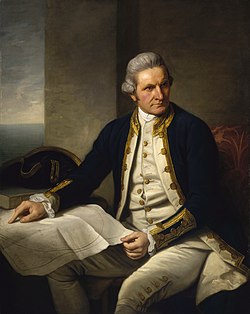
Later, the British and French people came to Australia. William Dampier, an English buccaneer and explorer, landed on the north-west coast of New Holland in 1688 and again in 1699, and published influential descriptions of the Aboriginal people. In 1769, Lieutenant James Cook in command of HMS Endeavour, travelled to Tahiti to observe and record the transit of Venus. Cook also carried secret Admiralty instructions to locate the supposed Southern Continent. Unable to find this continent, Cook decided to survey the east coast of New Holland, the only major part of that continent that had not been charted by Dutch navigators. On April 19, 1770, Endeavour reached the east coast of New Holland and ten days later anchored at Botany Bay. Cook charted the coast to its northern extent and formally took possession of the east coast of New Holland on 21/22 August 1770 when on Possession Island off the west coast of Cape York Peninsula. In March 1772 Marc-Joseph Marion du Fresne, in command of two French ships, reached Van Diemen's land on his way to Tahiti and the South Seas. His party became the first recorded European to encounter the Indigenous Tasmanians and to kill one of them.
In the same year, a French expedition led by Louis Aleno de St Aloüarn, became the first European to formally claim sovereignty over the west coast of Australia, but no attempt was made to follow this with colonization. European colonization and imperialism in Australia existed. Many Europeans from the British to the Swedish had plans to colonize Australia long before 1800. After the American Revolutionary War (1775-1783), Britian lost most of its North American colonies and consider establishing replacement territories. Britain had transported about 50,000 convicts to the New World from 1718 to 1775 and was now searching for an alternative. The temporary solution of floating prison hulks had reached capacity and was a public health hazard, while the option of building more jails and workhouses was deemed too expensive. In 1779, Sir Joseph Banks, the eminent scientist who had accompanied James Cook on his 1770 voyage, recommended Botany Bay in Australia as a suitable site for a penal settlement. Banks's plan was to send 200 to 300 convicts to Botany Bay where they could be left to their own devices and not be a burden on the British taxpayer. Under Banks's guidance, the American Loyalist James Matra, who had also travelled with Cook, produced a new plan for colonizing New South Wales in 1783. The British wanted to send convicts to Africa, but it failed.
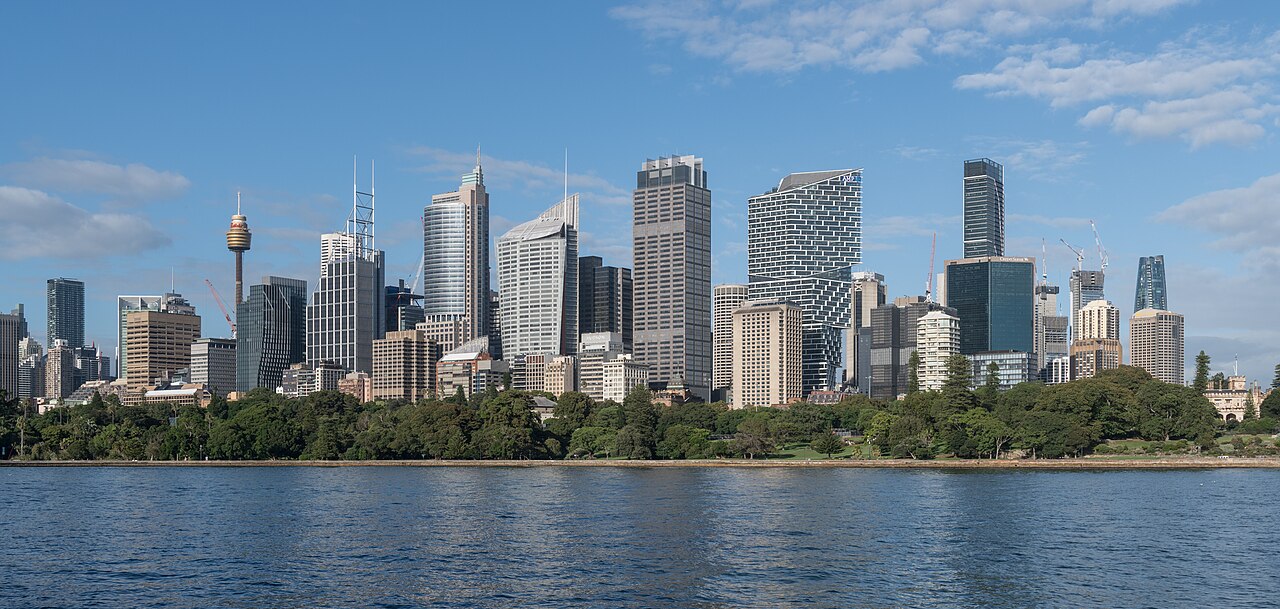
The colony of New South Wales was established with the arrival of the First Fleet of 11 vessels under the command of Captain Arthur Phillip in January 1788. It consisted of more than a thousand settlers, including 778 convicts (192 women and 586 men). A few days after arrival at Botany Bay the fleet moved to the more suitable Port Jackson where a settlement was established at Sydney Cove on January 26, 1788. This date later became Australia's national day, Australia Day. The colony was formally proclaimed by Governor Phillip on February 7, 1788, at Sydney. Sydney Cove offered a fresh water supply and a safe harbor, which Phillip described as being to him as the greatest harbor in the world. The territory of New South Wales claimed by Britain included all of Australia eastward of the meridian of 135° East. This included more than half of mainland Australia. The claim also included "all the Islands adjacent in the Pacific" between the latitudes of Cape York and the southern tip of Van Diemen's Land (Tasmania). In 1817, the British government withdrew the extensive territorial claim over the South Pacific, passing an act specifying that Tahiti, New Zealand and other islands of the South Pacific were not within His Majesty's dominions. However, it is unclear whether the claim ever extended to the current islands of New Zealand.
Governor Phillip wanted the inhabitants to have harmonious relations with the Aboriginal people and try to reform the convicts of the colony. People struggled at first. Early efforts at agriculture were fraught and supplies from overseas were scarce. Between 1788 and 1792 about 3546 male and 766 female convicts were landed at Sydney. Many new arrivals were sick or unfit for work and the condition of healthy convicts also deteriorated due to the hard labor and poor food. The food situation reached crisis point in 1790 and the Second Fleet which finally arrived in June 1790 had lost a quarter of its passengers through sickness, while the condition of the convicts of the Third Fleet appalled Phillip. From 1791, however, the more regular arrival of ships and the beginnings of trade lessened the feeling of isolation and improved supplies. Many settlers were in Tasmania. By the late 1790s, there were freed convicts. Farms grew in more fertile areas around Paramtta, Windsor, Richmond, and Camden. The New South Wales Corps was created in England in 1789 as being part of the British army. Australia grew. The amount of convicts and free settlers increased in New South Wales. More colonies grew in Western Australia and Tasmania. In Australia, conflicts among convicts, free settlers, and Aboriginals grew.
Families of convicts were also offered free passage and about 3,500 migrants were selected under the English Poor Laws. Various special-purpose and charitable schemes, such as those of Caroline Chisholm and John Dunmore Lang, also provided migration assistance. Women fought for their rights too. Back then, most people in Australia who were settlers and convicts were of the Church of England. The Church of England worked with many Governors. Catholic Churches grew by the 1830s and the 1840s. Secular schools grew. Matthew Flinders led the first successful circumnavigation of Australia from 1801 to 1802.
Many Aboriginals died after Europeans settlements via smallpox as the Aboriginals had little resistance to many introduced diseases back then. An outbreak of smallpox in April 1789 killed about half the Aboriginal population of the Sydney region. The source of the outbreak is controversial; some researchers contend that it originated from contact with Indonesian fisherman in the far north while others argue that it is more likely to have been inadvertently, or deliberately, spread by settlers. There were further smallpox outbreaks devastating Aboriginal populations from the late 1820s (affecting south-eastern Australia), in the early 1860s (travelling inland from the Coburg Peninsula in the north to the Great Australian Bight in the south), and in the late 1860s (from the Kimberley to Geraldton). According to Josephine Flood, the estimated Aboriginal mortality rate from smallpox was 60 per cent on first exposure, 50 per cent in the tropics, and 25 per cent in the arid interior. Other introduced diseases such as measles, influenza, typhoid and tuberculosis also resulted in high death rates in Aboriginal communities. Butlin estimates that the Aboriginal population in the area of modern Victoria was around 50,000 in 1788 before two smallpox outbreaks reduced it to about 12,500 in 1830.
Between 1835 and 1853, the Aboriginal population of Victoria fell from 10,000 to around 2,000. It is estimated that about 60 per cent of these deaths were from introduced diseases, 18 per cent from natural causes and 15 per cent from settler violence. Many racist British settlers attacked and murdered Aboriginal people, because they believe in the myth of the superiority of British civilization. Many Aboriginals were kidnapped including men, women, and children. Some Aboriginals burned the crops of British settlers and the burning of property. These were acts of resistance to the loss of traditional land and food resources. There were serious conflicts between settlers in the Sydney region and Aboriginals (Darug people) from 1794 to 1800 in which 26 settlers and up to 200 Darug were killed. Conflict also erupted south-west of Sydney (in Dharawal country) from 1814 to 1816, culminating in the Appin massacre (April 1816) in which at least 14 Aboriginal people were killed.
In Van Diemen's land, the Black War broke out in 1824, following a rapid expansion of settler numbers and sheep grazing in the island's interior. Martial law was declared in November 1828 and in October 1830 a "Black Line" of around 2,200 troops and settlers swept the island with the intention of driving the Aboriginal population from the settled districts. From 1830 to 1834, George Augustus Robinson and Aboriginal ambassadors including Truganini led a series of "Friendly Missions" to the Aboriginal tribes which effectively ended the war. Around 200 settlers and 600 to 900 Aboriginal Tasmanians were killed in the conflict and the Aboriginal survivors were eventually relocated to Flinders Island. Racists used the Australian native police (made of native troopers under white officers) to disperse Aboriginal tribes in eastern Australia, especially in New South Wales and Queensland.
In central Australia, it is estimated that 650 to 850 Aboriginal people, out of a population of 4,500, were killed by colonists from 1860 to 1895. In the Gulf Country of northern Australia five settlers and 300 Aboriginal people were killed before 1886. The last recorded massacre of Aboriginal people by settlers was at Coniston in the Northern Territory in 1928 where at least 31 Aboriginal people were killed. Some in Australia wanted self-government. There were the gold rushes of the 1850s in Australia. There were new constitutions in New South Wales, Victoria, and Van Diemen's Land. Women's suffrage was formed in Victoria by 1884. Political parties, entertainment, and other strikes existed in the 1800s and 1900s. Australia used its troops in WWI and WWII. There was Robert Menzies and the Liberal Party of Australia having a large political influence in the country.
The Menzies era (1949–1972) saw significant strides in civil rights for indigenous Australians. Over the period, Menzies and his successors dismantled remaining restrictions on voting rights for Aboriginal and Torres Strait Islander peoples culminating in the Menzies Government's 1962 Commonwealth Electoral Act, while the Holt Government's landmark 1967 Referendum received overwhelming public support for the transfer of responsibility for Aboriginal Affairs to the Federal Government, and the removal of discriminatory provisions regarding the national census from the Australian Constitution. By 1971, the first Aboriginal Senator was sitting on the government benches, with Neville Bonner becoming a Liberal Senator for QLD. There was the problem of assimilation which deals with negating Aboriginal families and culture. There were forced removal of multiracial and biracial people from their families even in the 1960s and 1970s to brainwash them to view whiteness as superior. In 1997, the Human Rights and Equal Opportunity Commission estimated that between 10 per cent and one-third of Aboriginal children had been removed from their families from 1910 to 1970. Regional studies indicate that 15 per cent of Aboriginal children were removed in New South Wales from 1899 to 1968, while the figure for Victoria was about 10 per cent. Robert Manne estimates that the figure for Australia as a whole was closer to 10 per cent. The Aboriginals fought for their civil rights too. Australia has been run by both progressive and conservative leaders for decades since the 1940s. The 1960s proved a key decade for Indigenous rights in Australia, with the demand for change led by Indigenous activists and organizations such as the Federal Council for the Advancement of Aborigines and Torres Strait Islanders and embraced by the wider population as citizenship rights were extended. Lionel Rose and Evonne Goolagong were famous Aboriginal people.
In 1965, Charles Perkins, helped organize freedom rides into parts of Australia to expose discrimination and inequality. In 1966, the Gurindji people of Wave Hill station commenced the Gurindji strike in a quest for equal pay and recognition of land rights. In 1966, the Australian government gave Aboriginal people the same rights to social security benefits as other Australians. A 1967 referendum changed the Australian constitution to include all Aboriginal Australians in the national census and allow the Federal parliament to legislate on their behalf. A Council for Aboriginal Affairs was established. Popular acclaim for Aboriginal artists, sportspeople and musicians also grew over the period. In 1968, boxer Lionel Rose was proclaimed Australian of the Year. That same year, artist Albert Namatjira was honored with a postage stamp. Singer-songwriter Jimmy Little's 1963 Gospel song "Royal Telephone" was the first No.1 hit by an Aboriginal artist. Women's Tennis World No. 1 Evonne Goolagong Cawley was celebrated as Australian of the Year in 1971.
Country Liberal Adam Giles became the first indigenous Australian to head a state or territory government when he became Chief Minister of the Northern Territory in 2016. Neville Bonner was appointed Liberal Senator for QLD in 1971, becoming the first federal parliamentarian to identify as Aboriginal. Eric Deeral (QLD) and Hyacinth Tungutalum (NT) followed at a state and territory level in 1974. In 1976, Sir Doug Nicholls was appointed Governor of South Australia, the first indigenous Australian to hold vice-regal office. By the 2020s, Aboriginal representation in the federal parliament had exceeded the proportion of Aboriginal people in the general population, and Australia had its first Aboriginal leader of a state or territory in 2016, when the Country Liberal Party's Adam Giles became Chief Minister of the Northern Territory. In January 1972, Aboriginal activists erected an Aboriginal "tent embassy" on the lawns of parliament house, Canberra and issued a number demands including land rights, compensation for past loss of land and self-determination. The leader of the opposition Gough Whitlam was among those who visited the tent embassy to discuss their demands.
The Whitlam government came to power in December 1972 with a policy of self-determination for Aboriginal people. The government also passed legislation against racial discrimination and established a Royal Commission into land rights in the Northern Territory, which formed the basis for the Fraser government's Aboriginal Land Rights Act 1976. Women have increased power in Australian government; more migrants and immigrants have come to Australia too. The Prime Minister of Australia now is Anthony Albense since May 23, 2022. Australia had high inflation in recent years. He is part of the Labor government. To this day, Aboriginals still fight for equality, home ownership, adequate employment, adequate education, and health care.

Culture and Demographics
Australia has a population density of 3.4 person per square kilometers of total land area, which makes it one of the most sparsely populated countries in the world. The population of Australia is heavily concentrated on the east coast, in particular in the south-eastern region between South East Queensland to the north-east and Adelaide to the south-west. Australia is heavily urbanized with 67% of the population living in the Greater City Statistical Areas (metropolitan areas of the state and mainland territorial capital cities) in 2018. Metropolitan areas with more than one million people are found in Sydney, Melbourne, Brisbane, Perth, and Adelaide. Australia is shifting to being a demographic shift towards an older population (which is common with many developed countries), with more retirees and fewer people of working age. In 2021, the average age of the population was 39 years old. Between 1788 and the Second World War, the vast majority of settlers and immigrants came from the British Isles (principally England, Ireland and Scotland), although there was significant immigration from China and Germany during the 19th century. Following Federation in 1901, the white Australia policy was strengthened, restricting further migration from these areas. However, this policy was relaxed following WW2, and in the decades following, Australia received a large wave of immigration from across Europe, with many more immigrants arriving from Southern and Eastern Europe than in previous decades. All overt legalized racial discrimination ended in 1973, with multiculturalism becoming official policy. Subsequently, there has been a large and continuing wave of immigration from across the world, with Asia being the largest source of immigrants in the 21st century.
Today, Australia has the world's eighth-largest immigrant population, with immigrants accounting for 30% of the population, the highest proportion among major Western nations. In 2022–23, 212,789 permanent migrants were admitted to Australia, with a net migration population gain of 518,000 people inclusive of non-permanent residents. Most entered on skilled visas, however the immigration program also offers visas for family members and refugees. The Australian Bureau of Statistics asks each Australian resident to nominate up to two ancestries each census and the responses are classified into broad ancestry groups. At the 2021 census, the most commonly nominated ancestry groups as a proportion of the total population were: 57.2% European (including 46% North-West European and 11.2% Southern and Eastern European), 33.8% Oceanian, 17.4% Asian (including 6.5% Southern and Central Asian, 6.4% North-East Asian, and 4.5% South-East Asian), 3.2% North African and Middle Eastern, 1.4% Peoples of the Americas, and 1.3% Sub-Saharan African. At the 2021 census, 3.8% of the Australian population identified as being Indigenous—Aboriginal Australians and Torres Strait Islanders. Most Australians speak English with an unique accent. At the 2021 census, English was the only language spoken in the home for 72% of the population. The next most common languages spoken at home were Mandarin (2.7%), Arabic (1.4%), Vietnamese (1.3%), Cantonese (1.2%) and Punjabi (0.9%). More than 250 Australian Aboriginal languages are thought to have existed at the time of first European contact. The National Indigenous Languages Survey (NILS) for 2018–19 found that more than 120 Indigenous language varieties were in use or being revived, although 70 of those in use were endangered. The 2021 census found that 167 Indigenous languages were spoken at home by 76,978 Indigenous Australians — Yumplatok (Torres Strait Creole), Djambarrpuyngu (a Yolŋu language) and Pitjantjatjara (a Western Desert language) were among the most widely spoken. NILS and the Australian Bureau of Statistics use different classifications for Indigenous Australian languages.
.jpg/250px-P20220524AS-1533_(52245766080).jpg)
Australia has no state religion; section 116 of the Australian Constitution prohibits federal legislation that would establish any religion, impose any religious observance, or prohibit the free exercise of any religion. However, the states still retain the power to pass religiously discriminatory laws. At the 2021 census, 38.9% of the population identified as having no religion, up from 15.5% in 2001. The largest religion is Christianity (43.9% of the population). The largest Christian denominations are the Roman Catholic Church (20% of the population) and the Anglican Church of Australia (9.8%). Non-British immigration since the Second World War has led to the growth of non-Christian religions, the largest of which are Islam (3.2%), Hinduism (2.7%), Buddhism (2.4%), Sikhism (0.8%), and Judaism (0.4%).
In 2021, just under 8,000 people declared an affiliation with traditional Aboriginal religions. In Australian Aboriginal mythology and the animist framework developed in Aboriginal Australia, the Dreaming is a sacred era in which ancestral totemic spirit beings formed The Creation. The Dreaming established the laws and structures of society, and the ceremonies performed to ensure continuity of life and land. Australia's life expectancy is 83 years old (81 years for men and 85 for women) being the fifth largest in the world. Australia has a high-income mixed market economy which is rich in natural resources.
Australia has a diverse culture. It has indigenous traditions, Anglo-Celtic culture, and multicultural traditions (especially since 1945). Many Australians love egalitarianism, humor, and the freedom of the individual. Many Australians love to show respect to people and believe in mateship. Australia has more than 100,000 Aboriginal rock art sites including many museums. Many Australians have music bands, Aboriginal religious and secular songs, literature, and ballet. Australia has food like bush tucker, fish and chips, macadamia nut, kangaroo meat, and steak pie. Chinese cuisine is found in Australia too. Australians love to do swimming, track and field, cycling, soccer, golf, tennis basketball, surfing, netball, and cricket. Australia is one of the five nations that have participated in every Summer Olympics of the modern era. It has hosted the Games twice in 1956 and 2000 in Sydney. It is set to host the future 2032 Games in Brisbane (2023 is when I will be 50 years old). Surfing is also very popular in Australia too.
Heroes in Australia
There are tons of heroes of Australia who stood up for freedom in a legitimate fashion. Many civil rights heroes in Australia fought for the Aboriginal and Torress Strait Islander rights, for disability rights, and for women's rights. Charles Perkins, Faith Bandler, and Neville worked hard to champion Aboriginal rights. People like Carly Findlay, and Dylan Alcott have made many contributions to disability rights. Jessie Street, Edna Ryan, and Elizabeth Reid have been instrumental in advancing women's rights and equality in Australia. The Australian Aboriginal Civil Rights Movement has been known to me for years, but many people are unaware of this history. This movement fought for equal rights and recognition of Aboriginal and Torres Strait Islander people. It has grown since the early 20th century and continues to this day. Many people used protests, legal challenges, and political lobbying to fight for self-determination, an end to discrimination, and the recognition of their titles. Back in 1901, Aboriginal and Torres Strait Islander people were banned from the census and denied basic human rights like voting and enlistment in the Armed services when the Australian Federation was formed in 1901. So, people fought back against these injustices. This movement gained more power after WWII with the creation of organizations like the Federal Council for Aboriginal Advancement (FCAA). Aboriginal activists were inspired by us, black Americans, in our Civil Rights Movement. So, the Aboriginal activists and non-Aboriginal allies formed Freedom Rides (during the 1960s) to expose discrimination in Australia and raise awareness. This movement has victories like the 1967 referendum that removed discriminatory clauses from the Australian Constitution and recognized Aboriginal and Torres Strait Islander peoples as citizens. The Aboriginal Legal Rights Movement (ALRM) was formed in 1972 to give legal services and advocacy for Indigenous Australians facing injustice. There was a 1972 protest of Aboriginal people outside Parliament House in Canberra by1972 to demand land rights and self-determination. Aboriginals still fight for native title, reconciliation, and eliminating other problems faced by Indigenous communities.


The 2000 Syndey Summer Olympics
This year is the 25th anniversary of the 2000 Summer Olympics. I remember watching the Sydney 2000 Olympics when I was almost 17 years old. It took place from September 15 to October 1, 2000. It took place in Sydney, New South Wales, Australia. It was the second time when the Summer Olympics were held in Australia and in the Southern Hemisphere, the first being in Melbourne, in 1956. Teams from 199 countries participated in the 2000 Games, which were the first to feature at least 300 events in its official sports program. The Games were estimated to have cost A$6.6 billion. These were the final Olympic Games under the IOC presidency of Juan Antonio Samaranch before the arrival of his successor Jacques Rogge. The final medal tally at the 2000 Summer Olympics was led by the United States, followed by Russia and China with host Australia in fourth place overall. Cameroon, Colombia, Latvia, Mozambique, and Slovenia won a gold medal for the first time in their Olympic histories, while Barbados, Kuwait, Kyrgyzstan, Macedonia, Saudi Arabia, and Vietnam won their first-ever Olympic medals. The 2000 Games received universal acclaim, with the organization, volunteers, sportsmanship, and Australian public being lauded in the international media. Bill Bryson of The Times called the Sydney Games "one of the most successful events on the world stage", saying that they "couldn't be better." James Mossop of the Electronic Telegraph called the Games "such a success that any city considering bidding for future Olympics must be wondering how it can reach the standards set by Sydney", while Jack Todd of the Montreal Gazette suggested that the "IOC should quit while it's ahead. Admit there can never be a better Olympic Games, and be done with it," as "Sydney was both exceptional and the best." These games would provide the inspiration for London's winning bid for the 2012 Olympic Games in 2005; in preparing for the 2012 Games, Lord Coe declared the 2000 Games the "benchmark for the spirit of the Games, unquestionably", admitting that the London organizing committee "attempted in several ways to emulate what the Sydney Organising Committee did."
_5.jpg/800px-Nancy_Johnson_(sport_shooter)_5.jpg)
Australia will host the Summer Olympics in Brisbane in 2032, making it the first Asia-Pacific country to host the Summer Olympics three times and also the second time Australia will host the Summer Olympics after the United States hosting it with how Brisbane will come after Los Angeles hosting the 2028 Summer Olympics. Sydney won the right to host the Games on September 24, 1993. The opening ceremony began with a tribute to the pastoral heritage of the Australian stockmen and the importance of the stock horse in Australia's heritage. It was produced and filmed by the Sydney Olympic Broadcasting Organization and the home nation broadcaster Seven Network. This was introduced by lone rider Steve Jefferys and his rearing Australian Stock Horse Ammo. At the cracking of Jefferys' stockwhip, a further 120 riders entered the stadium, their stock horses performing intricate steps, including forming the five Olympic Rings, sounded by a new version of the song that Bruce Rowland had previously composed for the 1982 film The Man from Snowy River.
*It is important to cite the many Australian winners of the 2000 Olympics in Syndey too. Ian Thorpe (a professional swimmer) won gold in the 400m freestyle, 200m freestyle, and the 4x200m freestyle relay. He broke his own world record in the 200m freestyle at the Olympic trials too. Simon Fairweather won gold in the men's individual event in archery. Brett Aiken and Scott McGrory won gold in the men's Madison involving cycling. Australian Women's Hockey Team won gold in the women's hockey tournament. Jenny Armstrong and Belinda Stowell won gold in the women's 470 in sailing and Grant Hackett won gold in the 1500m freestyle. The Australian women's water polo team also had success too.

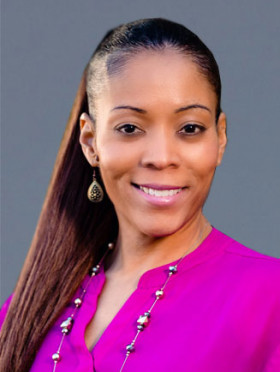
The Australian National Anthem was sung in the first verse by Human Nature and the second by Julie Anthony. The cultural segments of the event take place with many aspects of the land and its people: the affinity of the mainly coastal-dwelling Australians with the sea that surrounds the Island Continent. The Indigenous inhabitation of the land, the coming of the First Fleet, the continued immigration from many nations, and the rural industry on which the economy of the nation was built, including a display representing the harshness of rural life based on the paintings of Sir Sidney Nolan. Two memorable scenes were the representation of the heart of the country by 200 Aboriginal women from Central Australia who danced up "the mighty spirit of God to protect the Games" and the overwhelmingly noisy representation of the construction industry by hundreds of tap-dancing teenagers.
Because the wife of then-IOC President Juan Antonio Samaranch was seriously ill and unable to accompany her husband to the Olympics, Dawn Fraser, former Australian Olympic Champion swimmer and member of the Parliament of New South Wales, accompanied Samaranch during the Australian cultural segments, explaining to him some of the cultural references that are unfamiliar for the people from outside Australia. The Olympic Flag was carried around the arena by eight former Australian Olympic champions: Bill Roycroft, Murray Rose, Liane Tooth, Gillian Rolton, Marjorie Jackson, Lorraine Crapp, Michael Wenden and Nick Green. During the raising of the Olympics Flag, the Olympic Hymn was sung by the Millennium Choir of the Greek Orthodox Archdiocese of Australia in Greek. Following this, Tina Arena sang a purpose-written pop song, The Flame. The opening ceremony concluded with the lighting of the Olympic Flame, which was brought into the stadium by former Australian Olympic champion Herb Elliott. Then, celebrating 100 years of women's participation in the Olympic Games, former Australian women Olympic medalists Betty Cuthbert and Raelene Boyle, Dawn Fraser, Shirley Strickland (later Shirley Strickland de la Hunty), Shane Gould and Debbie Flintoff-King brought the torch through the stadium, handing it over to Cathy Freeman, who lit the flame in the cauldron within a circle of fire. The choice of Freeman, an Aboriginal woman, to light the flame was notable given the history of human rights abuses against Aboriginal people in Australia. Some Australians used racial abuse against Freeman, but Freeman courageous stood up for her dignity as a human being. The first medals of the Games were awarded in the women's 10 metre air rifle competition, which was won by Nancy Johnson of the United States.
The Triathlon made its Olympic debut with the women's race. Set in the surroundings of the Sydney Opera House, Brigitte McMahon representing Switzerland swam, cycled and ran to the first gold medal in the sport, beating the favoured home athletes such as Michelie Jones who won silver. McMahon only passed Jones in sight of the finish line. The first star of the Games was 17-year-old Australian Ian Thorpe, who first set a new world record in the 400-metre freestyle final before competing in an exciting 4 × 100 m freestyle final. Swimming the last leg, Thorpe passed the leading American team and arrived in a new world record time, two-tenths of a second ahead of the Americans. In the same event for women, the Americans also broke the world record, finishing ahead of the Netherlands and Sweden. Samaranch had to leave for home, as his wife was severely ill. Upon arrival, his wife had already died. Samaranch returned to Sydney four days later. The Olympic flag was flown at half-staff during the period as a sign of respect to Samaranch's wife. I will mention the elephant in the room. You know what that issue is. Marion Jones originally won many gold medals in the 2000 Summer Olympics. She was disqualified for those medals because she was found to have taken performing enhancing drugs. Marion Jones is different than Lance Armstrong, who scream profanities and acted with strident arrogance. Marion Jones (who was involved in track and field and basketball before) became humble, apologized, served her time in prison, and came out to show remorse. Marion Jones wrote a book about her experiences, loves her children, and is moving on with her life being a businesswoman, motivational speaker, and Crossfit athlete. Her redemption story should inspire not only athletes but everyone else that redemption is possible for those who sincerely want to turn their lives around. The great Aboriginal Australian Olympic champion Catherine Freeman won gold in the 400m in Sydney, Australia. It was a great testament to her hard work. She is an Aboriginal human being. She would go on to win gold in the 4 x 400m relay in the 2002 Commonwealth Games in Manchester, UK.

The Cathy Freeman Foundation to this day helps Indigenous and non-Indigenous Australian children to attend school and promote education in general for Australian people. As Cathy Freeman has said, "I want to be a positive role model, especially for kids and Aboriginal people... When people see me, often all they see is another Australian athlete having a go. It isn't until they see the full Cathy Freeman picture that they realise how proud I am of my ancestry and heritage. I'd like a little more tolerance and acceptance of my culture and all the differing cultures that make up Australia." The USA basketball men's and women's teams won gold. Vince Carter made one of the most famous dunks in basketball history too dunking over Frederic Weiss (who is over seven feet tall). The Canadian flag at the athletes' village was lowered to half-mast as Canadian athletes paid tribute to the former prime minister Pierre Trudeau after hearing of his death in Montreal (because of the time zone difference, it was 29 September in Sydney when Trudeau died). The Canadian flag was flown at half-mast for the remainder of the Olympics, on orders from both IOC President Juan Antonio Samaranch and Canadian Foreign Affairs Minister Lloyd Axworthy, and as the state funeral did not take place until October 3, two days after the closing ceremony, so they have enough time to head back to Canada after the Games and attending his funeral. Cameroon won a historic gold medal over Spain in the Men's Olympic Football Final at the Olympic Stadium. The game went to a penalty shootout, which was won by Cameroon 5–3.
Australia in 2025
In Australia, the Liberal Party lost at the 2025 election, with Dutton losing his seat of Dickson in Brisbane. The Liberal Party is heavily conservative in their political views. This party also has a great internal diversity in views. This party is anti-labor, anti-socialist, and supports individual freedom and private enterprise. For us Americans, the Liberal Party would be akin to far right Republicans. Robert Menzies wants Australia's middle class to form its main constituency. Menzies is a constitutional monarchist too. Peter Dutton is part of the National Right faction of the Liberal Party. That means that Dutton is more conservative than even Menzies. He follows similar views to Donald Trump. This is a reflection of the Maga movement overseas. Dutton is racist for opposing flying the Aboriginal and Torres Strait Islander flags alongside the national flag. Dutton opposes the ALP's climate policy, the Paris Agreement, and COP 31. Still, there are tons of Australians who are not bigots but want freedom and justice for all people. I live in the Northern Hemisphere and Australia is in the Southern Hemisphere. Australia is filled with tons of culture, cities, farms, and other cultural greatness. Also, the Aboriginal people, being the first people in Australia, have suffered oppression and other forms on injustice, but they still rise to continue to live and to advance their own legacies as human beings.
_2019-06-21.jpg/960px-Sydney_Opera_House_and_Harbour_Bridge_Dusk_(2)_2019-06-21.jpg)
Conclusion (Australia)
The continent of Australia is known by many people the world over. There can be no discussion about Australia without the respect shown to its first human inhabitants, who are the Aboriginal people. They represent a large part of the culture of Australia in terms of respect for the environment, resiliency, cultural heritage, language, art, and other aspects of human culture. Australia has been a place of both conflict and growth. It has been a place filled with some evil people and some righteous people who fought injustice with eagerness and zeal. Australia is a diverse location too. There are Aboriginal people, white people, Asian people, black people, Latino people, and people of diverse ethnicities and creeds that live in Australia. From its rural locations, urban centers, suburbs, and grasslands, Australia has a massive different amount of communities and ecosystems. Australia is a place that has hosted concerts, a historic Olympic Summer Games (that existed in the year of 2000), various sporting events, and other types of celebrations. Today, Australia is dominated by a conservative government, but we all have hope for the future as the principle of equality of all people is paramount.

Conclusion (for Summer of 2025)
The Trump economic budget is more than a bad austerity bill. It represents total profound cruelty against human beings. Some GOP members are so extremist that they want the bill to have even more steep cuts to government programs. Trump is trying to get more Republicans to support this bill. Moody's stripping the U.S. government of the top credit rating is a new development. Republicans desire a $700 billion in health-related spending cuts like in Medicaid. The bill has tax breaks for the super-rich and wealthy mega-corporations. Medicaid is a great social program to help the elderly, the youth, and the poor in America. It helps to provide healthcare coverage for almost 60 percent of all nursing home residents. The U.S. spent $618 billion on the Medicaid program in 2024, which is less than Social Security, Medicare, and the U.S. war budget. As of 2024, about 37 percent of Medicaid enrollees are children under the age of 19. Medicaid coverage is high among the poor with over 8 in 10 children in poverty covered by the program (according to the Kaiser Family Foundation). The proposal wants to cut $715 billion from Medicaid for over the next decade. This harms about 8.7 million people. Medicaid was created in 1965 being part of President Lyndon Baines Johnson's Great Society agenda (that included the Medicare Act or the Social Security Amendments of 1965).
Medicare provided health insurance for person aged 65 and old. Medicaid provided health insurance for the poor, many people with disabilities, and other human beings. These programs came after the protests of workers in the 1930s, 1940s, and the 1950s. Medicaid expansion has existed in America. Now, some want work requirements which will allow many people to be kicked out of Medicaid (especially the elderly who aren't part of working age). The bill wants to amend the Food and Nutrition Act of 2008 to block immigrants from accessing the SNAP (Supplemental Assistance Program). Trump and the fascist Republican Party desire imperialism, bank bailouts for the oligarchy, hatred of democracy, and radical financial austerity. The establishment Professor Carrol Quigley admitted the agenda of the financial oligarchy in the following quotation:
“The powers of financial capitalism had another far reaching aim, nothing less than to create a world system of financial control in private hands able to dominate the political system of each country and the economy of the world as a whole. This system was to be controlled in a feudalist fashion by the central banks of the world acting in concert, by secret agreements, arrived at in frequent private meetings and conferences. The apex of the system was the Bank for International Settlements in Basel, Switzerland, a private bank owned and controlled by the worlds’ central banks which were themselves private corporations. The growth of financial capitalism made possible a centralization of world economic control and use of this power for the direct benefit of financiers and the indirect injury of all other economic groups.’—Carroll Quigley, Tragedy and Hope: A History of The World in Our Time, Macmillan Company, New York, (1966) p. 337.

The Trump administration is growing its feud with Harvard by trying to ban Harvard from enrolling international students. This is fascism and xenophobic. The Trump administration is an evil administration who abhors due process, lies about medicine, desires to cut the social safety net, fires innocent federal workers unjustly, and glorifies authoritarian dictators like Putin. These actions alone doesn't represent true integrity, honor, or morality. You have notice that Trump defenders are declining, because there is absolutely no excuse for the evil policies from Donald Trump. A tyrant pardons January 6th terrorists, and we have the First Amendment right to disagree with that decision completely. Trump banning Harvard's ability to enroll international students can jeopardize the legal status of more than a quarter of its students. Trump did this on purpose, because it wants to punish Harvard for its refusal to submit to Trump's far right agenda.
Kristi Noem, the Homeland Security secretary said that the international students at Harvard must transfer to other universities or risk losing their legal status. Noem said that Harvard has 72 hours to change its mind. She wants Harvard to give the government disciplinary records of every international student for the past five years. This is illegal as Harvard has the right to host international nations, and forcing records to be sent to the Trump administration without just cause is anti-democratic.
There is breaking news about 2 Israeli Embassy members being murdered outside the Capital Jewish Museum in Washington, D.C. This was during the time where the American Jewish Committee was hosting an event on Wednesday night. The victims were Yaron Lischinsky and Sarah Milgrim. According to Israel's ambassador to America, they were a young couple in love who were about to be engaged. The murderer is a 30-year-old Elias Rodriguez from Chicago. He chanted "Free Free Palestine" while in custody, according to the police. Eyewitnesses said to CNN that the shooter waited for the police to arrive before saying he "did it for Gaza." This murderer is a disgrace who hides behind Gaza to justify his evil actions. There is no excuse for murder, and his actions only desecrate the legitimate cause of Palestinians to have true freedom and justice in the world. Murder, anti-Semitism, and unjust violence have no place in the Universe. We all condemn this murder as wrong, immoral, and evil. Ironically, the event wanted humanitarian aid for Gaza. European leaders and others worldwide condemned the action too.


I will leave on a positive note. The good news is that Coco Gauf has won the 2025 French Open on June 7, 2025, in Paris, France. She is 21 years old, so her career is just getting started. It was not an easy match for her. She defeated Aryna Sabalenka, who is a great tennis player in her own right. Yet, Coco Gauf used strategy and other tennis skills to achieve a total victory. This victory is Gauf's second major Grand Slam title. Coco Gauf was the second American to win a Grand Slam since Serena Williams. Many people were in the French Open like Spike Lee in the audience. Gauf's parents supported Coco Gauf constantly and gave her advice during her matches. Former First Lady Michelle Obama congratulated Coco Gauf as using determination, strength, and grace throughout the French Open. The icon of tennis Billie Jean King celebrated her victory too along with Carlos Alcaraz, Matthew McConaughey, and other people. Like I have said before, the younger generation are rising up and taking the torch. Coco Gauf is a young woman who is taking that torch and running with it filled with strength, courage, and humbleness. We appreciate the younger people in the world making their own accomplishments on their own terms. In less than 9 years, I will be 50 years old. That reality is very surreal (Don't get twisted because I don't have gray hair now. I a'int that old. lol.), but I'm appreciative of living almost a half century on Earth. I will continue to show the facts to the people for decades into the future as that is my destiny from God for me to do.
By Timothy

No comments:
Post a Comment