Sunday, June 18, 2017

Progressive Primary Challenger: Senator Joe Manchin A Democrat in Name Only
http://therealnews.com/t2/story:19339:Progressive-Primary-Challenger%3A-Senator-Joe-Manchin-A-Democrat-in-Name-Only
http://www.wsws.org/en/articles/2017/06/17/immi-j17.html
https://www.aclu.org/blog/speak-freely/attorney-general-jeff-sessions-more-dangerous-trump
http://www.telegraph.co.uk/news/worldnews/northamerica/usa/3848570/Deep-Throat-Watergate-timeline-of-events.html
http://www.wsws.org/en/articles/2017/06/17/immi-j17.html
https://www.aclu.org/blog/speak-freely/attorney-general-jeff-sessions-more-dangerous-trump
http://www.telegraph.co.uk/news/worldnews/northamerica/usa/3848570/Deep-Throat-Watergate-timeline-of-events.html
Saturday, June 17, 2017
World War II Research
https://blackthen.com/army-corps-six-triple-eight-battalion-first-all-african-american-all-female-unit-to-serve-over-seas-in-world-war-ii/
http://newyorktheaterfestival.com/sixtripleeight/
http://inamerica.blogs.cnn.com/2012/02/02/women-of-tuskegee-supported-famed-black-pilots/
https://yesshedidyeswecan.wordpress.com/2012/01/26/tuskegee-air-women/
http://www.redtail.org/womans-perspective-serving-tuskegee-airmen-support-personnel/
http://libcdm1.uncg.edu/cdm/ref/collection/WVHP/id/1685
http://www.tadias.com/08/11/2008/african-american-and-ethiopian-relations/
http://lcweb2.loc.gov/ammem/aaohtml/exhibit/aopart8.html
http://runningfromemptyshoes.com/2016/12/08/double-v-campaign-the-war-against-fascism/
https://www.boundless.com/u-s-history/textbooks/boundless-u-s-history-textbook/from-isolation-to-world-war-ii-1930-1945-26/social-effects-of-the-war-206/african-americans-in-wwii-1130-9024/
https://www.pinterest.com/cookhorn/women-men-of-colour-in-history/
https://www.pinterest.com/pin/462956036680100325/
http://www.independent.co.uk/news/world/europe/what-happened-to-black-germans-under-the-nazis-a6839216.html
The African American Story Part 5 (World War II)


The African American Story Part 5 (African Americans in World War II)
During World War II, it was a national and international affair. Nations formed alliances to fight for the power of the Earth's resources during World War II. Black Americans were in the middle of the global conflict. Many of our people were drafted into that war. That is why many of our grandparents and great-grandparents participated in World War II. Segregated units would fight in the battles. Black people fought fascism overseas and against racism at home. So, WWII signified battling multiple battles domestically and outside America. Over 2.5 million black men registered for the draft and many served as draftees or volunteers in all of the branches of the Armed Forces during the war. Black men and Black women fought with distinction. In fact, more than 12,000 black men, who served in the 92nd Division, received citations and were decorated for their effort. The all-black 761st Tank Battalion received the Presidential Unit Citation for “extraordinary heroism.” Also, black women were involved in WWII too. Many black women were in the military including nurses. Their heroism will be mentioned here too. Many African American G.I.s were in concentration camps and many black people were victims of the evil Holocaust (which was about the Nazis' evil action of the extermination of millions of human beings). Many labor strikes existed (among workers of diverse colors) to fight for workers' rights during this time period. There was a class struggle for economic justice back then. Racial riots happened nationwide during the 1940's from Detroit to Chicago. Hollywood grew. Jazz grew and the Second Great Migration flourished during this time period as well. The Tuskegee Airmen helped to defeat the Axis Powers and numerous World War II (including Korean War) veterans would go onward to be part of the Civil Rights movement. WWII and its aftermath ironically propelled a new inspiration to make the Civil Rights movement to achieve more successes. World War II was a long, very bloody war. It was destructive and took more human lives than any other war in human history. War shouldn't be sugarcoated. We honor the sacrifice of heroes who defeated fascism. We are motivated to fight for justice in our time during the 21st century.
Still, we rise.
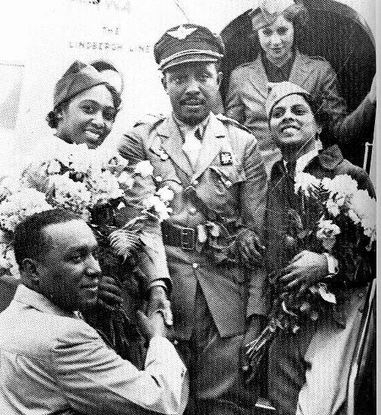

The Beginning and Black Units
From the beginning, African Americans (both black men and black women) fought in every American war. African Americans back then knew of the contradiction of fighting for freedom overseas while being unjustly denied freedom at home in the United States of America. In this situation, African Americans have shown courage and strength. Before World War II, black Americans fought against fascists in Ethiopia and against the Fascists plus the Nazis in Spain during the 1930’s. The U.S. government didn’t fight Italy or fascists invading Ethiopia, but African Americans did so independently in order for them to defend freedom. Back during October 4, 1935, fascist Italy invaded Ethiopia. Ethiopia was the only non-colonized African country at that time other than Liberia. So, African Americans were inspired to defend Ethiopia. This was personal for us. Black people raised money for medical supplies and many volunteered to fight for the nation. Ethiopia at first was overpowered by the Italian forces using mustard gas and other advanced weaponry. Yet, Ethiopia soon defeated the Italians years later. Many years later, Haile Selassie I would comment on the efforts of black Americans:
"We can never forget the help Ethiopia received from Negro Americans during the crisis. ... It moved me to know that Americans of African descent did not abandon their embattled brothers, but stood by us.”
The Spanish Civil War was about the fascist Franco and his forces fighting against the pro-Republican forces of the secular Spanish Republic. Many African Americans volunteered to fight for the Republican Spain. Many black Americans had Communist ideals while serving in the Abraham Lincoln Brigade. Many black people like Vaughn Love had rightfully said that fascism is the enemy of all “black aspirations.” Oliver Law was an African American activist and World War I veteran who also fought in the Abraham Lincoln Brigade during the Spanish Civil War too. He is believed to be the first African American officer to command an integrated unit of soldiers. James Peck fought against the fascists in Spain. He was a black man. He was a pilot in the Spanish Republican Air Force. He shot down fascist airplanes. A black woman named Salaria Kea was a young African American nurse from Harlem Hospital who served during the Spanish Civil War too. She was one of the two only African American female volunteers in the midst of the war-torn Spanish Republican areas. When Salaria came back from Spain she wrote the pamphlet "A Negro Nurse in Spain" and tried to raise funds for the beleaguered Spanish Republic. We honor the bravery and sacrifice of these heroic black men and black women. Now, we focus on World War II.
After World War I, the League of Nations existed. It failed, because of many reasons. Many nations refused to abide by its rules and regulations. Its rules were weakly enforced. There was the rise of Hitler and Stalin who advanced authoritarian regimes. Japan also used imperialist aggression against China and other Asian countries. By 1939, Hitler invaded Poland unjustly and illegally, which started World War II. WWII was the bloodiest and most deadly war in human history. More people died during WWII than any other war in human history. Hitler was an evil racist, a liar, and a murderer. He and his Nazis used imperialism for the sake of stealing mineral resources, to promote genocide, to advance racism, and to form an evil worldwide empire. Hitler, Franco, Mussolini, and Tojo united into the nefarious Axis Powers. They spread their evil worldwide. In America, most Americans back then were isolationists. Most Americans didn’t want to be involved in another war, because of the destructiveness of WWI and their view of promoting solely focusing on American affairs. Recent research has found that some Americans knew of the Holocaust and still was hesitant in condemning the Holocaust (which is disgraceful). Pearl Harbor changed everything. Japan attacked American military forces on December 7, 1941.


Many Americans died. There were many heroes during that deadly day. One hero was a black man named Doris Miller. He was a Navy mess attendant. He had voluntarily manned an anti-aircraft gun and fired at the Japanese anti-aircraft, despite of him having no prior training in the weapons’ use. He saved many lives. Later, Admiral Chester W. Nimitz pinned the Navy Cross on Doris Miller at a ceremony on board a warship in Pearl Harbor, Hawaii. This happened on May 27, 1942. He was the first black American to receive the Navy Cross because of his actions during the Pearl Harbor attack. Immediately, America declared war against Nazi Germany. The world soon changed and Franklin Delano Roosevelt overnight was overly involved in WWII (previously, he was covertly involved via the Lend Lease program where American forces would send money and supplies to Allied forces like those of the UK). By this time, the war was in the beginning. After the Pearl Harbor incident, the majority of Americans supported American involvement in World War II. Many black Americans hoped that defeating fascism overseas would defeat fascism and racism at home in America. Many black people opposed the draft, went to jail for rejecting the draft, etc. The journey of World War II for African Americans would change the world forever.

Discrimination
Over 1.9 million black Americans served in uniform during World War II. They served in segregated units. About 75 percent of the soldiers who served in the European theater of the war as truckers for the Red Ball Express and kept Allied supply lines open were African Americans. 708 African Americans were killed in combat during World War II. By June of 1940, the Navy had 4,007 African American personnel. That represented 2.3 percent of its total strength of nearly 170,000. One month after Pearl Harbor, African Americans being in the Navy were 5,026. Back then, many were restricted to work as steward’s mates. This changed slowly. The destroyer escort Mason was the only Navy vessel during World War II with a totally black crew who were not cooks or waiters. In 1995, 11 surviving crew members were all given belated recognition and letters of commendation from Navy Secretary John Dalton for having braved harsh weather and quickly welding the cracks in their ship so they could continue escorting support ships to England. The draft existed and there was a high enlistment rate in the U.S. Army for African Americans. African Americans also served in all branches of the American military. There was still massive discrimination and racism in the military. During the early part of the war, most African Americans never saw combat and most were not in the position that was high up in the military. Black women and Black men, who were in the military, were segregated at church services, in transportation and canteens, in barracks, and even in parades. Black men suffered such bad treatment in many cases that African American soldiers in many cases were treated worse than German prisoners of war.
That is a disgrace. Black women were given separate training, bad living quarters, and rations. Black nurses suffered both racism and sexism. They still cared for wounded soldiers and served magnificently. Soldiers of color including black soldiers served their country with distinction during World War II. About 125,000 African Americans were overseas in World War II. There were many segregated units. Many of them included the Tuskegee Airmen, the 761st Tank Battalion, and the 452nd Anti-Aircraft Artillery Battalion. They performed greatly in combat situations. Native Americans and Asian American suffered racism and discrimination in the military too. Asian Americans were integrated with European American soldiers. The first Chinese American USMC (or Marine) officer was Wilbur Carl Sze. He was commissioned as second lieutenant in December of 1943. Native Americans in many cases served as code talkers to pass coded messages throughout the military during World War II. This story is shown in a movie I saw back in 2002 called Windtalkers. Black people were not accepted into the Marines until 1942.
During World War II, like in previous eras, racial tensions were extremely high. Many black people excelled in jazz and other economic endeavors, but the system of oppression still existed in America. Racial riots and racial violence existed in Detroit, Mobile (Alabama), Chicago, Philadelphia, and other places nationwide during the 1940’s. During World War II, a lot of African Americans worked in industrial jobs. Many racists falsely accused black people of stealing jobs and placed black people as scapegoats for labor and economic issues. There were many immigrants in Northern and Midwestern plus Western cities who had such jobs too. Many resources were scarce and competition for resources intensified. Racial riots were the harshest during this era in Detroit during 1943. In June 20, 1943, black people and white people were found in the Belle Isle Park to escape the summer heat. Later, fights between black people and white people existed. It spread into widespread riots over false rumors of rape and murder. Later, white people with the aid of the police came into Detroit African American neighborhoods to attack black people at random. Mobs surrounded streetcars in Detroit to beat up innocent black people. 2 days later, 25 black people and 9 white people were killed. In June 15, rioting happened in Beaumont, Texas. A white woman accused a black man of raping her. Then, white racists destroyed homes, restaurants, and other buildings in black neighborhoods.
Over 100 homes were destroyed. The mayor caused the city to be under martial law with the help of the Texas National Guard. In Harlem in 1943, there was a rebellion of black people who were tired of racism, police brutality, and discrimination. This was after a white police officer in NYC injured an African American whom he arrested. In May 23, 1946, black workers in Mobile, Alabama were assaulted by white racists. These black workers just wanted to work in the Alabama Dry Dock and Shipbuilding Company in Mobile, Alabama. The FEPC wanted the plant to desegregate the workforce in Alabama. There were the rioting in Los Angeles (during the 1940’s) where racists assaulted Latino Americans with zoot suits especially, black people, Filipinos, and others (which was called the Zoot Suit Riots). This happened in June of 1943 in Los Angeles, California. The riot appeared to trigger similar attacks that year by whites against Latinos in Chicago, San Diego, Oakland, Evansville (in Indiana), Philadelphia, and New York City. In 1946, police and other authorities shot at windows and destroyed the property of innocent black people in Columbia, Tennessee.
There were blue discharges during World War II as well. This was another form of discrimination against African American soldiers. Blue discharges were discharges from the military without honor. It wasn’t honorable. It wasn’t dishonorable. It was equivalent to being fired from the military. Black troops disproportionately experienced blue discharges during WWII. They were created in 1916. 48,603 blue discharges were issued by the Army from December 1, 1941 to June 30, 1945. 10,806 were issued to African Americans. This accounts for 22.2% of all blue discharges, when African Americans made up 6.5% of the Army in that time frame. Blue discharge recipients had faced many difficulties obtaining employment. They were routinely denied the benefits of the G.I. Bill by the Veterans Administration (VA). By October 1945, Black-interest newspaper The Pittsburgh Courier launched a crusade against the discharge and its abuses. Calling the discharge "a vicious instrument that should not be perpetrated against the American Soldier", the Courier rebuked the Army for "allowing prejudiced officers to use it as a means of punishing Negro soldiers who do not like specifically unbearable conditions.” The Courier printed instructions on how to appeal a blue discharge and warned its readers not to quickly accept a blue ticket out of the service because of the negative effect it would likely have on their lives. The House Committee on Military Affairs held hearings in response to the press crusade, issuing a report in 1946 that sharply criticized its use and the VA for discriminating against blue discharge holders. Congress discontinued the blue discharge in 1947, but the VA continued its practice of denying G. I. Bill benefits to blue-tickets.


The Tuskegee Airmen
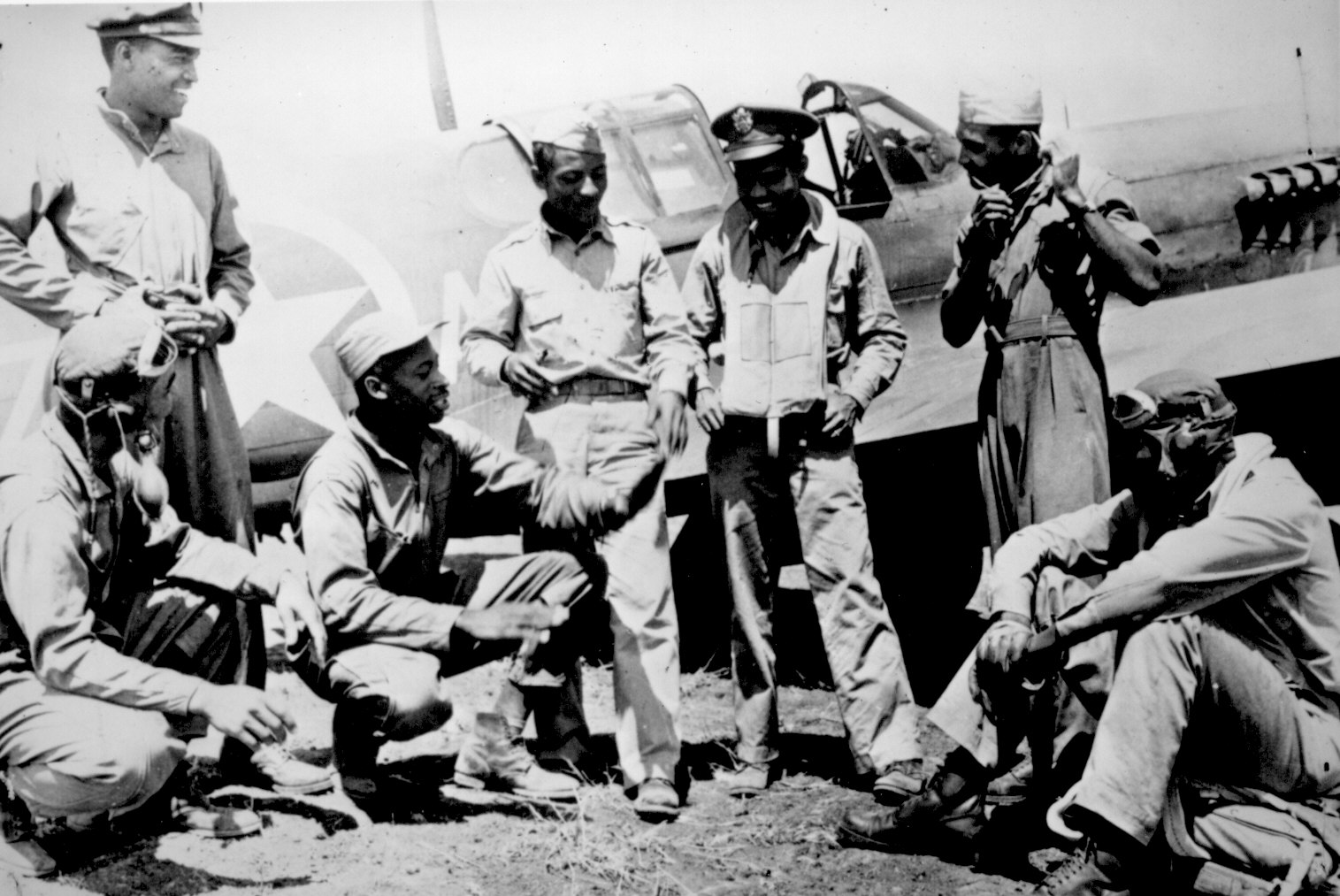
Courage and sacrifice define the Tuskegee Airmen. They were a group of military pilots who fought during World War II. They were active in the military throughout the 1940's. The Tuskegee program officially started on June 1941 with the 99th Pursuit Squadron at Tuskegee University. It had a unit of 47 officials and 429 enlisted men. One leader of the Tuskegee Airmen was Captain Benjamin O. Davis Jr. (who was the commander of the Tuskegee Airmen 332nd Fighter Group. He flew his P-47 Thunderbolt in Sicily). These men experienced racism and oppression, but they performed magnificently during the war. Mary McLeod Bethune and so many unsung heroes advanced the program to cause the Tuskegee Airmen to exist. Walter White of the NAACP, A. Philip Randolph, and Judge William H. Hastie wanted black men to be military aviators. So, in 1939, the federal government sent money to fund civilian flight schools to train African Americans. The Civilian Pilot Training Program allowed African Americans from colleges and universities to join the Tuskegee Airmen movement. Tuskegee Institute allowed many members to fly as well. The first class of black pilot prepared to do so in July 19, 1941. They were trained rigorously. They studied flying, navigation and meteorology. The first African Americans to get their silver wings and graduate was on the date of March 7, 1942. The Tuskegee Army Base was segregated and had many black pilots. The Tuskegee Airmen were in 9 different squadrons like the 332nd Fighter Group, the 99th, 100th, 301th, 302nd Fighter Squadrons, and the 616th, 617th, 618th, and 619th Bombardment Squadrons (they flew medium two engine bombers). When the pilots of the 332nd Fighter Group painted the tails of their P-47s and later, P-51s, red, the nickname "Red Tails" was coined. The red markings that distinguished the Tuskegee Airmen included red bands on the noses of P-51s as well as a red rudder; the P-51B and D Mustangs flew with similar color schemes, with red propeller spinners, yellow wing bands and all-red tail surfaces. Many of them were navigators, bombardiers, mechanics, instructors, crew chiefs, nurses, cooks, and other supporters of pilots. All black military pilots trained near Tuskegee Alabama at Moton Field in the Tuskegee Army Air Field. Jim Crow existed, so they were segregated.


The Tuskegee program was a successful endeavor and even First Lady Eleanor Roosevelt flew with the African American chief civilian instructor C. Alfred “Chief” Anderson on March of 1941. Anderson flew since 1929. Eleanor Roosevelt gave a loan to help build Moton Field. The loan was of $175,000. The 99th Squadron was involved in combat in April of 1943. They attacked an island on the Mediterranean Sea to clear lanes for the Allied invasion of Sicily in July 1943. By June 2, the combat mission was flown by the 99th. They moved into Sicily. They received a Distinguished Unit Citation for its actions in combat. Many of the Tuskegee Airmen were used as convoys to protect aircraft. Many of them shot down many Nazi aircraft including jets throughout Europe from France to Italy. The 332nd flew missions in Sicily, Anzio, Normandy, the Rhineland, the Po Valley and Rome-Arno and other places. Pilots of the 99th once set a record for destroying five enemy aircraft in less than four minutes. The Tuskegee Airmen shot down three German jets in a single day. In all, 992 pilots were trained in Tuskegee from 1941-46. 355 were deployed overseas, and 84 lost their lives in accidents or combat.
On March 24, 1945, the 332nd were involved in the longest bomber escort mission of the war. They shot down three of the new German ME-262 jet fighters and damaged 5 others without losing any of their own bombers or planes. The Tuskegee Airmen included some of the best pilots of the war. After the war in 1949, the 332nd Fighter Wing took first place in a shooting competition. It took place in Las Vegas, Nevada. The pilots were Capt. Alva Temple, Lts. Harry Stewart, James Harvey III and Herbert Alexander. Lt. Harvey said, "We had a perfect score. Three missions, two bombs per plane. We didn't guess at anything, we were good." They received congratulations from the Governor of Ohio, and Air Force commanders across the nation. Many famous Tuskegee Airmen included Edward C. Gleed of Lawrence, Kansas, Robert W. Williams, William H. Holloman, Ronald W. Reeves, Christopher W. Newman, Edward A. Gibbs, General Daniel “Chappie” James Jr., Marion Rodgers, and Walter M. Downs. Many of them would later work in NORAD, NASA, etc. The Tuskegee Airmen’s actions definitely contributed to the ending of the segregation of the military by 1948 (via the Executive Order of President Harry S. Truman called E.O. 9981). The excellence of the Tuskegee Airmen will always be remembered.


Other Stories of Service
During the Battle of the Bulge (which was one of the last offensives of the Nazis and the Nazis were defeated) during December of 1944, General Eisenhower was very short of replacement troops for existing all-white companies. So, he made the decision to allow 2,000 black servicemen volunteers to serve in segregated platoons under the command of white lieutenants to replenish these companies. These platoons would serve with distinction and according to an Army survey in the summer of 1945, 84% were ranked "very well" and 16% were ranked "fairly well". No black platoon received a ranking of "poor" by those white officers or white soldiers that fought with them. Unfortunately, these platoons were often subject to racist treatment by white military units in occupied Germany and were quickly sent back to their old segregated units after the end of hostilities in Germany. Despite their protests, these brave African American soldiers ended the war in their old non-combat service units. Though largely forgotten after the war, the temporary experiment with black combat troops proved a success - a small, but important step toward permanent integration during the Korean War. A total of 708 African Americans were killed in combat during World War II. There is the picture of an African American Battery A of the 452nd AAA (or Anti-Aircraft Artillery) Battalion on November 9, 1945. In 1945, Frederick C. Branch became the first African-American United States Marine Corps officer. There is another picture of African American soldiers in Burma reading President Truman’s Proclamation of Victory in Europe on May 9, 1945. In 1965, Marcelite J. Harris (who was born in Houston, Texas) became the first female African American United States Air Force officer. On January 13, 1997, President Bill Clinton (in a White House ceremony) awarded the nation’s highest military honor, which is the Medal of Honor, to seven African American servicemen who had served during World War II.


Double V
The Double V campaign was one of the most important campaigns of World War II. The Double V movement was a slogan. Its meaning was that it wanted black Americans to fight for democracy abroad and in America in order for racism to end in the States. The V victory sign was a double meaning. People who endorsed the Double V campaign wanted victory against the Axis Powers (along with their evils of aggression, slavery, and tyranny) and another victory for African Americans in America. It first appeared in the African American newspaper called the Pittsburgh Courier on February 7, 1942. The slogan started in a response to the letter, “Should I Sacrifice to Live 'Half American?'" written by 26-year-old reader James G. Thompson (He was from Wichita, Kansas). Pitched as "Democracy – Double Victory, At Home - Abroad", the campaign highlighted the risks African Americans took while they fought in the military campaign against Axis powers while denied their rights as citizens within the United States. Victory over fascism and racism (the double victory) was promoted by black people and many non-black people too. The campaign wanted civil rights and to get more African Americans to be involved in the war effort too. The Courier newspaper received massive support in dealing with the Double V movement. Telegrams came in to promote the campaign as well. Movie starts, other celebrities, etc. in magazines, postcards, and newspapers endorse the Double V movement. The Double V campaign was eventually adopted by other black newspapers, including the Los Angeles Sentinel, the Washington Tribune, and the Challenger of Columbus, Ohio. Despite the Courier’s effort, by 1943, the paper provided less space in promoting the campaign and by September 1945 the paper stopped using Double V. The Double V campaign gave voice to many African Americans in opposing racism and discrimination.
The arts and the sciences excelled in African American life during that time period too. Jacob Lawrence created artistic masterpieces. Hattie McDaniel acted and worked in charities in her life to help people. Charles R. Drew helped to send plasma to save countless life of soldiers during World War II. Charles R. Drew was one of the greatest doctors of the 20th century. Frederick Douglas Patterson helped many African Americans to have greater educational opportunities.


African American Women in World War II
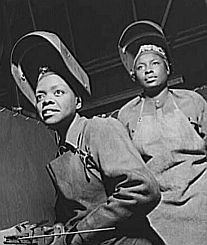
African American women have a huge involvement in World War II. African American women worked in factories (like Luedell Mitchell and Lavada Cherry, who worked in the El Segundo Plant of Douglas Aircraft Company during WWII), and shipyards nationwide when a labor shortage existed. They were also in the armed forces too. They experienced sexism and racism (massive segregation existed in America), but they continued to contribute their talents in making society better for themselves and their families. Many black people were given menial jobs. Black women experienced lax pay in many cases and gender discrimination. Some racists walked off jobs instead of working with black people.

These Sisters in the picture above are from the Tuskegee Air Women. This is from the 1940's. They were assigned as weather observers and forecasters, cryptographers, radio operators, repairmen, sheet metal workers, parachute riggers, link trainer instructors, bombsite maintenance specialists, aerial photograph analysts and control tower operators in the Air Corps. Famous black women pilots during this era were Janet Harmon and Willa Brown. They worked in Chicago. Both women helped to train black pilots. Mildred Hemmons Carter also was a member of the 1st graduating class of Tuskegee Institute's Flight School. Willa Brown Chappell was instrumental in training more than 200 students who went on to become the legendary Tuskegee airmen. Janet Harmon was the first black woman to receive a commercial pilot's license.

She is Sister Gertrude Marguerite Bertram and she is a black American nurse. This picture is taken from about 1943. She is wearing her ANC blue service uniform. The location appears to be Fort Bragg, North Carolina.
There was the WAC. The WAC stands for the Women’s Army Corps. By January 1941, African American women join the ranks of Army nurses to strengthen the war effort. Black nurses worked hard too. Sammie Mae Rice (1913-2006) was among the first African American nurses to serve in an overseas theater during World War II. Sammie Mae Rice (1913-2006) of Laurens, South Carolina, enlisted in the Army Nurse Corps on 24 July 1942. She served courageous and was discharged in March 1, 1946. In 1942, Charity Adams (Earley) became the first African-American female commissioned officer in the WAAC (or the Women’s Army Auxiliary Corps). The WAAC was converted to the Women's Army Corps (WAC) in 1943, and recognized as an official part of the regular army. More than 150,000 women served as WACs during the war, and thousands were sent to the European and Pacific theaters. In 1944, WACs landed in Normandy after D-Day and served in Australia, New Guinea, and the Philippines in the Pacific. In 1945 the 6888th Central Postal Directory Battalion (the only all African-American, all-female battalion during World War II) worked in England and France, making them the first black female battalion to travel overseas.
The battalion was commanded by MAJ Charity Adams Earley, and was composed of 30 officers and 800 enlisted women. WWII black recruitment was limited to 10 percent for the WAAC/WAC—matching the percentage of African-Americans in the US population at the time. For the most part, Army policy reflected segregation policy. Enlisted basic training was segregated for training, living and dining. At enlisted specialists schools and officer training living quarters were segregated but training and dining were integrated. A total of 6,520 African-American women served during the war. There is a picture of Major Charity E. Adams and Captain Abbie N. Campbell inspecting WACs in England on February of 1945. Mrs. Callie O. Gentry was the stenographer of the Tuskegee Airmen.


These Pictures show the “Six-Triple Eight” Central Postal Battalion. They were made up of about 1,000 women. They moved mountains of mail for millions of American service members and civilians that clogged warehouses in England and France. Their service to their country had been overlooked for years. They were the first all African American, all women unit to serve overseas during World War II.

She was Alberta Martin. She tried to enlist in the Army Nurse Corps. In autobiographical notes, she wrote that her application was denied because there was a quota for black nurses. In March 1945, she finally received a commission as a lieutenant and was one of 20 black nurses to serve in an integrated unit in Fort Meade, Maryland.
Bessie Stringfield was a legendary woman. She is known as the “Motorcycle Queen of Miami”. She was the first Jamaican-American woman to ride across America solo. At the age of 16 Stringfield taught herself to ride her first motorcycle, a 1928 Indian Scout. In 1930, at the age of 19, she commenced traveling across the United States. She made seven more long-distance trips in the US, and eventually rode through the 48 lower states, Europe, Brazil and Haiti. During World War II, she served one of the few motorcycle dispatch riders for the American military. During WWII Stringfield served as a civilian courier for the US Army, carrying documents between domestic army bases. She completed the rigorous training and rode her own blue 61 cubic inch Harley-Davidson. During the four years she worked for the Army, she crossed the United States eight times. She regularly encountered racism during this time, reportedly being deliberately knocked down by a white male in a pickup truck while traveling in the South. In the 1950's Stringfield moved to Miami, Florida. Some police harassed her since she was a black woman riding a motorcycle. Later, the police allowed her to ride her vehicle. She owned 27 of her own motorcycles. She broke down barriers for women and Jamaican American motorcyclists. In fact, Stringfield was inducted into the Motorcycle Hall of Fame. This award was bestowed by the American Motorcyclist Association (AMA) for “Superior Achievement by a Female Motorcyclist” is named in her honor. He lived from February 9, 1911 to February of 1993 in Opa Locka, Florida. She was born in Kingston, Jamaica.


Black women and men were about 6 percent of all employees in aircraft industries (whereas white women made up of 40 percent of all aircraft workers). Lena Horne, Dorothy Dandridge, Hazel Scott, and other African American women not only performed music and were in movies. They were active to oppose fascism during World War II. Clara Camille Carroll worked in Washington, D.C. in 1943. She was a black woman. She worked in a clerical job and she was from Cleveland, Ohio. By the 1950’s, she would be the first black American woman sailor based on Norfolk Naval base. She came into Howard University. There is a picture of Lt. Harriet Ida Pickens and Ens. Frances Willis from 1944. Black women worked in railroads, built planes, worked in the battlefield, and traveled across the world in fulfilling their occupations. Willa Beatrice Brown was the first black woman to earn a pilot’s license in America. A lifelong advocate for gender and racial equality in flight and in the military, Brown not only lobbied the U.S. government to integrate the U.S. Army Air Corp and include African Americans in the Civilian Pilot Training Program (CPTP), but also co-founded the Cornelius Coffey School of Aeronautics with Cornelius Coffey, which was the first private flight training academy in the United States owned and operated by African Americans. She trained hundreds of pilots, several of whom would go on to become Tuskegee Airmen. She was politically and socially active in Chicago. She taught many on how to fly. Pvt. Ruth L. James worked hard during World War II too. Frances Bates was an US Navy WAVE Apprentice Seawoman back in 1945. The Navy did not allow women of color until January 25, 1945. The first African-American woman sworn into the Navy was Phyllis Mae Dailey, a nurse and Columbia University student from New York. She was the first of only four African American women to serve in the Navy during WW2.


The Fights for Justice
Black Americans fought for justice during World War II. During the era of World War II, African Americans grew their political power. More African Americans moved into being Democrats than Republicans because of the administration of Franklin Delano Roosevelt’s claim to do something about discrimination in the military and involving society in general. FDR said that this New Deal would help Americans, but FDR had a mixed record on civil rights. Groups like the NAACP (or the National Association for the Advancement of Colored People), the National Urban League, and the National Negro Congress have called for equality and justice for black Americans. The Pittsburgh Courier was a newspaper of a large black readership. By 1938, it created the Committee on Participation of Negroes in the National Defense Program. Many people wanted to increase the amount of proportion of African Americans in the military. NAACP’s the Crisis magazine published articles about wanting democracy at home. During the 1940 presidential election, both parties courted the black vote. Incumbent President Franklin Delano Roosevelt was re-elected, partly because substantial numbers of black voters crossed previous party lines and voted for the Democratic Party candidate. During this time, great leaders like Ella Baker, Mary McLeod Bethune, Rosa Parks, Mary Church Terrell, and others fought for racial justice.
By 1941, civil rights activists A. Philip Randolph, A.J. Muste, and Bayard Rustin pushed Roosevelt to order fair employment for black people in the federal government. The activists threatened to march on Washington, D.C. in July 1941. Roosevelt didn’t want this to happen, because he felt that it would be a public relations disaster for his Presidency. A. Philip Randolph and others rightfully found it appalling that the Nazis were doing injustices overseas while black people were denied fundamental human rights in America. Back then, many black people were restricted from having skilled jobs in war production companies. Many of these companies refused to hire African Americans. The federal government at first refused to do anything about it. So, Randolph launched the MOWM or the March on Washington Movement. He wanted thousands of black people to march on Washington in 1941 to demand that Roosevelt issue an executive order to ban discrimination in the defense industry.
Walter White of the NAACP, Lester Granger of the Urban League, and other black leaders agreed with the plans for the march. Eleanor Roosevelt met with Randolph and White to try to convince them to call off the march. Randolph refused. He wanted action. So, FDR had a meeting with Randolph and other march leaders in June of 1941. Mayor Fiorello La Guardia of New York City worked with FDR and other to form a compromise agreement with Randolph. A. Philip Randolph agreed to call off the march and FDR issued the Executive Order 8802. This order banned employment discrimination in the defense industry and government. He or FDR also created a temporary Fair Employment Practices Committee to help ensure that defense manufacturers wouldn’t advance racial discrimination. It was the first action of the federal government to address racism nationwide since Reconstruction. Randolph called off the march and this was the first step in a long journey. This was one foundation of the civil rights movement of the 1950’s and the 1960’s.

CORE or the Congress of Racial Equality was created in 1942. Its founders were James Farmer, George Houser, and Bernice Fisher. It was created in Chicago and wanted to promote the philosophy of nonviolence in order for black people and all people to have equality, freedom, and justice. They would be involved in many efforts to fight for civil rights from the era of WWII to decades afterwards. The Port Chicago disaster caused another fight for justice. The Port Chicago disaster happened on July 17, 1944. It was an explosion of about 2,000 tons of ammunition. It was loaded onto ships by black Navy sailors under pressure from their white officers to hurry. It happened in Northern California and conditions were bad in that location. The explosion killed 320 military and civilian workers, most of them were black people who were killed. This led into the Port Chicago Mutiny, which called for safer working conditions in the location. This was the only case of a full military trial for mutiny in the history of the U.S. Navy against 50 African American sailors who refused to continue loading ammunition under the same dangerous conditions. The trial was observed by the then young lawyer Thurgood Marshall and ended in conviction of all of the defendants. The trial was immediately and later criticized for not abiding by the applicable laws on mutiny, and it became influential in the discussion of desegregation.
It is important to mention more information about Josephine Baker. She was born in St. Louis, Missouri and became an international entertainer. Yet, she was more than a musician and a dancer. She had a great deal of conscious about the world society. She dedicated her life to tolerance and fighting Jim Crow segregation in America. She lived long enough to see legal Jim Crow segregation to be gone by 1965 in America. She also heroically worked for the French Resistance. The French Resistance was fighting the Nazis and the evil pro-Nazi Vichy state during World War II. After the war, she was awarded the Croix de guerre by the French military, and was named a Chevalier of the Légion d'honneur by General Charles de Gaulle. She loved Paris as her 2nd love. She worked in the Civil Rights Movement and was a proponent of freedom, artistic creativity, and loyalty (or fidelity) to justice.
Rest in Power Sister Josephine Baker.


Black people and the Holocaust
There were black people in Germany back then. The Nazi Empire murdered many Afro-Germans. Even before WWI, Afro-Germans faced racism and discrimination in Germany. Many German racists didn’t want black people and biracial people in Germany to have equal rights. After WWI, many African colonial troops in the Rhineland had fathered children with German women. Newspapers in Germany called these children “Rhineland ba___.” That was wrong and evil. A very small number of biracial children were born (only about 400-600). There was a total black population of 20,000 to 25,000 human beings in Germany at the time. Hitler was a racist and he believed in the lie that black people were genetically inferior to whites (when Hitler wasn’t even a blue eyed, blonde Aryan). In Mein Kampf, he accused Jewish people of sending black people into the Rhine to make children in order for the white race to be harmed (while Jewish people would dominate Germany). He blamed France for this too. Of course, Hitler was wrong and a racist plus an anti-Semite. The Nazis used a eugenics program to sterilize biracial children born during occupation. Hitler and the Gestapo executed the sterilization of 500 children under this program including girls as young as 11. That was heinous. One biracial person named Hilarius Gilges (he grew up in Dusseldorf, Germany) was captured by SS officers in June of 1933. The SS stands for Schutzstaffel or the paramilitary and the surveillance organization formed by Hitler in 1925. Hilarius Gilges was tortured and murdered by them. Afro-Germans experienced discrimination in employment, welfare, and housing in Nazi Germany. Many of them were banned from having a higher education. There were Afro-German prisoners of war and African American soldiers who were prisoners of war too. Many of them were executed and many were not. Violence against black prisoners of war existed, which was against the Geneva Convention.
In prisoner of war camps, black soldiers were kept segregated from white prisoners, and generally experienced worse conditions than their white comrades, conditions that deteriorated further in the last days of the war. Roughly half of the French colonial prisoners of war did not survive captivity. Groups such as North Africans were sometimes treated as black, sometimes as white. Sister Valaida Snow was an African American woman who was a great musician. She was victim of Nazi imprisonment in 1941 while in Denmark. She was released in May 1942 after a prisoner exchange. She continued to make music afterwards. The story of the Liberian-German, Hans Massaquoi, who died at age 87 in 2013 is important to know about. He was a former managing editor of the American Ebony magazine and he wrote a memoir about his childhood in Nazi Germany. Black soldiers of the American, French, and British armies were worked to death on construction projects or died as a result of mistreatment in concentration or prisoner-of-war camps. Others were never even incarcerated, but were instead immediately killed by the SS or Gestapo. Other victims of Nazis included Jean Marcel Nicolas, Mahjub bin Adam Mohamed, the African American pilot from Portland, Oregon Lieutenant Darwin Nichols, Gert Schramm, and others. Some African American members of the U.S. armed forces liberated people. They saw the evil Nazi atrocities first hand. The all African American tank unit called the 761st Tank Battalion was under the command of General George Patton. The Battalion participated in the liberation of Gunskirchen or a subcamp of the Mauthausen concentration camp in May of 1945.

Conclusion
World War II was a long, deadly war. It involved the death of more people than any war in history. War is filled with bloodshed and destruction. African Americans were heavily involved in WWII as pilots, nurses, soldiers, tank operators, naval leaders, etc. They wanted the Axis Powers to be defeated. Also, they wanted racism to be defeated domestically in America. That is the precise meaning of the Double V movement. It wanted fascists defeated overseas and in America. The fascists in America promoted not only Jim Crow, but discrimination, racism, lynching, and other forms of oppression. Yet, black people never quit. We fought against injustices, stood up to the status quo, and defeated fascists in Europe at the same time. There were riots in Detroit and Chicago along with a rebellion in Harlem during the 1940’s. The activism of black people caused FDR to issue the first pro-civil rights executive order from a President since Reconstruction. World War II veterans weren’t just men. Many World War II veterans were black women too. Their service should be acknowledged, respected, and honored. After the War, black people still faced oppression and injustice. Many WWII veterans were murdered by racists. Many veterans continued to form an important part of the civil rights movement too in their activism. The Allied victory ended one chapter and started a new one in world history. America became the most powerful military nation on Earth. It became an international military and economic force overnight. It used capitalism to rebuilt markets in Europe and Japan. Also, the evil of Jim Crow would continue after WWII for the next 2 decades. The Civil Rights Movement in the modern sense would rise after the war. The next chapter of the African American History series will describe the modern Day Civil Rights Movement from 1954 to 1968.
Yes, Our Eyes are on the Prize.
By Timothy


Appendix A: The Second Great Migration and the Korean War
One of the greatest events in human history was the Second Great Migration of African Americans. It was the migration of more than five million African Americans. They traveled from the South to the North, the Midwest, and the West Coast. It happened from 1941 to 1970. It was much larger and was different from the first Great Migration (which lasted from ca. 1910-1940). The Second Great Migration started during the era of World War II. During the Second Great Migration, people traveled into Californian cities too like Los Angeles, Oakland, Richmond, and Long Beach. These places offered skilled jobs in the defense industry. In the Midwest, the West, and the North, discrimination still existed. Back then, many African Americans already had urban jobs in the South before they relocated. Many black workers were forced to work in segregated, low skilled jobs in many cities of the South. The Great Migration allowed African Americans to get highly skilled, well paid jobs at California shipyards. The Second Great Migration caused many African Americans to live in urban locations in a higher level. By the end of the Second Great Migration, 80 percent of black people lived in cities. Fifty-three percent remained in the Southern United States, while 40 percent lived in the Northeast and North Central states and 7 percent in the West. Many black people experienced dangerous work conditions too. There was a mention explosion at Port Chicago, California (near San Francisco). It killed over 200 black people in 1944. Later, some workers refused to work until conditions improved. Up to 50 were tried for mutiny and imprisoned. Many people migrated for a diversity of reasons.
Many wanted economic improvement in their own lives. They didn’t want economic deprivation. African American men and women wanted skilled jobs. They wanted to support their families. Northern employees hired African Americans from the South and whites from the South as a cheap labor force to replace the more costly European immigrant workers. Racial violence, political disenfranchisement, and educational opportunities were other reasons for the 2nd Great Migration too. In cities like San Francisco, Los Angeles, Chicago, etc. de facto segregation existed. De Facto segregation is segregation by policy not by law. Many black people were forced into low income housing, because of racial and economic discrimination. Freeways, urban renewal, and covenant policies in the Midwest, the West, and the North harmed black communities and advanced more segregation. Many families were overcrowded. White flight grew during the 1960’s too. White flight was driven in part by the process of blockbusting. White property owners, fearful of minority groups, sold their homes to real estate agents at a low price, often due to the tactics of the real estate companies themselves. Agents would then encourage that the vacant properties be bought by black families seeking respite from the overcrowded neighborhoods in which they were sequestered. When one black family moved in, the white neighbors would immediately sell their homes to the waiting real estate companies, who would in turn sell to more black people at a significant markup. Black people fought discriminatory housing laws too. The 1963 Rumford Fair Housing Act banned discrimination in housing in California. Yet, right wingers ended that law by the Proposition 14 (which harmed housing rights) in 1964. It would take the Supreme Court to declare Prop 14 unconstitutional. Some scholars believe that Prop 14 (which is an evil policy) contributed to the Watts rebellion of 1965. Many black Southerners brought their culture from food to music to areas across the West Coast, the North, and the Midwest in homogeneous communities. The Second Great Migration changed the culture of America permanently.
After World War II, the integration of the Armed Forces existed. On July 26, 1948, President Harry S. Truman signed Executive Order 9981. That order integrated the military and mandated equality of treatment and opportunity. It was a historic time. It made it illegal, per military law, to make a racist remark. It would be years later for the whole military to be desegregated. All black units were in the Korean War. The last all-black unit was disbanded by 1954. In 1950, Lieutenant Leon Gilbert of the still-segregated 24th Infantry Regiment was court martialed and sentenced to death for refusing to obey the orders of a white officer while serving in the Korean War. Gilbert maintained that the orders would have meant certain death for himself and the men in his command. The case led to worldwide protests and increased attention to segregation and racism in the U.S. military. Gilbert's sentence was commuted to twenty and later seventeen years of imprisonment; he served five years and was released. Harry Truman extended his executive order to schools and neighborhoods as well as military units. Fifteen years after the Executive Order, Secretary of Defense Robert McNamara issued Department of Defense Directive 5120.36. "Every military commander", the Directive mandates, "has the responsibility to oppose discriminatory practices affecting his men and their dependents and to foster equal opportunity for them, not only in areas under his immediate control, but also in nearby communities where they may gather in off-duty hours." While the directive was issued in 1963, it was not until 1967 that the first non-military establishment was declared off-limits. In 1970 the requirement that commanding officers first obtain permission from the Secretary of Defense was lifted, and areas were allowed to be declared housing areas off limits to military personnel by their commanding officer. The end of military segregation caused the increase of representation of African Americans in the military. Now, we have an all-volunteer army.
The Korean War has been forgotten by many, but we will never forget. It was a war about a dispute between North and South Korea over philosophies and territories. North Korea was a Communist state while South Korea was a capitalist state. North Korea received military aid from the Soviet Union and China while South Korea received military aid from America and its allies. The war was short, but extremely bloody. Tons of people lost their lives among both sides. African American soldiers were heavily involved in the war. Jesse L. Brown was the U.S. Navy’s first black aviator in October 1948. He was killed when his plane was shot down during the Battle of Chosin Reservoir in North Korea.


He was unable to parachute from his crippled F4U Corsair and crash-landed unsuccessfully. His injuries and damage to his aircraft prevented him from leaving the plane. A white squadron mate, Thomas Hudner, crash-landed his F4U Corsair near Brown and attempted to extricate Brown but could not and Brown died of his injuries. Hudner was awarded the Medal of Honor for his efforts. The U.S. Navy honored Jesse Brown by naming a frigate after him—the USS Jesse L. Brown (FF-1089), Two enlisted men from the 24th Infantry Regiment (still a segregated unit), Cornelius H. Charlton and William Thompson, posthumously received the Medal of Honor for actions during the war. African Americans served in all combat and combat service elements during the war. By 1950, about 100,000 African Americans were on active duty in the U.S. Armed Forces. That was about 8 percent of the total manpower. By October 1951, the all black 24th Infantry Regiment was disbanded. It was formed in 1869 and it served in the Spanish American War, WWI, WWII, and during the beginning of the Korean War. The recapturing of Yech’on was done heavily by a battalion combat team commanded by Lieutenant Colonel Samuel Pierce Jr. and it was made up of 3 infantry companies and an engineer company. This took place on July 21, 1950. Captain Charles Bussey was the commander of the engineer company during that operation and he was awarded the Silver Star for preventing a flanking operation by a North Korean battalion during the battle. Second Lieutenant Frank E. Peterson Jr., was the first black Marine Corps pilot. Peterson flew 64 combat missions before the war ended. He earned the Distinguished Flying Cross and six Air Medals in the final months of the Korean War. In 1950, the Air Force had 25 black pilots in integrated fighter squadrons led by Captain Daniel "Chappie" James Jr., who was assigned to the 36th Squadron, 5th Air Force. Captain James was an exceptional fighter pilot who often flew his F-86 Sabre jet on dangerous, unarmed reconnaissance missions behind enemy lines -- a task reserved for a select group of the most able and trusted flyers. James flew 101 combat missions in Korea and earned the Distinguished Flying Cross before being reassigned stateside. In July 1951, he became the first African-American in the Air Force to command a fighter squadron.
More than 600,000 African Americans served in the armed forces during the Korean War. More than 5,000 black people died in combat. There were African American POWs in the Korean War too. Black women were involved in the Korean War too. The WACs started to integrate training and living in April of 1950. By January 6, 1948, Ensign Edith De Voe was sworn into the Regular Navy Nurse Corps and in March, First Lieutennant Nancy C. Leftenant was a part of the Regular Army Nurse Corps. She was part of the corps’ first black members. The African American WAC detachment at Fort Lewis, Washington was mostly black all over the Korean War. The detachment commander was Mary Teague Smith. She fought discrimination about white women going up the ranks faster than black women. She was reassigned to Japan by 1952. By 1952, the Secretary of the Army did something. They told a congressional committee of the armed services of wanting African American women to comprise only 20 percent of the unit. Army Nurse Captain Yorke in 1952 was a black woman who was stationed in Korea for the whole Korean War. She treated the injured. African American women in the military fought both racism and sexism in the service.

In 1952, 2 African American military women fought to end Jim Crow policies in interstate transportation. One was Sarah Keys Evans. Sarah Evans refused to go to the back of the bus was while in North Carolina. She was arrested, jailed overnight, and fiend. She fought in the courts. Dovey Johnson Roundtree (she was in the Women’s Auxiliary Army Corps or WAAC via the advice of her mentor Mary McLeod Bethune. Bethune fought of the desegregation of the military) was a former WAC officer. She was an attorney in Washington D.C. too. She took on the Keys case. Roundtree continued to file suit and by 1955, the 11 man ICC Commission agreed with Keys. It ended Jim Crow policy on all interstate transportation. Keys experienced unjust discrimination and racism. She won her battle. Black women were in the Air Force by 1949. One person in the Air Force was Helen Gentry. Women were allowed into the Navy by 1944. Freddie Mae Hopson was enlisted in the Navy in early 1952. The first African American women in the Marines were Annie Graham and Ann Lamb in 1949. They volunteered. Annie Grimes was the third person to enlist in 1950. The African American involvement in the Korean War was very extensive.
By Timothy
P.S. The following links gives you an opportunity to assist an upcoming documentary about African American women involvement in WWII.
http://invisiblewarriorsfilm.com/
http://www.ebony.com/entertainment-culture/invisible-warriors-african-american-women-in-world-war-ii-981#axzz4wHR4Aknt
https://www.scribd.com/document/354466703/The-African-American-Story-Part-5
https://drive.google.com/file/d/0B9ao63AKn_rLOXA3cEs4NDhIZWc/view
The Legacy of President Barack Obama

The Legacy of President Barack Obama
Today, we are close to the beginning of a new decade. In our lifetimes, we have witnessed amazing historical events and new challenges. The struggle for racial equality and economic justice continues. The legacy of President Barack Obama will be debated for years and decades to come. What is true is that President Barack Obama has lived an extraordinary, interesting life. He is a man who married a beautiful, extremely influential First Lady Michelle Obama and the couple has two very intelligent black daughters (whose names are Sasha and Malia). The First Family has remained united firmly. Barack Obama is the first African American President in American history. Before his Presidency, there was 9/11. The Bush administration along with neoconservatives implement their extremist foreign policy agendas from the Iraq War (before 2003, Rumsfeld and others desired to bomb Iraq when Iraq had nothing to do with 9/11), the existence of the Patriot Act, and to its torture policies. As the 44th President of the United States, his Presidency (from 2009-2017) is marked by policies in dealing with the economic recession, the continued existence of police brutality, the complex manifestations of the war on terror, the Black Lives Matter movement, a lot of social issues, climate change, and continued debates on health care. He has given numerous speeches that were progressive and he has expressed more conservative speeches on family parenting and on other matters. His Presidency has existed in ups and downs. It is greatly fair to outline what he got correct and wrong to order to designate a fair appraisal of his ultimate legacy as President. He has shown great eloquence in his speeches and a massive Republican opposition came his way. He has expressed great praise (from many quarters) and criticism (from many quarters too). Barack Obama is known to try to bridge generational, political, and racial gaps via his Philadelphia speech of 2008. He is also known to be serious about what he stands for. Therefore, the time is right to show the world about his life and Presidency, so future generations can witness the unvarnished truth. His great accomplishments and his great mistakes (i.e. continuing many of the same policies from the previous Bush administration. Obama has been viewed by the establishment as a far better manager of the national security state) will be shown here.
President Barack Obama's historic Presidency has changed the world forevermore.


Early Life
To fully start, it is important to describe Barack Obama’s early life. He was born in August 4, 1961 in Honolulu, Hawaii. He was born at the old Kapiolani Maternity and Gynecological Hospital at 1611 Bingham Street. The Honolulu Advertiser and the Honolulu Star-Bulletin announced the birth of Barack Obama. His father was Barack Obama Sr. and he was born in Kenya. He lived from 1936-1982. Barack Obama’s mother was Ann Dunham. Ann Dunham was born in Wichita, Kansas. She lived from 1942-1995. Obama’s parents met in 1960 while both of them were attending the University of Hawaii at Manoa. Barack Obama’s father was the university’s first foreign student from an African nation. Obama’s parents married on the Hawaiian island of Maui on February 2, 1961. The couple would travel across the country to take educational classes. Barack Obama lived a lot of his childhood in Honolulu, which is where his mother completed college. His parents soon divorced in 1964. Later, he also developed a close relationship with his maternal grandparents too. By 1965, his mother married Lolo Soetoro from Indonesia. In 1967, Barack Obama moved into Indonesia. In that location, he was raised by his mother and stepfather Lolo. Barack Obama lived in Jakarta during this time. Barack Obama attended the Indonesian-language Santo Fransiskus Asisi (St. Francis of Assisi) Catholic School around the corner from their house for 1st, 2nd, and part of 3rd grade. Barack Obama came into Hawaii by 1970 in order for him to visit his maternal grandparents, Stanley and Madelyn Dunham. Barack Obama’s younger sister is named Maya Kassandra Soetoro and she was born on August 15, 1970.
Barack Obama came back into Hawaii in 1971 to live with his grandparents. There, he attended Punahou School (at the 5th grade) and graduated from there in 1979. He loved basketball and he was a great people person. His mother completed her coursework at the University of Hawaii for an M.A. in anthropology in December of 1974. Ann Dunham traveled into Jakarta with May in August of 1975 while Barack Obama decided to stay with his grandparents in Honolulu to finish his studies at Punahou School for his high school years. Barack Obama had an unique childhood and he grew up in massive diversity. As found in many children of multiracial heritage, he faced insecurities and questions about his own identity during his early life. His knowledge about his African father, who returned once for a brief visit in 1971, came mainly through family stories and photographs.
Of his early childhood, Obama writes: "That my father looked nothing like the people around me—that he was black as pitch, my mother white as milk—barely registered in my mind." Barack Obama wrote that he used alcohol, marijuana, and cocaine during his teenage years to "push questions of who I was out of my mind.” His “Dreams of My Father” book describes his life in great detail. After his teenage years, he stopped using illegal drugs. He would attend parties with many African Americans too. The diversity of the culture of Hawaii most definitely influenced his ideological outlook and his embrace of the values of mutual respect and tolerance of the different races, creeds, and identities found in the human family. After high school, Barack Obama moved into Los Angeles in 1979.

College Life
To understand the legacy of President Barack Obama, you have to understand his life. Barack Obama studied at Occidental College for 2 years in Los Angeles, California. By February 18, 1981, he made his first public speech. He called for Occidental’s divestment from South Africa (during the anti-apartheid movement). In the summer of 1981, Barack Obama traveled into Jakarta, Indonesia to visit his mother and half-sister Maya. He also visited the families of Occidental College friends in Hyderabad (in India) and Karachi (in Pakistan) for 3 weeks. He later transferred to Columbia University in New York City. He majored in political science with a specialization in international relations. During this time period of his life, he lived off campus in a modest rented apartment at 142 West 109th St. He graduated with an A.B. from Columbia in 1983. Soon afterwards, he worked at Business International Corporation and New York Public Interest Research Group.


Community Organizer
After working in New York for four years, Barack Obama moved into Chicago. In Chicago, he became a community organizer. He worked for three years from June 1985 to May 1988 as director of Developing Communities Project (or DCP). DCP is a church based community organization. It was at first made up of eight Catholic parishes in Greater Roseland (Roseland, West Pullman, and Riverdale) on Chicago’s far South Side. He was a DCP Director for 3 years. The staff grew from 1 to 14 in that timespan. Its annual budget grew from $70,000 to $400,000. The program caused a job training program, a college preparatory tutoring program, and a tenant’s rights organization in Altgeld Gardens. This was during the time of Mayor Harold Washington of Chicago (who believed in infrastructure development, affirmative action, and ending patronage hiring. He was the first African American mayor of Chicago) during the 1980's. Washington won his mayoral election by forming a multiracial coalition to vote for him. Ironically enough, it would be a multiracial coalition that would vote for Obama to be President of the United States of America in 2008 and in 2012. Barack Obama worked as a consultant and instructor for Gamaliel Foundation, which is a community organizing institute. By the summer of 1988, he traveled to Europe for three weeks and to Kenya for 5 weeks where he met many of his paternal relatives for the first time. Barack Obama entered Harvard Law School in late 1988. In an interview with Ebony in 1990, he stated that he saw a degree in law as a vehicle to facilitate better community organization and activism: "The idea was not only to get people to learn how to hope and dream about different possibilities, but to know how the tax structure affects what kind of housing gets built where." At the end of his first year he was selected as an editor of the Harvard Law Review based on his grades and a writing competition. In February 1990, his second year at Harvard, he was elected president of the law review, a full-time volunteer position functioning as editor-in-chief and supervising the law review's staff of 80 editors. Obama's election as the first black president of the law review was widely reported and followed by several long, detailed profiles.


Barack Obama was elected by convincing a crucial swing bloc of conservatives that he would protect their interests if they supported him. He listened to people like he listened to poor people in the neighborhood of South Side Chicago, etc. Richard Epstein, who later taught at the University of Chicago Law School when Obama later taught there, said Obama was elected editor "because people on the other side believed he would give them a fair shake." When he was in law school, he worked as an associate at the law firms of Sidley & Austin in 1989. In that place, he met his future wife, Michelle LaVaughn Robinson Obama. Newton N. Minow was a managing partner. Minow would introduce Obama to some of Chicago’s top business leaders. He worked at Hopkins & Sutter in the summer of 1990. Also during his law school years, Obama spent eight days in Los Angeles taking a national training course on Alinsky methods of organizing. He graduated with a J.D. magna cum laude from Harvard in 1991 and returned to Chicago. He has great publicity from his election as the first African American president of the Harvard Law Review. He had a contract and advance to write a book about race relations. The University of Chicago Law School wanted to recruit him to join their faculty. So, they provided Obama a fellowship and an office to work on his book. He at first wanted to write his book in one year. It took longer, because the book evolved into his own personal memoir. He wanted to work without interruptions.
So, Barack Obama and his wife, Michelle Obama, traveled into Bali where he wrote for several months. The manuscript was finally published as “Dreams from My Father” in mid-1995. He married Michelle Obama in 1992. They settled down with each other in Hyde Park. That is a liberal, integrated, and middle class Chicago neighborhood. It has a history of electing reform minded politicians independent of the Daley political machine. The couple's first daughter, Malia Ann, was born in 1998; their second, Natasha (known as Sasha), in 2001. Their marriage caused them to form more links with Chicago politicians. One of Michelle’s best friends is Jesse Jackson’s daughter, Santita Jackson. Santita is the godmother of Obama’s first child. Michelle Obama once worked as an aide to Mayor Richard M. Daley. Marty Nesbitt, a young, successful black businessman (who played basketball with Michelle's brother, Craig Robinson), became Obama's best friend and introduced him to other African-American business people. Before the marriage, according to Craig, Obama talked about his political ambitions, even saying that he might run for President someday.
Barack Obama was involved in Project Vote from April to October 1992. It was a nonpartisan voting drive that helped Carol Moseley Braun to be the first black women ever elected to the Senate. He helped to register up to 400,000 African Americans to vote in the state. His staff was made up of 10 and 700 volunteers. Crain’s Chicago Business named Obama to its 1993 list of “40 under Forty” powers to be. According to Sandy Newman, who founded Project Vote, Obama "raised more money than any of our state directors had ever done. He did a great job of enlisting a broad spectrum of organizations and people, including many who did not get along well with one another." The wealthy elite of Chicago from the liberal crowd contacted Obama. Many of them would be his supporters in his future political career. One of them would be David Axelrod who would be head of his campaign for President. The fundraising committee was chaired by John Schmidt, a former chief of staff to Mayor Richard M. Daley, and John W. Rogers Jr., a young black money manager and founder of Ariel Capital Management. Obama also met much of the city's black political leadership, although he didn't always get along with the older politicians, with friction sometimes developing over Obama's reluctance to spend money and his insistence on results. "He really did it, and he let other people take all the credit", Schmidt later said. "The people standing up at the press conferences were Jesse Jackson and Bobby Rush and I don't know who else. Barack was off to the side and only the people who were close to it knew he had done all the work."
From 1992 to 1996, Barack Obama taught constitutional law at the University of Chicago Law School. He was a senior lecturer from 1996 to 2004. He taught courses in due process and equal protection (including the issues of voting rights, racism, and law). He joined Davis, Miner, Barnhill & Galland, which was a 12 attorney law firm. It was involved in civil rights litigation and economic development. The firm worked with Chicago’s black community for years. He wanted to go into politics. He was also a lawyer. He was involved in 30 cases. He worked on voting rights cases. He worked in the Joyce Foundation. By 1995, Barack Obama announced his candidacy for a seat in the Illinois state Senate and he attended Louis Farrakhan’s Million Man March in Washington, D.C.
Barack Obama was elected to the Illinois Senate in 1996. He succeeded Democratic State Senator Alice Palmer from Illinois’s 13th District. He gained bipartisan support for supported ethics reform and health care laws. He sponsored a law that increased tax credits for low-income workers, negotiated welfare reform, and promoted increased subsidies for childcare. Barack Obama was a state Senator from 1997 to 2004. He was reelected in 1998. He sponsored bipartisan passage of legislation to monitor racial profiling by requiring police to record the race of drivers they detained, and legislation making Illinois the first state to mandate videotaping of homicide interrogations. He was U.S. Senator by November of 2004. By this time, he was an early opponent of George W. Bush’s administration’s 2003 invasion of Iraq. He spoke out against the war in October 2, 2002 and in March of 2003 in an anti-war rally. In 2004, he gave his historic Democratic National Convention speech of July of 2004. It was a very eloquent speech about hope, coming together, and transcending political differences.

U.S. Senator
Barack Obama was sworn in as a U.S. Congressional Senator on January 3, 2005. He was the only U.S. Senator member back then who was a member of the Congressional Black Caucus. He voted on legislation. He would resign on November 16, 2008 before he was inaugurated as President. As a Senator, he fought for immigration reform, the reduction of nuclear weapons, and financial transparency. In December 2006, President Bush signed into law the Democratic Republic of the Congo Relief, Security, and Democracy Promotion Act, marking the first federal legislation to be enacted with Obama as its primary sponsor. In January 2007, Obama and Senator Feingold introduced a corporate jet provision to the Honest Leadership and Open Government Act, which was signed into law in September 2007. He worked with Democrats and Republicans like Senator Richard Lugar of Indiana. He worked on many committees too.


His Historic 2008 Presidential Campaign
On February 10, 2007, Barack Obama announced his candidacy for President of the United States. He did so in the front of the Old State Capitol building in Springfield, Illinois. He wanted to speak at that location as it is viewed as symbolic since it was where Abraham Lincoln gave his historic “House Divided” speech in 1858. In other words, Barack Obama wanted to break down divisions and want to form a unified America. Barack Obama talked about ending the Iraq War, increasing energy independence, reforming health care, and other themes. Throughout his campaign, he talked about the themes of hope and change. In fact, the theme of his campaign would be "Hope and Change." Many celebrities and young people were enthusiastic supporters of his campaign. There were many candidates in the Democratic Party Presidential primaries from Edwards to Kuinich. Later, it was narrowed to Barack Obama and Hillary Clinton (both Senators at the time). It was a close campaign in the beginning and then Barack Obama gained the lead in pledged delegates. The reason for this was that Barack Obama’s campaign executed a historic long range planning, better fundraising, better organizing, and a better usage of the delegate allocation rules.
On March 18, 2008, Barack Obama gave his “A More Perfect Union” speech in Philadelphia. It was historic and he shown his remarks in response to remarks made by Reverend Jeremiah Wright (ironically enough, Wright told the truth about many subjects from the evils of imperialism to the advocacy of racial justice). Barack Obama’s speech tried to appeal to both black people and white people including all Americans in general. His tone was conciliatory while acknowledging America has much to go on racial issues. In essence, the speech was about forming unity in America. Barack Obama called Wright’s comments wrong, but he realized that black people have every right to express anger at injustices. To that end, he called for the African-American community to "[bind] our particular grievances—for better health care, and better schools, and better jobs—to the larger aspirations of all Americans" and for the white community to acknowledge the "legacy of discrimination ... and current incidents of discrimination." The speech was very moderate, eloquent, nuisance, and a representation of Obama’s conciliatory tone.
Some believe that it was one big factor of him winning the Presidential election (along with the massive support among African Americans, young people, college educated people, women, other minorities, etc.). By June 7, 2008, Hillary Clinton ended her campaign and endorsed Barack Obama. On August 23, 2008, Barack Obama announced his selection of Delaware Senator Joe Biden as his vice Presidential running mate. He gave his historic speech in the Democratic National Convention in Denver, Colorado. The crowd was over 75,000 in Invesco Field at Mile High. Over 38 million people worldwide watched his speech. He made fundraising records, especially in dealing with small donations. The speech that he gave in Denver was once again very eloquent. On June 19, 2008, Obama became the first major-party presidential candidate to turn down public financing in the general election since the system was created in 1976. John McCain was his Republican opponent. They had three debates. The 2008 Presidential campaign was filled with many events. There was the massive financial crisis. Obama was slandered by reactionaries as a Muslim, a socialist, not a citizen, and other words. He was called names by racists. The Obama campaign used the Internet like Myspace and Facebook to gather and grow supporters. Barack Obama traveled to Europe and the Middle East from July 23-28, 2008. John McCain and Sarah Palin lost the election.

Victory and History
On November 4, 2008, Obama won the presidency with 365 electoral votes to 173 received by McCain. Obama won 52.9% of the popular vote to McCain's 45.7%. He became the first African American to be elected president. Obama delivered his victory speech before hundreds of thousands of supporters in Chicago's Grant Park.

The 2009 Inauguration
Tons of people know where they were when the first inauguration of President Barack Obama transpired. It happened in the date of January 20, 2009. I was 25 years old and I remember the event like yesterday. After his oath of office, he became the 44th President of the United States and the first African American President as well. The Inaugural theme was “A New Birth of Freedom” which was a phrase from the Gettysburg Address. It was used to commemorate the 200th anniversary of the birth year of Abraham Lincoln. On January 17, 2009, Barack Obama and others used a commemorative train tour from Philadelphia to Washington, D.C. There were many events from the time of January 18 to 21, 2009. There were concerts, a national day of community service on Dr. Martin Luther King Jr. Day, inaugural balls, and the interfaith inaugural prayer service. There was a large audience to witness the swearing in of Barack Obama as President. There was the first ever Neighborhood Inaugural Ball with free or affordable tickets for ordinary citizens. That time was a transitional era in America as Barack Obama was the first President born from the 1960’s. Also, Barack Obama in 2009 was about to deal with serious issues from the financial crisis, racism, foreign policy issues, etc.
Two committees planned by inauguration mostly. They were the Joint Congressional Committee on Inaugural Ceremonies and the 2009 Presidential Inaugural Committee. Money was raised to make sure that it was funded. Celebrity donors to the Presidential Inaugural Committee included Jamie Foxx, Halle Berry, George Soros, and George Lucas. There were about one million public invitations to the inaugural ceremony of Barack Obama. There was the "We are One" concert on the Lincoln Memorial on January 18, 2009. About 400,000 attended the concert. On Dr. King’s holiday (on January 19, 2009), there was the King Day of Service to promote citizen volunteering in honor of Dr. King. Barack Obama visited Walter Reed Army Medical Center privately with the families of troops recovering from wounds sustained from the Iraq and Afghanistan wars. He visited Martin Luther King III to help teens in homeless shelters. Joe Biden hung drywall at a Habitat for Humanity home in N.E. Washington, D.C. Biden's wife, Jill, their daughter, Ashley Biden, Michelle Obama and the Obamas' daughters, Malia and Sasha, spent the morning at Robert F. Kennedy Stadium where they helped thousands of volunteers prepare more than 85,000 care packages destined for U.S. troops overseas. Later that evening, the President-elect hosted three separate bipartisan dinners to honor the service of John McCain, Colin Powell and Joe Biden. Michelle Obama and Jill Biden hosted a children’s concert called “Kids’ Inaugural: We are the Future” event at the Verizon Center. Many people performed and spoke from Demi Lovato, Queen Latifah, Corbin Bleu, Shaquille O’Neal, and Jamie Foxx. Michelle Obama wanted people to be engaged including children to help homeless people, visit the elderly, and write letters to U.S. troops.

The inaugural ceremony took place at the West Front of the United States Capitol on January 20, 2009. Evangelical pastor Rick Warren delivered the invocation. Vocalist Aretha Franklin sang “My Country, ‘Tis of Thee.” Tons of performers were in the ceremony like Itzhak Perlman, Gabriela Montero, Yo-Yo Ma, Anthony McGill, and others. Joe Biden took the oath of office from Associate Justice John Paul Stevens. Barack Obama took the oath of office from Chief Justice John Roberts. It occurred shortly after noon. Then, President Barack Obama delivered his address. It was a mixture of hope for the future and a realization that the recession was still upon America. Barack Obama spoke about wanting accountability and responsibility in Washington. He wanted ordinary people to be involved in the democratic processes of democracy. The speech was critical of former Presidents too, especially George W. Bush. The 21 gun salute existed from the military. Poet Elizabeth Alexander then delivered the inaugural poem, "Praise Song for the Day", and civil rights activist Joseph Lowery, minister of the United Methodist Church, delivered the benediction. Afterwards, a luncheon took place.

Then, the inaugural parade came about in Washington, D.C. President Barack Obama and First Lady Michelle Obama walked in the parade to wave hands and celebrate. They traveled on Pennsylvania Avenue. Vice President Biden and his wife Jill walked the parade route at several points with their children Beau, Hunter and Ashley. The parade lasted for 2 hours and many marching bands were a part of it. I saw the parade on television. President Barack Obama and First Lady Michelle Obama attended 10 official inaugural balls during the evening of January 20, 2009. Barack Obama wore a tuxedo and Michelle Obama wore a white, one shouldered sleeveless gown. It was designed by then 26 year old NY based designer Jason Wu. The famous part of the events was the Neighborhood Inaugural Ball. It was held at Walter E. Washington Convention Center. Barack Obama and Michelle Obama danced while Beyoncé sang her rendition of Etta James’ classic “At Last.” Beyoncé Knowles-Carter was very emotional at the end of her powerful singing. Tons of people attended the historic inauguration. Over 1 million people attended the inaugural ceremony. Kenya, the United Kingdom, Israel, Mexico, Japan, Indonesia, and other nations had people who celebrated the inauguration too. After January 20, 2009, the new era began and President Barack Obama’s future as President has been filled with the good things that he has done and the mistakes that he has made. His historic Presidency began in the midst of celebrations and high hopes.

The First 100 Days
The first 100 Days of the Presidency of Barack Obama lasted from January 20, 2009 to April 28, 2009. On the eve of President Barack Obama's inauguration in January 2009, Obama's popularity reached 80 percent, and large numbers of Americans had sky-high expectations for the incoming administration. A USA Today poll showed that seven of 10 people believed the country would be better off after Obama's first term. Many folks had high hopes of him of being a progressive champion for the people. Yet, as time goes on, we see him as a person who governs mostly from the center-left including certain aspects of his foreign policy being not progressive at all. Early onward, he quickly gathered support to support the economic stimulus package. The law was the American Recovery and Reinvestment Act of 2009. I agree with the tenure of the law, because the Great Recession harmed millions of lives and emergency assistance is necessary and justified to help those Americans suffering from economic turmoil. The bill passed the House in late January and it was passed in the Senate on February 10, 2009 by a 61-37 margin.
Like many laws, there is a catch. The stimulus law allocated 40 percent of the money to tax cuts and credits to individuals and businesses. It was not a direct government jobs program modeled on the 1930’s era Works Progress Administration. The stimulus package stopped a massive plunge into a worse depression, but the unemployment rate continued to increase for numerous years until later on in his term. President Barack Obama continued to advance the Bush team’s bailout of Wall Street banks. He reappointed Bush’s Defense Secretary Robert Gates to run the Pentagon. Using only executive action, Obama could have unwound the Bush administration bailouts for the bankers and pressured bankruptcy judges to reduce or wipe out mortgage holders' debt. At the very least, he could have refused to allow executives from the bankrupt insurance giant AIG to collect their multimillion-dollar bonuses from the taxpayers' dime.
Obama stated that he should not be judged by his first hundred days: "The first hundred days is going to be important, but it’s probably going to be the first thousand days that makes the difference." I do agree with President Barack Obama signing the Lilly Ledbetter Fair Pay Act, which is great legislation. It relaxed the statute of limitations for equal pay lawsuits and fights against gender discrimination. President Barack Obama signed into law the expanded State Children’s Health Insurance Program (S-CHIP). It gives benefits to millions of working families. He signed new ethics guidelines designed to curtail the influence of lobbyists on the executive branch. He ordered the closure of the Guantanamo Bay detention camp in Cuba. By the end of the first 100 days of his Presidency, 65% of American approved of how Obama was doing and only 29% disapproved. According to Gallup's First quarter survey in April, President Obama received a 63% approval rating. Media coverage was extensive of his Presidency. During this time, he also appointed his administration cabinet members. Many members of his early cabinet were Secretary of State Hillary Clinton, Secretary of Treasury Tim Geithner, Attorney General Eric Holder, Secretary of the Interior Ken Salazar, Secretary of Agriculture Tom Vilsack, Secretary of Education Arne Duncan, etc. On February 17, 2009, President Barack Obama announced that the U.S. military presence in Afghanistan will be increased by 17,000 new troops by the summer. This comes after a recommendation from Defense Secretary Robert Gates, which shows an anti-progressive policy. On March 10, 2009, he called himself a New Democrat and a pro-growth Democrat supporting free trade (which is about neoliberalism). President Barack Obama promoted the goal of a nuclear free world on April 5, 2009.

Domestic Policy Developments in his First Term
On some social issues, President Barack Obama was the most progressive on social issues in American history. His domestic policy executive policies have been very clear. He signed the Lilly Ledbetter Fair Pay Act of 2009 to deal with lawsuits and promoting equal pay. He supported embryonic stem cell research and developed strict guidelines on the research. He appointed two women to serve in the Supreme Court. One was Sonia Sotomayor. She was nominated on May 26, 2009 and she replaced the retiring Associate Justice David Souter. After discussions and a vote, Sotomayor was confirmed on August 6, 2009. She was the first Hispanic Supreme Court Justice in American history. Barack Obama nominated Elena Kagan on May 10, 2010 to replace the retiring Associate Justice John Paul Stevens. She was confirmed on August 5, 2010. This caused three women to be on the Supreme Court simultaneously, which is the first time this has existed in American history. On LGBT issues, Barack Obama is the most pro-LGBT rights President in U.S. history. On October 8, 2009, he signed the Matthew Shepard and James Byrd Jr. Hate Crimes Prevention Act, a measure that expanded the 1969 United States federal hate-crime law to include crimes motivated by a victim's actual or perceived gender, sexual orientation, gender identity, or disability. On October 30, 2009, Obama lifted the ban on travel to the United States by those infected with HIV, which was celebrated by Immigration Equality. He repealed Don’t Ask, Don’t Tell in December 22, 2010.
On March 11, 2009, Obama created the White House Council on Women and Girls, which forms part of the Office of Intergovernmental Affairs, having been established by Executive Order 13506 with a broad mandate to advise him on issues relating to the welfare of American women and girls. The Council is currently chaired by Senior Advisor to the President Valerie Jarrett. Obama also established the White House Task Force to Protect Students from Sexual Assault through an official United States government memorandum on January 22, 2014, with a broad mandate to advise him on issues relating to sexual assault on college and university campuses throughout the United States. Co-chairs of the Task Force were Vice President Joe Biden and Valerie Jarrett. The President gave loans to the troubled automotive industry (to companies like General Motors and Chrysler). He signed into law the Car Allowance Rebate System, known colloquially as "Cash for Clunkers", that temporarily boosted the economy.

There have been debates about the debt ceiling too. The unemployment rate in America reached a peak of 10 percent in October of 2009. Later, it decreased to 9.7 percent in the first quarter of 2010. More declines of the unemployment rate existed by 2012. Overall, the economy expanded at a rate of 2.9% in 2010. There have been debates on whether the stimulus package has improved the economy. We do know that the economy has grown during the Obama Presidency. Within a month of the 2010 midterm elections, Obama announced a compromise deal with the Congressional Republican leadership that included a temporary, two-year extension of the 2001 and 2003 income tax rates, a one-year payroll tax reduction, continuation of unemployment benefits, and a new rate and exemption amount for estate taxes. The compromise overcame opposition from some in both parties, and the resulting $858 billion Tax Relief, Unemployment Insurance Reauthorization, and Job Creation Act of 2010 passed with bipartisan majorities in both houses of Congress before Obama signed it on December 17, 2010.
On environmental issues, he agrees with the existence of climate change. He proposed regulations on gas emissions. The April 20, 2010 explosion on the Gulf of Mexico destroyed an offshore drilling rig. The environment was heavily damaged. BP still hasn’t had real accountability. The President visited the Gulf. He promoted a federal investigation. A bipartisan commission existed to recommend new safety standards. He then announced a six-month moratorium on new deepwater drilling permits and leases, pending regulatory review. Many have criticized BP and Obama for desiring more federal government involvement. One of the biggest accomplishments of the Obama Presidency was the health care reform law. It was one of his big campaign promises. A stronger health care bill which had a public option was passed by the House on November 7, 2009. The Senate passed its bill without a public option on December 24, 2009. On March 21, 2010, the Patient Protection and Affordable Care Act (ACA) was passed by the Congress. President Barack Obama signed the bill into law by March 23, 2010. It was a historic time. It was a mixture of good and bad parts in it. It had the good parts of protections for those with preexisting conditions, Medicaid expansion, and other parts in it. Yet, it empowered private insurance companies too and it lacked a public option. Obama called the November 2, 2010 election, where the Democratic Party lost 63 seats in, and control of, the House of Representatives, "humbling" and a "shellacking.” He said that the results came because not enough Americans had felt the effects of the economic recovery.

Foreign Policy Matters in his First Term
President Barack Obama wanted a new era of working together with Russia in 2009. He immediately expressed a speech on March 19 to send outreach to the Muslim World. One of his historic speeches about Muslims was done on June 4, 2009 in Cairo. It was held in the Cairo University in Egypt. The speech was called “A New Beginning” where he wanted peace in the Middle East. He criticized the violence against Iranian protesters in Iran back on June 26, 2009. On September 24, 2009, Barack Obama was the first sitting U.S. President to preside over a meeting of the United Security Council. In March 2010, Obama made it clear that he was against Israeli Prime Minister Benjamin Netanyahu supporting building Jewish housing projects in predominantly Arabic neighborhoods in East Jerusalem. It is no secret that President Barack Obama didn’t get along with Netanyahu since Netanyahu was so extreme. During the same month, an agreement was reached with the administration of Russian President Dmitry Medvedev to replace the 1991 Strategic Arms Reduction Treaty with a new pact reducing the number of long-range nuclear weapons in the arsenals of both countries by about one-third. Obama and Medvedev signed the New START treaty in April 2010, and the U.S. Senate ratified it in December 2010. He sent many U.S. troops out of Iraq from 2009 to 2010.
During his second term, he sent some U.S. troops back to Iraq to support the U.S. embassy and help Iraqi forces to fight ISIS. He expanded drone attacks and increased military strength in Afghanistan. In 2011, the United States vetoed a Security Council resolution condemning Israeli settlements, with the United States being the only nation to do so. Obama supports the two-state solution to the Arab–Israeli conflict based on the 1967 borders with land swaps. Barack Obama on June 2011 said that he supports Israel. One of the biggest foreign policy mistakes of the Obama administration was its support of the NATO attacks in Libya. The Arab Spring existed and it was divided into sincere protesters and agents of the Western intelligence community (filled with NGOs, CIA backing, etc.). These protests in Libya started in February of 2011. By March 2011, rebels were been cashed by Gaddafi forces. U.S. forces were involved in airstrikes in Libya. Libya experienced a massive crisis years later. The Syrian Civil War started in early 2011. Barack Obama wanted President Assad of Syria to go. On 2011, American Navy Seals killed Osama bin Laden (in a large compound in Abbottabad, Pakistan). DNA testing was used to confirm the body as Osama bin Laden. Minutes later, the President announced his death on national TV. Celebrations existed in D.C., Ground Zero, and Times Square. By the beginning of 2012, the Barack Obama Presidency experienced multiple foreign policy issues at once. The 2012 Presidential campaign would later exist.

The 2012 Presidential Election
The 2012 Presidential campaign would be another victory for President Barack Obama. Yet, this campaign would be tougher than his previous Presidential campaign. It would be closer in the election results. This 57th quadrennial American Presidential election was historic. Barack Obama would defeat Mitt Romney. Mitt Romney was involved in the Republican primary where he debated people like John McCain, Ron Paul, Newt Gingrich, Newt Gingrich, Jon Huntsman, Jr., Michele Bachmann, Herman Cain, and other candidates. By May of 2012, Mitt Romney won the Republican primary race mostly. He picked Paul Ryan, who is a known reactionary especially on economic issues, as his running mate. Paul Ryan is a member of a new generation of conservatives. The 2012 Presidential campaign centered heavily on the Great Recession and debates on whether the economic recovery and job creation was powerful enough. Barack Obama and Mitt Romney had three debates that dealt with budge issues, the Affordable Care Act, foreign policy, taxes, etc. Barack Obama struggled in the first debate and did much better in the last 2 debates. Super PACs were used during this campaign. The 2012 broke previous records in financing, fundraising, and negative campaigning. The Republican nomination convention took place in August 2016 in Tampa, Florida. The Democratic National Convention was held in Charlotte, North Carolina during September 2016. The Constitution Party National Convention took place in Nashville, Tennessee. The Libertarian National Convention took place in Las Vegas, Nevada. The Green National Convention took place in Baltimore, Maryland. The election took place to end completely on November 6, 2012. There was early voting in September of 2012 too.
This was the time of voter suppression laws being first instituted massively (during the 21st century), which restricted the types of materials that people could use to vote and even the times when people could vote. Civil rights groups denounced such bad laws. Even former President Bill Clinton denounced them, saying, "There has never been in my lifetime, since we got rid of the poll tax and all the Jim Crow burdens on voting, the determined effort to limit the franchise that we see today." These voter suppression laws (which are supported by the American Legislative Exchange Council or ALEC) are found in Florida, Georgia, Ohio, Tennessee, West Virginia, Texas, Wisconsin, etc. Many third parties existed too. They include Jill Stein of the Green Party, Gary Johnson of the Libertarian Party, Virgil Goode of the Constitution Party, Rocky Anderson of the Justice Party, etc.


President Barack Obama defeated Mitt Romney involving both the popular vote and the Electoral College. Obama had 332 electoral votes to Romney’s 206 votes. Barack Obama carried every state and districts (among states that allocated electoral votes by district) that he had won in the 2008 Presidential election except North Carolina, Indiana, and Nebraska’s 2nd congressional district. His margin of victory has declined from 2008. Most liberals and moderates voted for President Barack Obama. More women voted for Obama than Romney. More single men and more single women voted for Obama than married men and married woman. The vast majority of African Americans and people of color voted for President Barack Obama during the 2012 election while the majority of white Americans voted for Romney. Young people younger than 40 mostly voted for Obama while those older than 40 voted mostly for Romney. Urban communities mostly voted for Barack Obama. Suburbs, towns, and rural communities mostly voted for Mitt Romney. Those who made less than $50,000 a year voted in the majority for Obama. Those who made more annual income voted mostly for Romney. Therefore, we see a pattern here. President Barack Obama became the first incumbent since Franklin D. Roosevelt in 1944 to win reelection with fewer electoral votes and a lower popular vote percentage. Yet, Obama was the first two term President since Ronald Reagan to win both his presidential bids with an absolute majority of the nationwide popular vote. Not since 1820 had three consecutive American presidents succeeded in securing two consecutive terms.

The Beginning of his Second Term
Barack Obama’s 2nd term started on his 2nd inauguration on January 20, 2013. He was sworn into office again by the Supreme Court Justice Chief Justice John Roberts. During this time, he was promoting gun control, the withdrawal of U.S. forces from Afghanistan with Afghan President Hamid Karzai, and other issues. During January 2, 2013, he pushed through a compromise bill that prevented the U.S. from falling off the fiscal cliff. The problem is that the bill has many sharp spending cuts. By the end of January of 2013, he talked across the country to promote reducing gun violence and promote comprehensive immigration reform at Del Sol High School in Las Vegas. During the start of February, President Barack Obama signed the No Budget, No Pay Act of 2013 into law. He continued to promote gun control, but nothing massively changes in Congress legislatively (because of the gun lobby and misunderstandings about what gun control is. To this very day, some believe that gun control means a total gun ban of every citizen, which is a lie). The President and First Lady attended the annual National Prayer Breakfast at the Washington Hilton in Washington, D.C. on February 7, 2013. During his February 12 State of the Union address, the President announced a drawdown of 34,000 troops from Afghanistan. Afghanistan continues to be a nation at war to this very day. President Barack Obama did the right thing to sign the Violence against Women Reauthorization Act of 2013 back in March 7, 2013. President Obama visited Ramallah in the West Bank. That is the location where he held a joint news conference with Palestinian Authority President Mahmoud Abbas and, later in the day, speaks at the Jerusalem International Convention Center. This occurred in March 21, 2013. On March 26, President Barack Obama visited the Stanley Cup winners the LA Kings and the MLS Cup winners the LA Galaxy in the White House. Terrorism continues to be a problem in the world. On March 21, 2013, the President said that Syria’s Assad regime will cross a red line if it uses chemical weapons.


In 2015, another terrorist attack happened in January in Paris. It happened by people who attacked the Charlie Hebdo offices (who spewed racist, Islamophobic, sexist, and xenophobic articles and pictures. Yet, the people of that magazine should never have been murdered). One of the most events of 2015 was the June 17, 2015 Charleston shooting where one white racist murdered 9 innocent black human beings. These Brothers and Sisters just wanted to worship God, but their lives were extinguished by one coward. Many people in Charleston, South Carolina came together to oppose racism and get rid of the Confederate flag from the state Capitol grounds (which should happen. This came after the heroic black woman Bree Newsome tried to take the Confederate flag off from public property). In November of 2016, he or President Barack Obama agreed to the Paris climate change agreement in dealing with climate change. 2016 would be the start of the end of the Obama Presidency. President Barack Obama spoke in Hiroshima, Japan in May 27, 2016 to desire a “world without nuclear weapons.” Barack Obama supported the 2016 Hillary Clinton campaign for President. Obama criticized Trump on many issues. He called Trump a “home grown demagogue” during the Democratic convention in Philadelphia on July 28, 2016. Obama has his veto overridden. The overridden veto by Congress was about a law that allowed 9/11 families to sue Saudi Arabia for its accused role in the 9/11 attacks. Trump won the election of 2016 which is a very horrific result. Republicans continued to control most of Congress by 2016. Obama called Trump and issue his words of congratulations to him. By the end of 2016, the Obama administration helped Trump and his team to transition into the White House. On December 28, 2016, Obama designated two new national monuments, protecting over 150m acres of land, including sacred Native American sites, in Nevada and Utah. During Obama’s presidency, he has federally protected over 550m acres with his executive powers. Barack Obama placed sanctions on Russia and he expelled 35 Russian diplomats from the U.S. The reason is that the administration accused Russia of using a cyber-attack against the Democratic National Committee during the 2016 election. Many in the intelligence community believe that these actions contributed to Trump winning the election. To this day, investigations are happening to find the truth.

Historic Changes
The Presidency of Barack Obama have witness a massive amount of historical changes for America. Barack Obama and Vice President Joe Biden including Valerie Jarett have promoted the fight against sexual assault against women in college campuses. During this second term, economic inequality still grew. This is represented on how there were nationwide strikes of fast food workers in desiring a higher minimum wage. Barack Obama tried to ratify the Trans-Pacific Partnership free trade pact (for 12 nations). People from across the political spectrum opposed the pact because of diversity of reasons. Obama is a believer in climate change. He said that he rejected the Keystone pipeline if it increases carbon pollution. He ended oil exploration in the Arctic in January of 2013. He protected federal lands in conservation. He created 25 new national monuments in his President. He protected a total of 553,000,000 acres (224,000,000 ha) of federal lands and waters, more than any other U.S. president. In June 2015, the Court ruled 6–3 in King v. Burwell that subsidies to help individuals and families purchase health insurance were authorized for those doing so on both the federal exchange and state exchanges, not only those purchasing plans "established by the State", as the statute reads. The President is the most pro-LGBT President in American history. During his second inaugural address on January 21, 2013, President Barack Obama was the first President to call for full equality for gay Americans. He supported the Supreme Court’s 2015 decision Obergefell v. Hodges, which ruled that same sex marriage is legal nationwide.
During his 2nd term, he visited Africa with Michelle Obama on July of 2015. He spoke in front of the African Union in Addis Ababa, Ethiopia on July 29, 2015. He was the first President to do so. He gave his speech to promote infrastructure, economic growth, education, etc. in Africa. He wanted to promote democracy in Africa, but democracy works well when imperialism is gone. He wanted African nations to grow. President Barack Obama in 2015 also spoke in Kenya on a diversity of issues. Also, he wanted to normalize relations with Cuba by December of 2014. Secret meetings between Cuban and American officials started in the spring of 2013. Both sides discussed about a calming down of tensions in Canada and the Vatican. Raul Castro shook hands with Obama during the Nelson Mandela memorial service in Johannesburg in December 10, 2013. So, there was a restorations of relations with Cuba. President Barack Obama announced the formal diplomatic relations among Cuba and America on July 1, 2015. Embassies opened in Washington and Havana. Barack Obama visited Havana, Cuba for two days in March 2016. He was the first sitting President to do so since Calvin Coolidge in 1928. He shook hands with Cuban President Raul Castro on April of 2015 in Panama. He signed the Iranian nuclear deal, which is one of his greatest foreign policy decisions. The deal happened in July 14, 2015 and it allowed Iran to not acquire nuclear weapons with investigations and follow through. By 2014, Obama worked with Russia to form a deal where Assad gave up chemical weapons. Chemical attacks in Syria continued still.

First Lady Michelle Obama
First Lady Michelle Obama is a heroic woman who made history as the first black African American First Lady in American history. Her eloquence, her grace, and her compassion are amazing. She is the wife to Barack Obama and she has been his great supporter. To understand the legacy of Barack Obama, you must understand about the life and accomplishments of Michelle Obama. In the beginning, Michelle LaVaughn Obama was born on January 17, 1964 in Chicago.
She was raised in the Southside of Chicago. Her father was Fraser Robinson III. He was a city water plant employee and Democratic precinct captain. Her mother was Marian Shields Robinson. She was a secretary at Spiegel’s catalog store. She is still here today and she is 79 years old. She is the maternal and only living grandparent of Malia and Sasha Obama. She lived in the White House when Barack Obama was President. Michelle Obama’s ancestry comes from the American South. She is descended from the Gullah people of South Carolina’s Low Country region. Her paternal great great grandfather was Jim Robinson (who was a slave on Friendfield Plantation in South Carolina). Some of her relatives live in South Carolina currently. Among her maternal ancestors was her great-great-great-grandmother, Melvinia Shields, a slave on Henry Walls Shields' 200-acre farm in Clayton County, Georgia. Melvinia's first son, Dolphus T. Shields, was biracial and born into slavery about 1860. In addition, a paternal first cousin once-removed is the African-American Jewish Rabbi Capers Funnye, son of her grandfather's sister. Michelle Obama grew up in a two story bungalow on Euclid Avenue in South side Chicago. Her great aunt lived downstairs from her. In her youth, she employed playing Monopoly and other games. She read and saw family members on both sides of her family. She and her family vacationed at times in White Cloud, Michigan. She and her other brother Craig skipped the second grade.


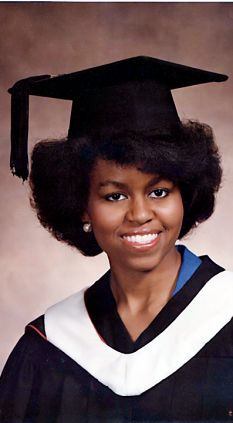
Her father and her mother inspired her. Her father suffered from multiple sclerosis and this had a great effect in her life. She made great grades. She was in a gifted class and she attended Whitney Young High School. She was the classmate of Jesse Jackson’s daughter Santita. She took three hours to come into the high school since it was located in the Near West Side. She experienced gender discrimination growing up. Michelle Obama was on the honor roll for four years, took advanced placement classes, and was a member of the National Honor Society. She served as student council treasurer. Michelle Obama graduated from high school in 1981 as a salutatorian of her class. She came into Princeton University and graduated in 1983. Her brother coached Oregon State University and Brown University as a basketball coach. Michelle Obama experienced racism and other issues in Princeton. Yet, she never gave up. Many college kids drove BMWs and were extremely wealthy. She was involved in the Third World Center (today’s it is called the Carl A. Fields Center). This is an academic and cultural group that supported minority students. They had their own day care center which was conducted after school tutoring.
As part of her requirements for graduation, she wrote a thesis titled Princeton-Educated Blacks and the Black Community. To research her thesis, she sent a questionnaire to African American graduates. It wanted to specify when and how comfortable they were with their race before enrollment at Princeton and how they felt about it when they were a student and since then. Of the 400 alumni to whom she sent the survey, fewer than 90 responded, and her findings did not support her hope that the black alumni would still identify with the African American community, even though they had attended an elite university with all of the advantages that accrues to its graduates. She majored in sociology and minored in African American studies, graduating cum laude with a Bachelor of Arts in 1985. In 1988, Michelle Obama earned her Juris Doctor (J.D.) degree from Harvard Law School. Her confidence has grown. Her faulty mentor at Harvard Law was the famous progressive teacher Charles Ogletree.

Ogletree inspired her. She called herself both brilliant and black. Michelle Obama demonstrated and fought for more minority representation as professors in Harvard. She worked for the Harvard Legal Aid Bureau. In that organization, he helped low income tenants with housing cases. She is the third First Lady with a postgraduate degree. The other first Ladies with the postgraduate degree are Hillary Clinton and Laura Bush. Michelle Obama loved the opportunities that education gave her. Michelle Obama’s father, Fraser C. Robinson III, passed away from complications from his illness in March 1991. She would later say that although he was the "hole in my heart" and "loss in my scar", the memory of her father has motivated her each day since. Around this time, her friend Suzanne Alele passed away from cancer. This was a turning point in her life as she continued to help society and influence the world. Michelle Obama first met Barack Obama when they were among the few African Americans at their law firm Sidley Austin LLP. She mentored him while he was a summer associate. They started to have a relationship with a business lunch and then a community organization meeting where he first impressed her. Before meeting Obama, Michelle had previously told her mother that she would focus solely on her career.
The couple's first date was to the Spike Lee movie Do the Right Thing. Barack Obama opined that he and Michelle had an "opposites attract" scenario in their interest for each other initially since Michelle had stability through her two-parent home while he was "adventurous." They married in October 1992. Their 2 daughters are Malia Ann (born in 1998) and Natasha (also known as Sasha who was born in 2001). The Obama family continued to live in the Chicago’s South Side until moving to Washington, D.C. Valerie Jarrett is one of the couple’s closest friends and advisors. In their marriage early on, they scheduled date nights despite their busy work lives. Michelle Obama is a Protestant Christian and has attended many churches from Shiloh Baptist Church, St. John’ Episcopal Church (both of which are found in Washington, D.C.) and African Methodist Episcopal Church. She worked as Assistant to the mayor in 1991. In 1993, she became Executive Director for the Chicago office of Public Allies, a non-profit organization encouraging young people to work on social issues in nonprofit groups and government agencies. She worked there nearly four years and set fundraising records for the organization that still stood 12 years after she left. In 1996, Michelle Obama was the Associate Dean of Student Services at the University of Chicago. She developed the University’s Community Service Center. In 2002, she began working for the University of Chicago Hospitals, first as executive director for community affairs and, beginning May 2005, as Vice President for Community and External Affairs.
As early as 1996, Michelle Obama knew that Barack Obama would go into a political career, but she was wary about the process. She campaigned for him during Barack Obama’s 2000 run for the U.S. House of Representatives. Barack Obama would lose that election and win the Senate race later on. Barack Obama decided to run for the Presidency in 2007. Michelle Obama wanted him to quit smoking as a condition to support his run. During the historic campaign, she talked about race and education including motherhood. Michelle Obama wrote her own speeches, made appearances with Oprah Winfrey, and increased campaign participation greatly by February 2008. In the campaign, Michelle Obama was disrespected by racists and her critics. She was falsely stereotyped as an “angry black woman” which is an evil misogynoir slur. Michelle Obama responded by saying that she will continue to stand up and speak up.


Michelle Obama is known for her eloquent speeches and she is known for a great fashion style. Her historic 2008 Democratic National Convention speech in August of 2008 showed that she is her own woman. In the speech, Michelle Obama said both she and her husband believed "that you work hard for what you want in life, that your word is your bond, and you do what you say you're going to do, that you treat people with dignity and respect, even if you don't know them, and even if you don't agree with them.” Michelle Obama continued to campaign and gave interviews in October. By November 2008, Barack Obama has won the election as the first black man to be elected President of the United States of America. During the early months as First Lady in early 2009, First Lady Michelle Obama visited homeless shelters and coup kitchens. She sent representatives to schools and advocated public service. She endorsed President Barack Obama’s bills. She hosted a White House reception for women’s rights advocates in celebration of the enactment of the Lilly Ledbetter Fair Pay Act of 2009 Pay equity law. She supported the economic stimulus bill in visits to the United States Department of Housing and Urban Development and United States Department of Education. She was involved in politics. She worked to promote the interests of military families, working women, mothers, etc. She promoted education and the arts. First Michelle Obama appeared on the cover and in a photo spread in the March 2009 issue of Vogue. She loves fashion a great deal.
She has traveled around the world. In April 1, 2009, she came into Buckingham Palace to met with Queen Elizabeth II. She spoke to students in Mexico in April of 2010. Michelle Obama traveled to Africa for the second official trip in June 2011, touring Johannesburg, Cape Town and Botswana and meeting with Graca Machel. Michelle Obama was also involved with community events in the foreign countries. She had a more active involvement in the 2012 Presidential campaign than the 2008 election. Barack Obama defeated Mitt Romney in the 2012 election too.


Throughout the 2 terms of President Barack Obama, First Lady Michelle Obama has received great popularity among the American people. She came into Washington, D.C. in 2013 to celebrate the 50th year anniversary of the 1963 March on Washington. She came into Selma with her husband to remember the 50 year anniversary of the March from Selma to Montgomery event (in March of 2015). In July 2015, Obama journeyed to Coachella Valley while coming to Los Angeles for that year's Special Olympics World Games. In October 2015, Obama was joined by Jill Biden and Prince Harry in visiting a military base in Fort Belvoir, Virginia, an attempt on the prince's part to raise awareness to programs supporting harmed service members. In December 2015, Obama traveled with her husband to San Bernardino, California, to meet with families of the victims of a terrorist attack that occurred two weeks earlier.


Cultural Impact
The Presidency of Barack Obama has had a huge cultural impact nationally and internationally. Many celebrities praise him. They are extremely numerous. They include people like Anthony Bourdain, Tina Knowles, Jason Wu, Jessica Alba, Nia Long, Jim Belushi, Jack Black, Ashton Kutcher, Rashida Jones, James Earl Jones, Ashley Judd, Common, Jamie Foxx, Jay Z, Beyoncé, Drew Barrymore, Alec Baldwin, Angela Lansbury, Brad Pitt, Matt Damon, Rosario Dawson, Robert De Niro, Danny DeVito, Michael Douglas, Kirk Douglas, Fran Drescher, Sheryl Lee Ralph, Michelle Pfeiffer, Robert Redford, etc. Many international leaders welcome him to speak in their nations. He is an African American who traveled internationally since his youth. He has a gift to communicate eloquently and appeal to people from across nationalities and races. He has been influenced by many social movements. He can play basketball and he can sing. He has won numerous awards and acknowledgements for his literature and other actions. President Barack Obama is part of the Internet age and more and more young people have been engaged in political issues during the Age of Obama. He has been called a hip hop President too, because of many reasons. One is that President Barack Obama is the first President who has a strong affinity to love hip hop music as he is a fan of hip hop. He admits that he loves to listen to a diversity of music including music from Jay Z to other artists. On April 17, 2009, then candidate President brushed his shoulder off when he campaigned against Hillary Clinton. He has allowed rappers to perform in the White House. The President worked with Kendrick Lamar to promote his My Brother’s Keeper program. Many young people respect the President Barack Obama. Obama has inspired the youth in many endeavors.


The End of an Era
At the month of December during 2016, the beginning of the end of the Presidency of Barack Obama commenced. It was a time of an end of an era. On December 2, he held a bilateral meeting with Secretary General designate Antonio Guterres of the United Nations. He spoke in MacDill Air Force Base in Florida in December 6 to talk about how terrorism is a dangerous threat in the world. He noted the 75th anniversary of the World War II Pearl Harbor Attack on December 7, 2016. He signed the 21st Century Cures Act on December 14. This law was a bipartisan effort to expand funding for medical research. President Obama signs the Better Online Ticket Sales (BOTS) Act of 2016, which makes it illegal to use a bot to purchase tickets online. This was done in December 15. He held his last press conference of 2016 on December 16. Later, he and his family take a vacation on Air Force One to Hawaii. This was part of their annual holiday vacation. The end of 2016 was a time for relaxation for President Barack Obama and his family. On December 23, 2017, he signed into law the annual defense spending bill which would increase military pay and require all new recruits to be issued athletic shoes made in the United States. By the date of President Obama visits the USS Arizona Memorial with Japanese Prime Minister Shinzō Abe to honor the 2,300 Americans who died on December 7, 1941. January 2017 would be the final time of his time as President. He came back to the White House after his annual Hawaiian vacation on January 2, 2017. One the next day, the 115th United States Congress started. He comes to visit Democratic lawmakers to try to send a message of trying to save the Patient Protection and Affordable Care Act, because many Republicans wanted to repeal and replace the law. On January 6, 2017, he hosted a farewell party at the White House with many celebrities like Kelly Rowland, Jordin Sparks, Al Sharpton, Beyoncé and Jay Z, etc. On January 10, President Barack Obama delivered his farewell speech at McCornick Place in his hometown of Chicago. He welcomed the 2016 World Series champion Chicago Cubs to the White House. He later commuted the sentences of General James Cartwright and Chelsea Manning. On January 19, 2017, President Obama grants 330 commutations to nonviolent drug offenders. That was the most acts of clemency that Obama granted in a single day and the most granted on one day in U.S. history by any president.

Goodbyes and Legacy
January 20, 2017 was the final day of President Barack Obama’s Presidency. He leaves the White House with First Lady Michelle Obama. His successor is the xenophobic right wing demagogue Donald Trump. Trump is the 45th President of America. Now, it is important to evaluate his legacy as a President. I lived throughout President Barack Obama’s tenure. So, his legacy is always a mixture of the legitimately great policies that he made along with his mistakes. Form the start of his Presidency, he wanted to promote a new society where people can come together to formulate solutions. He wanted a transformation generationally of society. Yet, he found out that the same bigotries and injustices continued to exist. He saw Democratic majorities in the Congress and Republican majorities in the Senate. He experienced slander by his critics and hagiography by his supporters. The truth is that President Barack Obama has advanced capitalism and neoliberalism. On some social issues, he is the most progressive President in history without question. On foreign policy issues, he has expressed many of the similar polices from the Bush and Clinton administrations. President Barack Obama has realized that many Republicans care more about party than truth or logic. The Great Recession (which was created by a Wall Street credit bubble that exploded) harmed millions of America. Obama’s policies did create millions of jobs (about 11.3 million jobs, which is great news), but many of these jobs were low wage. His policies prevented a permanent depression in America as the unemployment rate in 2016 is much lower than in 2009.

Likewise, economic inequality has increased during his term. One part of his legacy is the passage of the Affordable care Act, the Iranian nuclear deal (which is one of his greatest accomplishments), the Dodd Frank Wall Street Reform and Consumer Protection Act (which had legitimate parts in it), and other policies. He repealed don’t ask don’t tell. He continued drone strikes in Afghanistan, Iraq, Pakistan, Somalia, and Yemen. He expanded troop deployments in Afghanistan. I don’t agree with that. President Obama’s foreign policy is blatantly non-progressive by supporting the coup in Honduras, supporting aggressive acts against whistleblowers, he blocked habeas corpus rights for enemy combatants, sending arms to Saudi Arabia plus Israel, etc. This policies grew the military industrial complex and the national security state in an antithesis to human civil liberties. On issues of race, he talks about “personal responsibility” and moderate views. The ACA lacks a public option and many parts of it have been crafted by the insurance industry. The law was a compromise with good and bad parts in it. He talked about criminal justice issues too. According to Pew Research Center and United States Bureau of Justice Statistics, from December 31, 2009 to December 31, 2015, that inmates sentenced in US federal custody declined by 5% under US President Obama. This is the largest decline in sentenced inmates in US federal custody since Democrat US President Jimmy Carter. By contrast, the federal prison population increased significantly under US president Ronald Reagan, George H. W. Bush, Bill Clinton, and George W. Bush. On immigration, he has deported more immigrants than any President in American history. Therefore, the Presidency of Barack Obama has been a combination of successes and challenges. It has been both examples of great policies and great mistakes. The Presidency of Barack Obama represented a new era of American society indeed.


Post Presidency
One important point of his Post-Presidency is the creation of the Barack Obama Presidential Library, which will be held in Chicago, Illinois. It will be hosted by the University of Chicago. It will be located in Jackson Park on the South Side of Chicago too. It will become the 14th site in the National Archives and Records Administration’s Presidential library system. I do agree with the Obama family in giving $2 million to help fund Chicago summer job programs. During the summer, many people are out of work and it is important to give the poor and others economic and job opportunities. I have no problem with that. We can't be naive either. Chicago is a beautiful city with great culture. Likewise, we know problems exist in Chicago too. The solutions to those issues require a comprehensive diverse approach from economic programs, mentorships, job creation actions, neighborhood revitalization efforts (excluding excessive gentrification), infrastructure development, and other actions to combat poverty & economic inequality. Public services must be strengthened and families deserve the necessary love and resources to be strengthened. We have a long way to go. We may never see the Promised Land in our lifetimes. Yet, we start now, so the Promised Land can hopefully come in less than 100 years from now. We won't quit and we are victors. We may may even see the beginning of the end of oppression in our lifetimes.

This is the portrait of many members of the Obama family.
After January 20, 2017, Barack Obama was lifted off on Executive One. He rented a house in Kalorama, Washington, D.C. During the Democratic National Committee chairmanship election, Obama wanted Tom Perez to run against Keith Ellison. Perez won. On March 2, 2017, the John F. Kennedy Presidential Library and Museum awarded the annual Profile in Courage Award to Obama "for his enduring commitment to democratic ideals and elevating the standard of political courage.” Barack Obama wanted to promote participation in politics in his seminar at the University of Chicago on April 24, 2017. He supported Emmanuel Macron during the French Presidential election on May 4, 2017. In his May 25, speech in Berlin, Barack Obama wanted election participation and he rejected xenophobia (which is a criticism of the Trump regime). Obama traveled to Kensington Palace in England and met with Prince Harry on May 27, 2017; Obama tweeted afterward that the two discussed their foundations and offering condolences in the wake of the Manchester Arena bombing that occurred five days prior. He continues to speak. Barack Obama and Michelle Obama have stood side by side in their journeys as well.
Therefore, it is always important to stand up for democratic rights, to fight imperialism, to believe in hope, to believe in racial justice, to love altruism, to care for the environment, to protect our civil liberties, to reject bigotry, to honor our families plus our neighbors, and to embrace politically independent, progressive thinking.
By Timothy
https://www.scribd.com/document/352229339/The-Legacy-of-President-Barack-Obama
https://drive.google.com/file/d/1RikJbVgmt0qiGfilq9KQqYcJKrYtT28F/view?usp=sharing
is a link with more information.
Subscribe to:
Posts (Atom)